

Women join to make a powerful impact in their communities
By Mel Luymes
It was the most efficiently run meeting I’ve ever attended and in under an hour the group had raised over $10,000 for a local charity.
About 50 women were abuzz at the Drayton community centre back in March, dressed in green attire for St. Patrick’s Day and ready to give. They are members of the 100 Women Who Care - Rural Wellington (100WWC-RW) group. Every quarter, they meet and vote – between three presentations – on a local charity to which each of them will give $100, thus raising $10,000 in a matter of minutes.
After the networking time, Kay Ayres, executive committee member, called the meeting to order promptly at 7:00 p.m. with some announcements. She passed the microphone to Deborah Whale, another member of the executive committee, who introduced the three members who each gave a three-minute presentation about a local charity of their choice, followed by a time for questions.
The first presentation of the night was by Joan Craig, introducing the Grove Youth Wellness Hubs. They are drop-in spaces run by the Canadian Mental Health Association (CMHA) out of Fergus, Palmerston, Erin and Guelph for youth ages 12 to 26. It is important to have support for our youth, considering the difficulties of being a young person in the world today, she said.
They have daily drop-in hours, and the spaces have snacks, games, activities, and are all staffed with mental health professionals who provide a listening ear. In the past year, the three rural sites have had 1600 visits, typically seeing 130-150 youth per day, and can get young people connected with a mental health clinician within 72 hours of a request. Considering other avenues for support can take months, this is a phenomenal turnaround time, said Joan. These hubs are supported by government funding, foundations, corporate sponsors, and generous individuals within the community.
The second charity was presented by Helen McFadzeon; she presented on Parkinson’s Canada, which is an organization that supports over 120,000 Canadians living with the disease. Parkinson’s disease is a progressive neurodegenerative disorder causing tremors, affecting movement and balance issues. Most Parkinson’s research is done on men, Helen notes, and due to the lack of research on women, a Parkinson’s diagnosis can come late, or symptoms can be misattributed as stress in women. A donation from 100WWC-RW would be earmarked for women’s research as well as supporting local support groups. There are about 100 groups across Canada that provide support for local people living with Parkinson’s disease and they can be found through www.parkinson.ca.
The last presentation was for the Canadian National Institute for the Blind (CNIB), done by Tami McAleer. Vision issues likely affect a lot more people than we realize, she begins. Even her own daughter had vision concerns, and she was shocked to learn that the support is not covered by Ontario health insurance (OHIP). Tami outlined the work that CNIB does to advocate for and support people who have lost or are losing their site, including Vision Mate, connecting volunteers to visit and support people with impaired vision in their communities, as well as creating phone apps to provide support in our increasingly technological world.
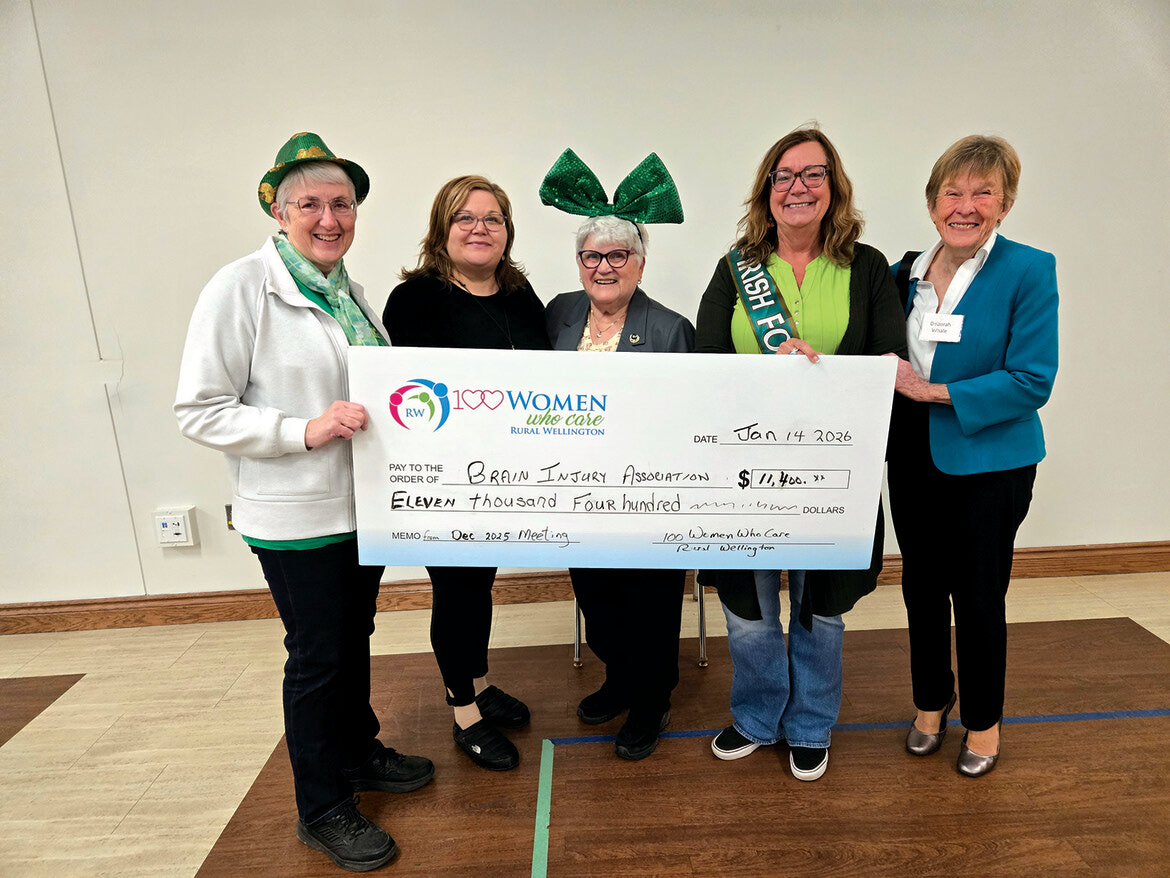
After the three presentations and question periods, everyone in attendance voted on a small piece of paper, and while the votes were being tallied by members, Dr. Deb Stark and Marlene Ottens, we heard from Mel Horvath-Lucid from Brain Injury Association of Waterloo Wellington (BIAWW), about their Lidz for Kidz program, which had been the recipient from the 100WWC-RW December meeting.
Mel began with deep appreciation. She explained that Chantelle Koeslag had presented on their behalf but that they didn’t know she had advocated for them until afterwards, when $11,400 came to them out of the blue. “There were tears among our non-profit staff team,” she says, “knowing there was an angel out there, caring and sharing our work.”
And when she learned there was a whole community of angels quietly working in their community, she was incredibly moved. “Connecting with this group of people has been the most incredible experience of community, sense of humour, connection and joy,” she says.
She explained the work of the BIAWW and that the need often outpaces capacity in their community. The group promotes brain injury prevention, reduces barriers to safety equipment and builds early awareness about brain health and how to be a good friend to someone who has experienced a brain injury. They are funded through various means, including through community memberships.
The Lidz on Kidz program provides helmets for children across Waterloo and Wellington. Cycling and sports accidents are a leading cause of concussions and brain injury in children, she notes. Bicycle helmets reduce the risk of head injury by 60-70 percent and of fatal injury by 65 percent. Along with the free helmets, they provide education about brain injury, as many will not know the signs.
Since the program began, they have educated 530 classrooms, reached 12,320 students and provided 6116 helmets. And because of the 100WWC-RW donation, they are on track to reach 550 students and rural school children around Palmerston. The donation will allow them to clear their list of people waiting for helmets.
“You remind us that when the community comes together, we can do extraordinary things,” Mel said, and added a quote from Dr. Seuss: “Unless someone like you cares a whole awful lot, it’s not going to get better, it's not.”
100 Women Who Care was started in Michigan in 2006 by Karen Dunigan. She needed to raise $10,000 quickly to purchase a shipment of new portable baby cribs for new mothers in her city. She thought if she could get 100 women to each contribute $100 then they would have the funding. So that is what she did. She called a meeting of women and together, they met the need.
Since then, the idea has been spreading across North America and there are approximately 700 groups, including a “co-ed” group – 100 People Who Care – in Huron County, one in North Perth and another in Grey Bruce, that will meet May 30 at the Bruce County Museum (along with a way to participate online). See 100womengreybruce.ca for details.
The 100WWC - Rural Wellington group has been meeting since 2018, though attendance and membership ebbs and flows above or below 100 women. It began when a few rural women attended a 100WWC meeting in Guelph and thought they would start a group with a focus on rural areas.
“They didn’t think we could get enough people,” says Deborah Whale, co-founder of the Rural Wellington group. “But boy did we prove them wrong.”
Since then, the group has raised over $300,000 for regional charities focusing on rural Wellington County. Their motto is “we give where we live” and so, all winning charities are required to spend the funds in Wellington (excluding the City of Guelph).
They meet in towns across Wellington and have had municipalities and groups donate facilities to them. They have a few costs, however. They have a website and have some refreshments at their meeting. These costs are covered by hosting a five dollar raffle at each event, which also adds to the fun.
They drew the raffle winners before announcing the recipient of their March 2026 meeting. It was the Grove Youth Wellness Hubs! Everyone grabbed a pen to fill out their cheque or hopped on their phone to log-in through the CanadaHelps website linked on their website to make their donation. An email also went out to all members who couldn’t make it that night and gave them the giving details. Within a few days, all the donations flooded in.
Their next meeting (their 33rd!) will be held on June 15 at the Harriston Legion where they will do it all over again. More details at www.100wwcrw.com.◊