

When good farming gets noticed
By Scott Stephenson, The Citizen (our sister publication)
Three Huron County farmers have been recognized among Ontario’s leading organic producers by the Organic Council of Ontario (OCO). Katrina McQuail of Meeting Place Organic Farm in Lucknow; Bill van Nes of St. Brigid’s Dairy near Brussels; and Gemma James-Smith of Bayfield Lavender Farm have each received a 2025 Organic Champions Award, presented at the annual Guelph Organic Conference last month.
The OCO supports farmers in the organic sector through research, outreach and advocacy. By honouring agricultural leaders like McQuail, van Nes and James-Smith, the organization celebrates not only their exceptional products, but the goal of ecological health, sustainability and community.
For generations, Huron County’s fertile soil has inspired farmers to cultivate deep roots, innovate and care for the land. From the earliest stewards to today’s growers, the county’s prosperity has always depended on those who balance hard work with forward thinking. Sometimes, innovation means returning to time-tested wisdom - a truth reflected in the region’s thriving organic movement.
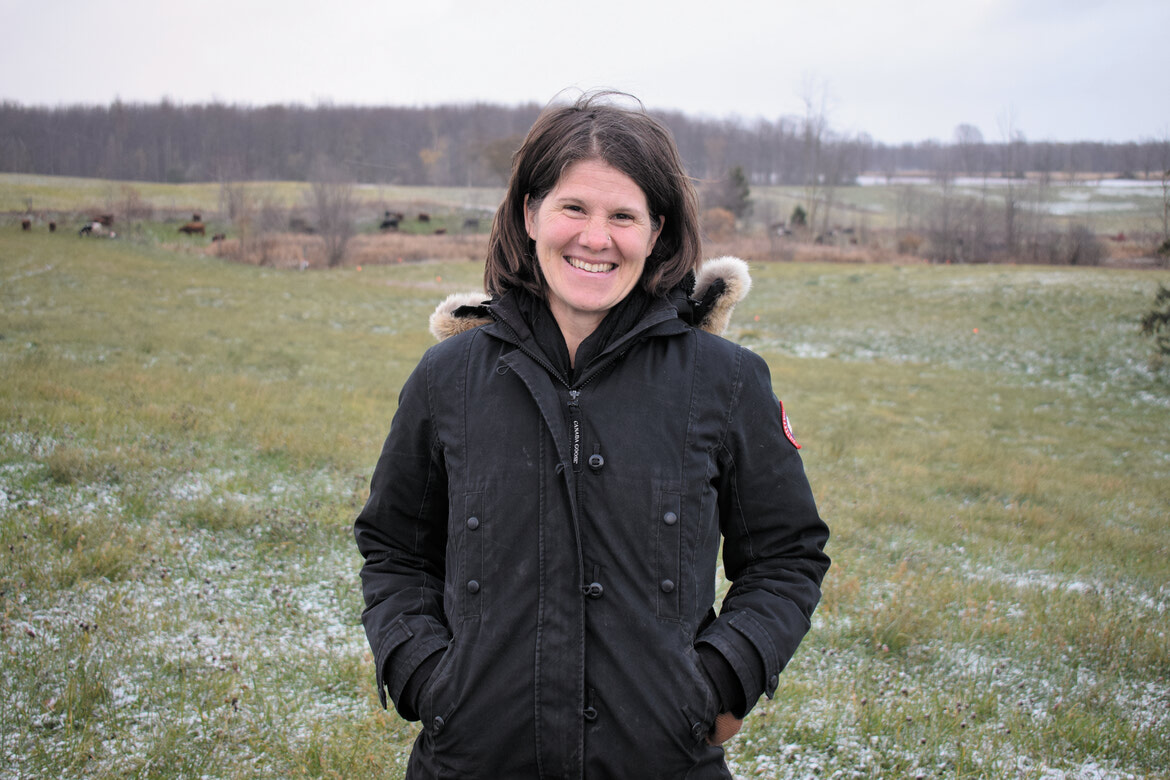
Katrina McQuail
Meeting Place Organic Farm near Lucknow is home to a variety of livestock, and farmer Katrina McQuail takes the well-being of each one seriously. Her careful, hands-on approach to animal care and land stewardship has earned her the Organic Council of Ontario’s 2025 Organic Champions Steward of the Herd Award, in recognition of her leadership in organic livestock management and her commitment to sustainable farming.
McQuail’s approach to organic farming is focused on both official certification and practical philosophy. “We are committed to organic certification, but it’s also about recreating natural systems. The way we graze our cattle emulates herd grazing in the wild - a large group in a smaller space for a short time before moving on. We use the manure our animals produce to fertilize our fields, so we don’t need commercial inputs,” she told The Citizen. “We take animal health seriously, so we focus on preventative care through housing, diet and stress management. We don’t need antibiotics or chemical treatments because our systems support their health…. It’s about creating a place that’s safe for wildlife, livestock and people, and good for the soil, air and water.”
McQuail’s philosophy of care guides daily life on the farm. “In some sense, yes, I own this property and these animals,” she explained, “but the way I approach it is that I have the honour of caring for them. It’s a responsibility. Our livestock’s well-being is a priority.”
For McQuail, proper stewardship also means striving for consistency. “If I’m sick, those animals still have to be cared for,” she pointed out. “If the weather’s miserable, they still need to be looked after. Sometimes that means putting yourself in an unpleasant situation to get them into a better one. It really is about the privilege of taking care of these creatures and stewarding their lives.”
Among the practices she’s most proud of are her herd’s living conditions and her approach to grazing. “We don’t bring our cattle into the barn except for vet checks or shipping,” McQuail asserted. “They live outside 99.9 per cent of the time, year-round. We feed them hay outside all winter, make sure they have water, and that’s it. It’s so much better for herd health, calving and even our own health. Our rotational grazing lets us get more grazing passes and animal units off the same land, because our pastures are healthier. It’s been transformative.”
Katrina is the second McQuail generation to run Meeting Place. Her parents, Tony and Fran McQuail, came to Lucknow in 1973, spending decades transforming a conventional farming operation into Meeting Place Organic Farm - one of the first certified-organic farming operations in the area. They raised grass-fed and finished cattle, pastured pork and poultry, tended apple orchards and vegetable gardens, and worked the farm with draft horses. In 2016, the McQuails passed the operation on to Katrina, though they are still very much involved with life on the farm.
Katrina’s work continues her family’s legacy of integrating ecological, social and economic sustainability. “It’s easy to do what you already know - I grew up with it. It just makes sense to me,” she declared. “I see the results of what we do - in how our animal management impacts the quality of the soil, the wildlife and our lives. It works for us. I wouldn’t even know how to start being conventional, and I have no cause to.”
Currently, the family farm has become a community hub for locally-produced organic food from both Meeting Place and neighbouring farms. “The beauty of Huron County is the diversity of farming,” Katrina pointed out. “As much as I think organics is the way to go, I know it’s a lot to expect farmers to transition without support. Farming is already full of risk: weather, markets, everything. So, expecting people to go organic and take on more risk without help isn’t fair. What’s beautiful here is that you’ve got small-scale Amish farms, farms like ours, that are small-scale and organic, and larger-scale conventional farms. Everyone’s respectful. There’s no hostility; it’s all hard work, and everyone knows it.”
Born and raised on the farm, McQuail left at 16 and spent about a decade away, studying, travelling and working before returning to help her parents. “I committed to being here for five to seven years, and if it became clear the farm was bad for me or I was bad for the farm, it would be a no-fault exit,” she recalled. “But here we are, over a decade later.”
Being recognized as one of the OCO’s 2025 Organic Champions has been both humbling and affirming for Katrina. “It’s cool. I definitely have imposter syndrome - I feel like I’ll never be what Mom and Dad were,” she admitted. “So it’s kind of wild to be noticed, and have someone think what I’m doing is noteworthy. Being recognized helps me realize that what I’m doing is interesting and worthwhile - it’s easy to feel like it’s just what one does, but it’s nice to have that acknowledgement.”
Organic farming has its challenges, but the rewards are clear. “Feet on the ground, hands in the dirt - I get to spend my life outside with animals. It’s exercise, stress reduction, connection,” she explained. “I don’t have to worry about what’s been sprayed or if it’s safe to walk in a field. It feels safe here. Aside from the electric fences, of course.”
Katrina feels that soil health and biodiversity are paramount to a healthy organic farm. “We want to add to and complement biodiversity - planting trees every year, creating habitats for pollinators, snakes, turtles, birds, and bats,” she said. “The more diversity, the better. Being organic means we aren’t killing the insects the birds feed on, so the whole ecosystem can exist and thrive. We stopped doing tillage to keep our soil intact. We’re always adding fertility and diversifying our seed mixes. Without healthy soil, you won’t have nutritious forage, and without that, your livestock won’t thrive. It’s all connected. When I plant trees, I take 10 of every type the conservation authority offers - I don’t know which will survive in 20 years. Diversity, diversity, diversity.”
As for the future of organic farming, Katrina remains hopeful. “We’ve gone from almost no organic farms to a solid number that are well recognized,” she noted. “My hope is that as farms change generationally, more people make that shift - especially as climate change and soil health become bigger conversations. I have no doubt that every farmer in Huron County is farming with their heart, doing the best they can in their situation. Farmers do it because they love it - their animals, their land, their community. As funding and programs come in to support transitions, I hope farms can take those steps sustainably, at their own pace. Change doesn’t have to be fast to be meaningful.”
Bill van Nes
Dairy farmer Bill van Nes was caught off guard when he learned he had been named the Organic Council of Ontario’s (OCO) 2025 Organic Trailblazer Organic Champion, but his new title couldn’t be more fitting. Van Nes is being recognized for his leadership in high-quality organic dairy production and his steadfast commitment to ethical, environmentally-conscious farming.
On his farm just outside Brussels, van Nes manages his Jersey cows with compassion and respect, while ensuring they have everything they need to succeed. The results speak for themselves - his happy herd is behind one of the country’s most sought-after culinary treasures: St. Brigid’s butter.
Born and raised on a family farm in Huron County, van Nes has always been a member of the agricultural community. He took his first steps away from conventional farming for a simple reason. “I really like the sight of cows on drives, and I saw the conventional way with cows more inside and less outside, so I wanted to go the opposite,” he explained.
Today, van Nes’ business is firmly rooted in the organic principles he believes will bring about the best butter possible. “I’m not going to lie - organic is a lot of work, especially the way we do it, focusing on cattle and pasture,” he admitted. “But there’s a reward for that. It’s very aesthetic, very pleasing to see cattle in their natural landscape instead of being in a barn all the time. I get the most satisfaction from that from the aesthetics, the senses, and producing a product that simply cannot be matched by conventional practices.”
For van Nes, being called a trailblazer means setting an example for others in the industry. “Just bringing organics to the next level and introducing a premium product - basically elevating the presence of organic through quality food,” he told The Citizen.
As a longtime member of the OCO, van Nes feels honoured to be singled out. “It’s definitely something to be proud of,” he pointed out. “It helps to have our work recognized in the public sphere and by your peers. It’s gratifying and motivates you to keep going, to persevere.”
He also praised the OCO for its leadership and advocacy. “They play a great role, and it can be larger. They’re coming up with an organic action plan across Canada to give more recognition for the good that organic can do,” van Nes said. “It’s very important to showcase what can be done with organic, for others to follow suit, and to bring it to the forefront, so it garners the recognition it deserves.”
Consumer attitudes toward organic food, he noted, have evolved dramatically since he first entered the business. “When I started farming 30 or 40 years ago, organic was in its infancy - especially organic milk,” he recalled. “It’s come a long way. Appreciation for organic has increased for sure…. Our butter gives organic a very good name. It’s simply not possible to make that product with conventional methods.”
Among the farm practices van Nes is most proud of are his rotational grazing methods and his commitment to animal welfare. “Being able to feed the cows as much fresh grass and pasture as we do - having them in their natural habitat, letting them experience the weather - our cows don’t need to be shielded from every element all the time,” he informed The Citizen. “Growing up, we had three fields - one for dry cows, one for high-milking cows, and one for low producers. And that was it for the year. When it was gone, it was gone. Now, we move the cows around and give them much better access to fresh pasture.”
That same philosophy extends to the soil beneath his herd. “We take it seriously - through rotation, multi-cropping and diversity, among other things. It’s very important because we believe we’re building soil and sequestering carbon,” he declared. “Organic farming has a definite role to play in building soil and storing the carbon everyone’s talking about.”
Van Nes is optimistic about the future - he believes that organic agriculture has an important role to play in Huron County’s farming landscape. “There’s definitely room for growth, especially for smaller landholders. The mantra of ‘get big or go home’ is only getting worse with large land prices,” he explained. “Organics is a clear challenge to that mentality. We need to return to everyone growing food at home as much as they can - like during the war era, when everybody had a home garden. We need that attachment back to the Earth. Other countries make better use of smaller parcels of land that big agriculture can’t access. There’s more room for that here, and I think we need to embrace it. It’s a mindset we need to build within the community: to grow our own food. It’s satisfying. We are what we eat.”
Gemma James-Smith
Lavender has long been prized for its delicate purple blooms, soothing fragrance and calming properties. But humans aren’t the only ones who benefit from this hardy herb - just ask Gemma James-Smith, proprietor of Bayfield Lavender Farm. Her dedication to creating a thriving, chemical-free haven for pollinators and biodiversity has earned her the Organic Council of Ontario’s (OCO) 2025 Pollinator Protector Organic Champion Award.
On her small farm just outside Bayfield, James-Smith grows an abundance of lavender that, in her words, “pretty much takes care of itself.” Her primary crop may be a simple herb, but the vibrant ecosystem she has built around it is anything but. “A very important part of the whole dream for me is building gardens around the lavender that foster and help beneficial pollinators - birds, butterflies, bees, praying mantises, ladybugs - everybody who wants to help us out. By attracting those beneficial insects, it does a job for us, in terms of getting aphids eaten, or whatever needs to go away,” she said to The Citizen. “Promoting and building a system here that helps itself means we don’t have to use herbicides or pesticides.”
Before moving to Huron County from Toronto almost 10 years ago, James-Smith never envisioned herself becoming a farmer. That all changed when she took up residence on a 10-acre farm with her family. It wasn’t long before fate intervened, changing the trajectory of her future forever. “I had a tiny little baby, and we moved onto this property - it was really beautiful and very overgrown. As I cleaned up the property, I came upon six very old lavender plants - they were so old that they had thick trunks,” she recalled. “I was really taken with the lavender when it bloomed that summer, so I decided to try harvesting it and doing a Christmas market. People really responded to it, and I loved doing it.”
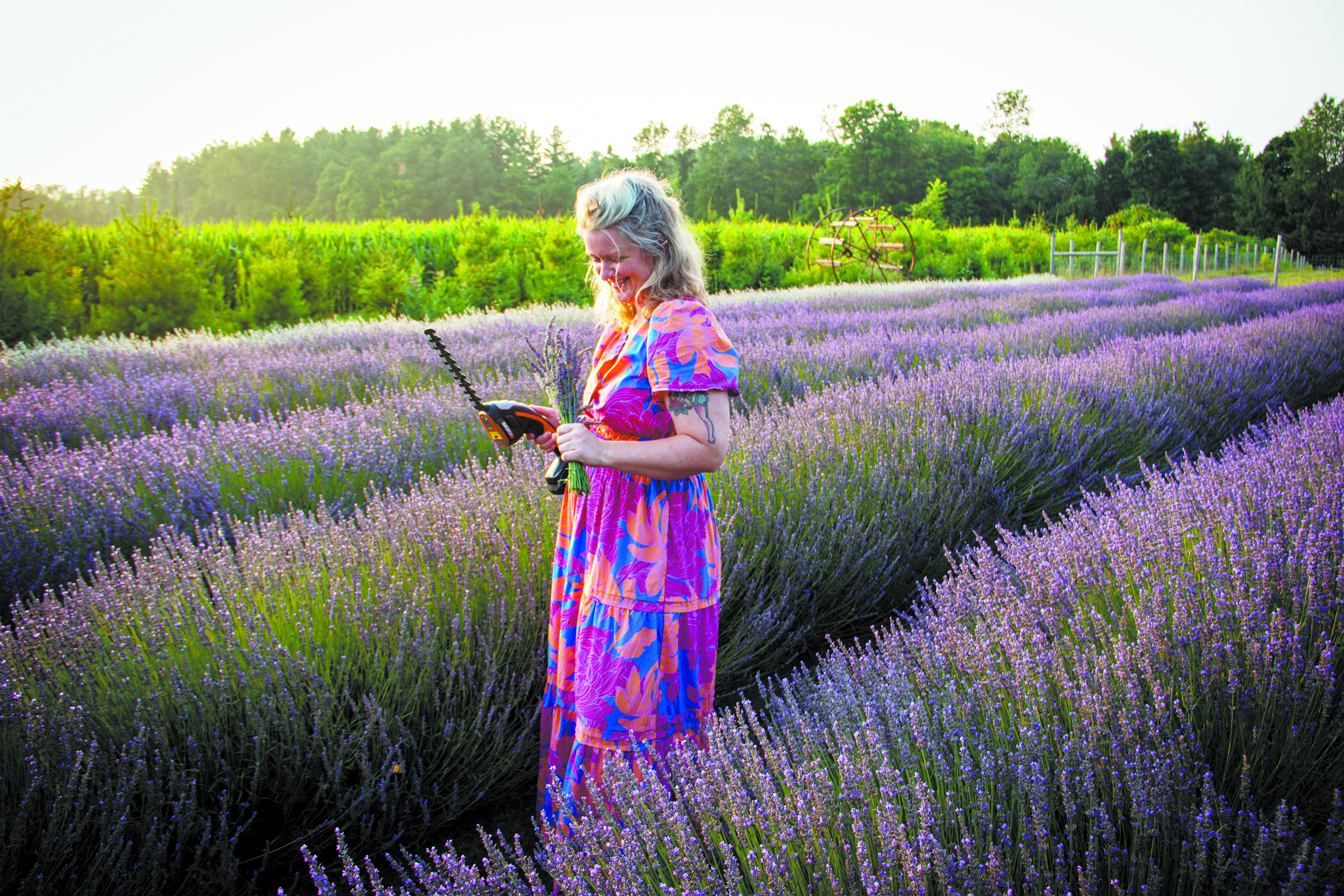
From those six plants, James-Smith taught herself to propagate lavender, eventually accumulating nearly 1,000 plants. When the pandemic hit, she just kept on planting and, by 2023, she was ready to open her farm to visitors. “It just seemed natural to start inviting people to visit - [the plants are] meant to be looked at and shared,” she pointed out. Today, Bayfield Lavender Farm boasts a wide variety of personal care and culinary products, including lip balm, lavender-infused honey and naturally-scented candles.
While her farm isn’t formally certified organic, James-Smith works to follow organic principles in every aspect of her operation. “We don’t use herbicides or pesticides,” she assured The Citizen. “For an operation my size, getting certified organic doesn’t quite make sense - there’s a lot of cost involved. To keep our products at a reasonable price point, certification isn’t practical, but we follow organic principles and are very much committed to an organic way of farming.”
Though this is her first major connection to the OCO, James-Smith is excited to learn more about the organization. “This award is really my big introduction,” she said. “I’m looking forward to attending their conference in January, and just spending time with that community and learning more about it… they provide education and keep getting the word out about how people can help. They promote things like soil health, biodiversity and beneficial microbes - working with nature rather than against it. It’s an important organization because they have so much information and so many resources available.”
Soil health and biodiversity are central to James-Smith’s approach. “I’ve planted literally thousands of wildflowers around the property. When we amend the soil, we use composted goat and chicken manure from our animals… we’ve been able to amend things naturally, and it really helps with plant resilience in the long term,” she declared. “I’m very proud that we have this pocket of land that’s alive and finding its own harmony. I often think about it like listening - watching the lavender and learning what it likes and doesn’t like. There are ways of listening to the land around you in order to shape it. That’s where I’m at with this whole project - just excited to keep watching it evolve… We saw a huge increase in monarchs this year on the farm. It’s better than TV! The gifts you get back are really healthy plants and ecosystems. That’s the biggest thrill!”
Looking to the future, James-Smith hopes traditional farmers and consumers will embrace organic farming techniques and products. “Money’s great, but having a planet to live on is also really cool,” she pointed out. “So it’s probably a good idea to keep an open mind and try new things.”
Being named a Pollinator Protector means a lot to this Toronto-transplant-turned Bayfield flower farmer. “I’m really touched. You can get recognition as a small business, but this means something more - because my business wouldn’t exist without my pollinators. I’m thrilled!…I’m one of those people who talks to the butterflies, talks to the bugs. I really feel connected to the whole environment around us,” she explained. “You can farm something without harming things. If you have to till or dig up a section, you can balance that out by planting trees or wildflowers. It’s about reciprocity - saying thank you to the land and the animals around you.” ◊