

What's in the seed?
By Mel Luymes
Eager for winter to be over, many are chomping at the bit and are two steps ahead of spring with their seeds already ordered for their garden. It is easy to pick up seed packets from the shelf at the hardware store, or while grocery shopping, but it doesn’t hurt to turn the package around and look at where the seed was grown. Many seed companies import and resell seeds that were grown halfway around the world. It’s not just that international seed may not be adapted to our growing regions or diseases and pests here in southern Ontario, but, perhaps even more important, is that local seed supports genetic diversity and resilience. But we’ll get to that later.
Most of the Rural Voice readership area, according to Natural Resources Canada, is in Hardiness Zone 5a or 5b. And we’re fortunate to have a seed grower right in our backyard.
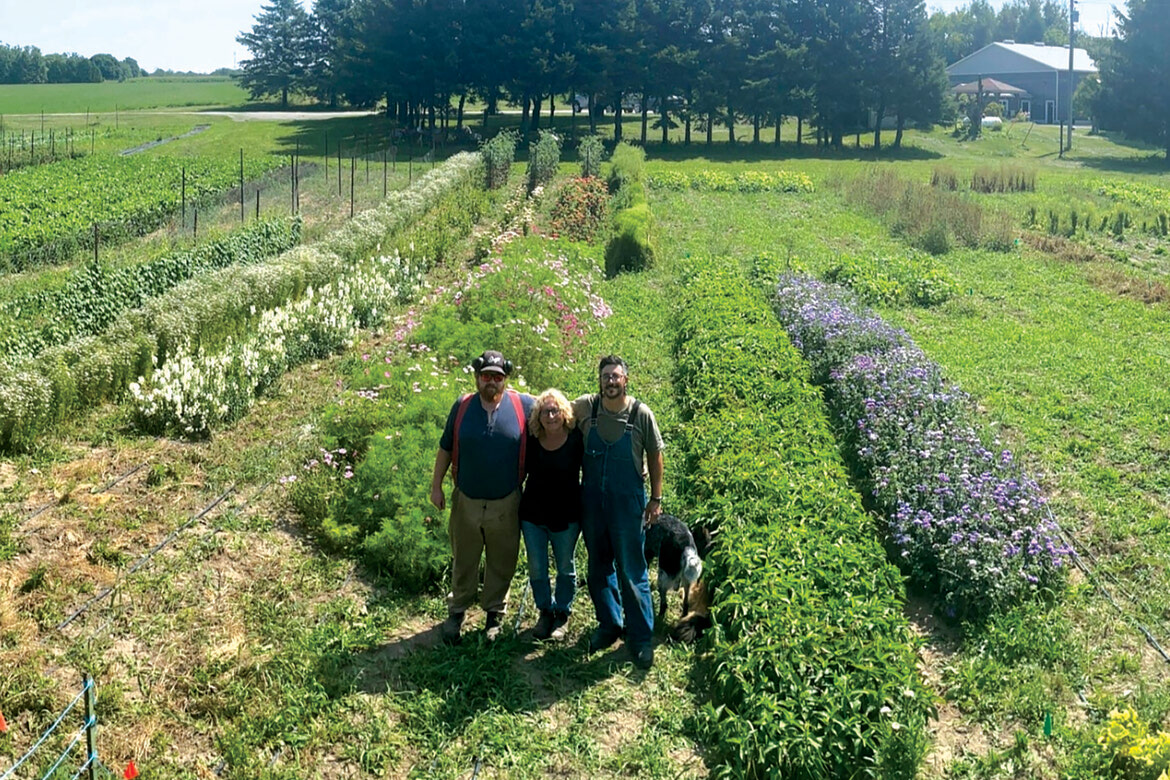
Hawthorn Farm Organic Seeds was started when Kim Delaney caught the seed bug around 2004 on her farm near Palmerston and started a seed catalogue in 2008, with a website by the next year. Aaron Lyons came along eventually as a full-time employee and now it is a whole team growing 600 varieties of organic vegetables, herbs, and flowers over four growing areas: two near Mount Forest, one near Harriston and the other near Palmerston. They have two off-farm field managers in Desboro and Hamilton, and contract growers near Allenford, Thunder Bay and Manseau QC. Five staff also do the cleaning, packing and filling orders the rest of the year.
“It’s sort of like we’re at the size where we’re not huge like Johnny’s Seeds, and we’re no longer a little company that’s counting out bean seeds by hand,” says Kim.
You may remember Kim from the cover of the August 2020 issue. At the time, Hawthorn Farm was going through a huge upswing in sales due to the pandemic craze. It was the first time in a while that people had seen empty grocery store shelves and suddenly, growing one’s own food became a priority.
“Sales went insane,” says Kim, “and we didn’t have any of our upgraded systems in place.”
While demand went down since then, it has come up slightly now with the price of food. However, Kim used that momentum to ramp up the business and expand across Canada.
“We did all the system work and then got ready for the next level — to scale up without burning out.”
She recently sat down with the Rural Voice at Hawthorn Farm’s new location near Mount Forest to catch up on the whirlwind of the last five years. This farm was purchased by Amy Stein with the same limited partnership agreement that was described in the June 2024 issue about Luna Mia Farm.
To start, there is a large, heated shop that has been converted into their seed warehouse. It is nearly five times the size of the shed she started with on her farm near Palmerston and there are now five people working full-time throughout the year.
Kim has brought two young employees – Aaron Lyons and Stephen Sergenese – as partners into the business and they have helped bring it to the next level, with advances such as automated seed counting equipment and bar codes connected to software tracking their inventory.
“It’s good to surround yourself with people who are very different from you — different skill sets,” says Kim, in awe of what the two of them were able to accomplish. Aaron has a mind for engineering, systems and logistics, while Stephen is very precise and has been improving the seed cleaning, germination testing and storage quality.
As for Kim, she loves growing, connecting and being creative. They recently launched a gorgeous new website at hawthornfarm.ca and are transitioning to new seed packages, printed with the product photos in full colour.
“We had to work a bit harder on the photo for the lettuce packet,” she laughs, “no matter how nice it looks in real life, it’s just not very photogenic.”
We begin the tour at the end of the process and work backwards. A series of seed racks are getting ready to be shipped to stores across Canada. Each rack holds 48 seed varieties and they usually ship with a standard array of vegetables, flowers, and herbs but can also be customized by the retailer. There are peppers, tomatoes, squashes, melons, lettuces and herbs and flowers.
“Our biggest sellers have been those work horse veggies you find in most backyard gardens like carrots, tomatoes, peppers, beans, basil,” says Kim, “but that is changing and we have a huge demand for our flower seeds, native and non-native too.”
A few steps away is a long table and shelves where they are preparing orders. The inventory of seed packs is on one side, with boxes of the “picked” packets for orders along the table. Kim removes a cardboard cover they put across the boxes.
“Otherwise, Filbert curls up and sleeps in the boxes,” laughs Kim. Filbert is the security cat that is always on duty, because the biggest threat to the seed warehouse is mice. Kim recalls a time when some mice gnawed into a plastic tote of corn seed and ruined that season’s seed.
But back to the tour. In one corner, they do their own weighing and postage of the boxes for Canada Post, FedEx or whichever option the customer chooses for shipping. In the other corner is a series of small machines that weigh seeds and seal packages. They also print labels with the seed lot numbers and latest germination test results. What ties all of this together is a custom-built inventory management system that tracks everything from the plants in the field to the seed in an envelope. For the ongoing process of their organic certification, this helps to keep all the details in one place. As a certified organic farm, it’s not just that they can’t use pesticides or commercial fertilizer in the fields where they grow seeds but the warehouse, the packaging, the whole process is inspected along the way.
Next steps are to an area dedicated to germination testing where every six months, the seeds in storage are tested and the labels updated. Kim explains that some seeds can last a few years, while others will only last one. Seed viability depends on the crop type and on storage conditions. At Hawthorn Farm, they store their seeds in containers in a climate-controlled room. They are constantly monitoring seed batches to ensure that every seed packet only contains the best seed.
Next, we move to the unheated area of the shop where an old enclosed room was converted into the seed storage and cleaning area. Plants are drying from the ceiling, atop screens of various sizes and an air column that Kim’s husband Brian rigged up. In this machine, the seed is dropped through a vertical column with an air flow that not only sorts out debris but also removes hollow unviable seed.
Lastly, we see a machine that Aaron is perfecting. It’s a rototiller blade in a steel tank that will pulverize large fruits such as pumpkins to separate their seeds from the flesh. For seeds, most everything is grown to be overripe. That means that getting seeds can be a messy, maybe smelly, job to do by hand, says Kim – hence, some mechanization.
Kim is passionate about seed growing and it takes a unique mentality, because growing seeds is a long game and requires meticulous organization. All of Hawthorn Farm’s varieties are open-pollinated, meaning they will produce seed that is true-to-type and gardeners can save them. Growing open-pollinated varieties involves careful planning and execution to protect each variety from accidental cross-pollination and ensure it stays true-to-type.
Some plants are more prone to cross-pollination than others, like squash and corn, and need to be isolated from others, sometimes by as much as a kilometre. “You’ve got to know your neighbours, who’s growing what, and where the wind comes from,” says Kim. There is a lot of corn growing around them, so it is nearly impossible to isolate by distance, instead they stagger the timing. She says farmers have been great to work with, as they let each other know when corn starts to tassel. As for the squash varieties, she has made agreements with neighbours to share the harvests or coordinate and grow the same varieties, to ensure the genetic integrity of the crops growing in Hawthorn’s fields.
However, even with the utmost care, there are some plants that will not produce high-quality seed in this bioregion. For instance, spinach sets seed at a time of year where average temps at Hawthorn Farm are too high, causing the seed to become dormant. To prevent this quality issue, Hawthorn Farm contracts seed grower Evalisa McIllfaterick in Thunder Bay to grow spinach crops. Her growing season in a much more northern latitude creates the perfect conditions for superb spinach seed crops.
For Kim, it is not just the work of maintaining open-pollinated varieties which motivates her, she is also working to push the envelope and breed new vegetables, flowers, and herbs for Canadian growers, like blight-resistant tomatoes for example. This adaptation is a slow process happening over several growing seasons, with deliberate cross pollination and rigorous selection for desired traits.
She began collaborating with other seed growers in Ontario a few years back on the Renegade Red pepper. It started with a discussion at an Ecological Farmers Association of Ontario (EFAO) conference where growers voiced a desire for blocky red peppers that would ripen in short-season climates. And over a few years, they selected for the traits growers said they wanted and ta da, Renegade Red was released on the market.
Kim is also excited about “landrace” varieties, which can more quickly adapt to a region or changing climate. If open-pollinated varieties stay the same, landraces learn as they grow. It starts with purposely planting many different varieties of the same species together and growing out their seeds season after season, selecting for the traits you want as the different varieties cross-pollinate constantly. With a landrace variety, you prioritize resiliency, adaptability, and genetic diversity over uniformity.
Hawthorn Farm’s breeding work also prioritizes selecting for flavour, which can be a tedious process. For biennial root vegetables like carrots or beets, they take a tiny slice from the bottom or side of the root, take a nibble, make notes and then cleanse their palette with a salty potato chip before tasting the next one. If they liked it, they grow it for seed the following year.
Flavour is only important if you’ve also got enough resiliency to grow it in your climate. In a changing climate, we’ll need more genetic diversity, not less, says Kim.
It is also important for seed companies and growers to be active together in the seed production process. This effort maintains a diversity of seed sources in order to prevent bottlenecking or pollution of unwanted traits from a singular source. One example she gives is the Delicata Zeppelin squash, in the Cucurbita pepo family. In the year 2000, people started going to the emergency room with throat issues after eating the squash they had purchased from local farmers. To find the cause of this problem, the farmers looked back at the seed lot and it turns out it had all been grown in one field in Colorado, where it had accidentally crossed with a toxic gourd. Thankfully, the grower had an earlier, uncontaminated lot saved in the freezer, so they were able to replenish seed stocks with the older lot and it goes to show the importance of saving seed.
It has been 30 years since Kim started Hawthorn Farm Organic Seeds and she doesn’t plan to retire anytime soon. She is still in love with seeds and growing, still driven by nature and food. She also loves the community in the area, remembering a gruff, older farmer who rubbed her head and said, “Oh Kimmy, you’re a real farmer now.” From packing her first seed envelopes by hand at her kitchen table to watching packets fly down conveyor belts and ship across the country, what has remained the same is her passion for sharing seeds from her farm to your garden. ◊