

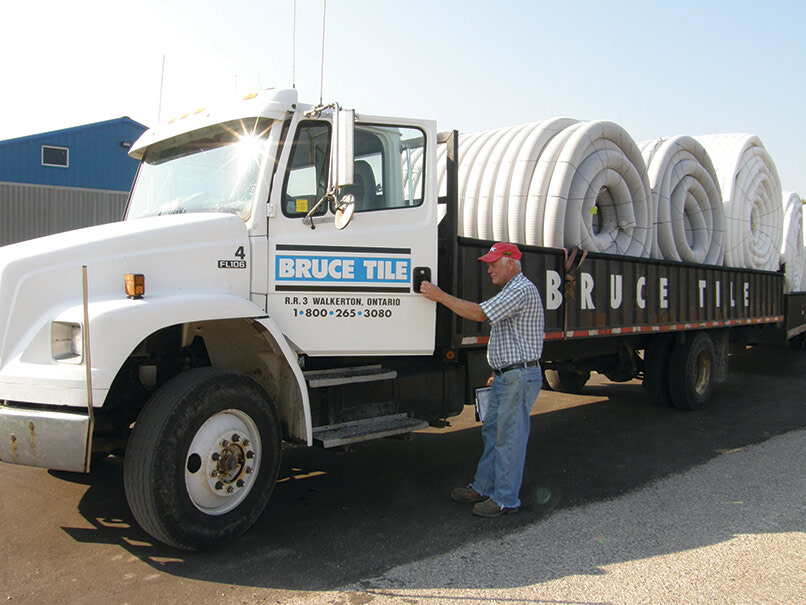
Tile by the mile: Dave and Doris Inglis look back on the history of Bruce Tile
By Mel Luymes
In 1980, Dave and Doris Inglis bought a farm just north of Wingham. The neighbours warned them it was a wet field and told stories of the equipment that had been stuck there.
But they weren’t worried; Dave had been a drainage contractor all his life. And more recently they had purchased Bruce Brick and Tile west of Walkerton and were making their own drainage pipe.
“The neighbours told us if we could make this farm work, it would prove to them that drainage works,” laughs Doris.
“And we did.”
Ontario’s drainage industry went through incredible shifts during their careers, and Dave and Doris were right there at the heart of it. In 2005, they were honoured with life memberships by the Land Improvement Contractors of Ontario (LICO) for their contribution to the industry.
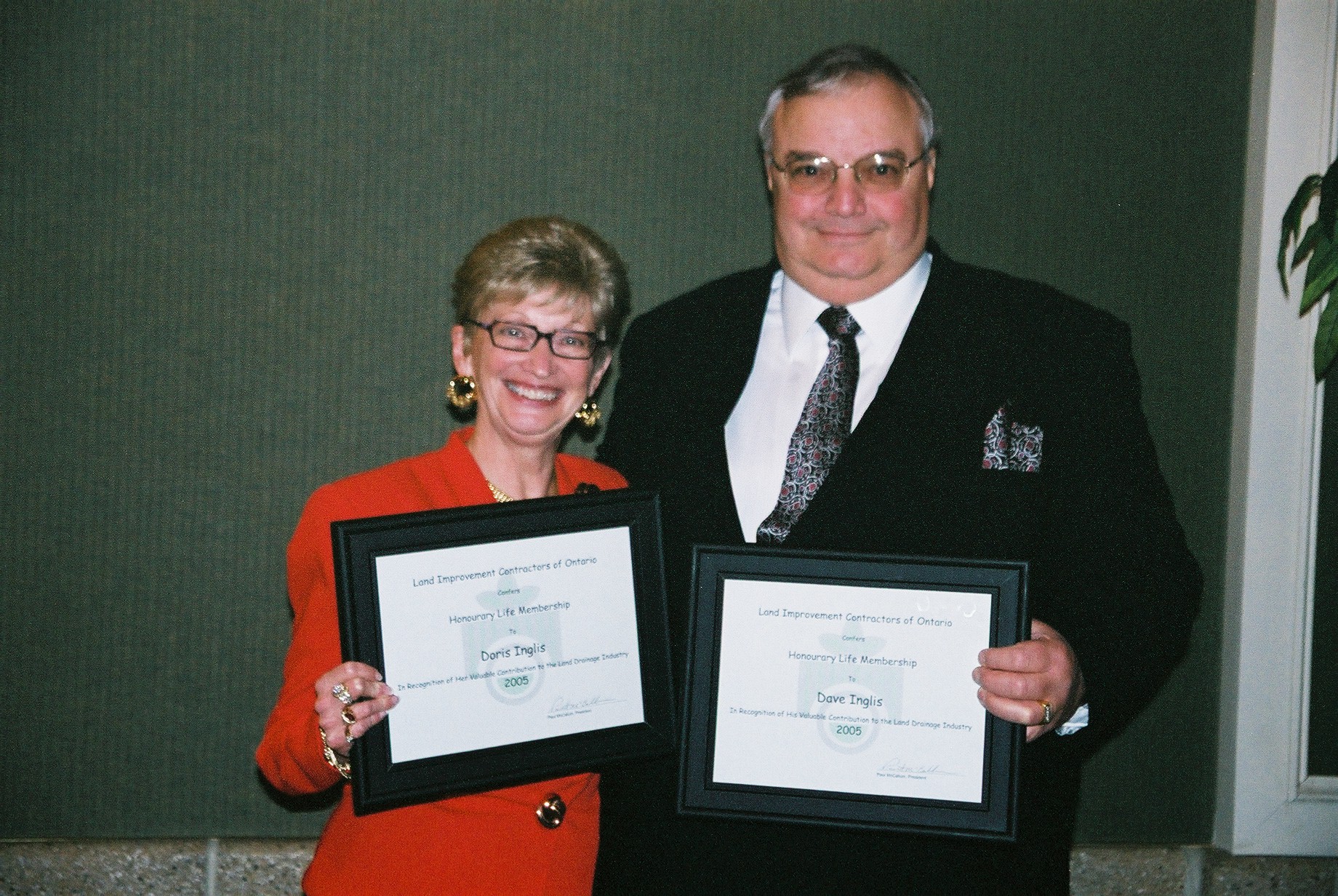
Dave Inglis was born into drainage; his father got him a bulldozer when he was 12 years old. Not a toy bulldozer that a child would get today – this was one that he used in the field.
He often skipped school to work with his dad installing tile. But he adds that he would also skip work to play sports and, by the end of high school, he would skip sports to see Doris Carswell. They both pursued higher education and Doris would go on to get her teacher’s certificate. But for Dave, he studied engineering for only a year before he had the opportunity to buy a drainage business of his own.
They got married and moved wherever the work was. Inglis Contracting did work around the Thedford Marsh and up to Clinton, and Doris tried to teach at nearby schools. She jokes that whenever she got a job close to where Dave was working, he would up and move to a different part of the province. Dave installed drainage systems in farm fields and did municipal work from time to time. They fondly remember a large pipeline machine they named “the Big Orange,” that they sold to Tait Bros. Contracting, who sold it to someone near Ridgetown.
Drainage installation was quite different back then, as many readers will know. Contractors used wheel-type trenchers to make ditches and laid foot-long four-inch diameter clay tiles on grade along the bottom, before covering the trench back with soil. They could install at a rate of nine metres a minute. They used grade stakes, Dave remembers, which required looking through a scope on the machine to line up with stakes placed along the path of the drainage run and making manual adjustments. The tiles needed to be placed at a precise depth and grade to make the field drain properly.
By 1962, Ontario had consolidated drainage legislation – some of the oldest legislation from Upper Canada -- into the Drainage Act, which governed outlets and municipal drains. The province also had the Tile Drainage Act, which – since 1878 – offered loans to farmers for the installation of field drainage systems. And the province was about to get a third piece of legislation, the Agricultural Tile Drainage Installation Act (ATDIA) in 1973, which required drainage contractors to hold a license. To this day, Ontario is perhaps the only jurisdiction with quality standards for drainage installation.
The ATDIA was introduced after a period of intense change. In 1967, the Ministry of Agriculture (OMAF at the time), installed 600 feet of corrugated plastic drainage tubing as a demonstration and the next year, Big ‘O’ Drain Tile Co. extruded the first plastic drainage pipe in the province near Hensall. By 1969, Daymond (owned by C&D Sugar), was making plastic pipe, followed by United Extrusions. The same year, the first drainage plow was imported to Ontario. At 30 metres/ minute, it could install plastic drainage tubing more efficiently than a trencher. In 1970, the first lasers for automatic grade control were introduced to Ontario drainage, and – by 1972 – the first double link plow was built in Woodstock, Ontario.
The ATDIA was passed in 1973 and required drainage plows and their operators to be licensed. Considering the investment that farmers were making, it was important that contractors had the right training and tools to do proper installation. The existing contractors, like Dave Inglis, were grandfathered into their licenses.
The move to plastic tile and plow machines came with a bit of resistance in Ontario.
Clay tiles were getting harder to purchase – so it made sense for Inglis Contracting to make its own. Dave and Doris, along with their friend Jerry Blake, purchased Bruce Brick and Tile in 1974. The business had closed after a fire a few years earlier. It was located along the edge of the Greenock Swamp near a deposit of clay soil that they used to make tile. Clay was extruded into hollow tubes, cut into foot-long sections, fired in a kiln and cooled before being piled on a palette for transport. Dave hired John Carswell (Doris’ brother), along with a few of the former employees of the plant and continued doing drainage installation in the area with Inglis Contracting.
Dave soon learned why clay tile businesses were having such a difficult time. The margins were extremely tight, due to a few manufacturers keeping the prices down in Ontario.
“If I could sell tile for $58 per 1000, it would cost me $57 to make it,” says Dave. At one point, the cost of the oil used in the kiln was more than what Dave could sell the resulting tile for and they were losing three cents every foot they produced.
So, when the opportunity to make plastic tile came in 1976, they made the switch. Out went the kilns and in went a plastic extrusion line. They had managed to buy an old corrugator that had been written off because it went through a fire, along with an extruder that was about to be scrapped. John went to work on setting up the line to run polyethylene.
When the lead administrator handed in her resignation, Dave asked Doris if she would quit teaching for good and manage the office. Doris says she didn’t know the first thing about plastic and manufacturing, but it turns out she would be a fast learner.
They recall it took quite a while before they got things running smoothly. When they started, they could produce only 12 feet of pipe a minute, but as they and their equipment improved, they were making 120 feet a minute. They grew to four extrusion lines – three ran four-inch diameter tile and the other did larger diameter.
Doris started working for the company the same day as Bill Ross, who became the best delivery driver they could have hoped for. They started making 5000 foot-long coils of four-inch pipe on reels, but it was difficult to coordinate getting the reels back. Then they moved to 3600-foot coils without reels that they just dropped off in the fields, and designed specialized trailers for unloading. That worked well, giving them a competitive advantage at the time.
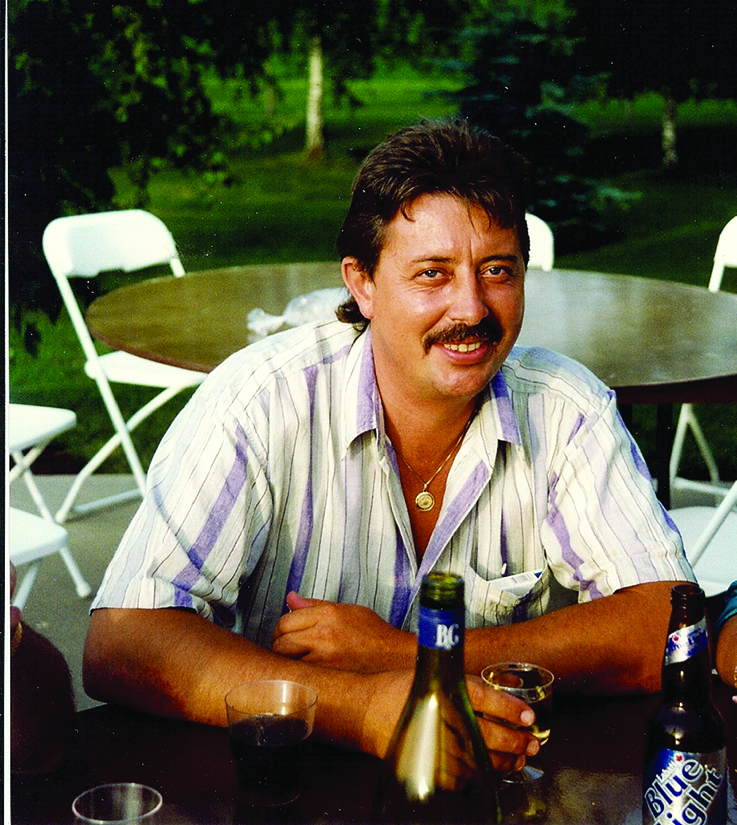
When Bill said he was interested in the sales position, they were nervous to lose Bill as a driver. He promised he would drive for them if they were ever in a pinch, and they admit they still needed him for some overnight runs from time to time. But Bill was equally great in the sales role and will be well-known to many readers. He retired in 2025.
They started advertising “Tile by the Mile.” And when contractors started asking for white pipe that wouldn’t get soft in the sun, they listened. Over time, all their four-inch diameter tile was made white. White pipe made it a bit harder to use recycled plastic, which was common in the industry (and still is).
Bruce Tile was selling pipe to local drainage contractors – particularly to Schmidt, Wiegel, Kuepfer, Tait Bros., KMM, Farrow, Scott Brothers and MacClennnans, as well as further afield to Walker Wright Drainage and DLG. They also sold from a tile yard they opened in Dresden. So, they stopped competing with their contractor customers and by 1985, Dave and his brother Tom had stopped doing installation altogether. Instead, he and Tom founded another plastics company, BI-AX and he worked in Tiverton at the plant. It would later expand in 2000 to another plant closer to home, in Wingham.
As for Doris, she and her brother managed the Bruce Tile plant, along with many dedicated employees – including Barb Breckles in the office and Rick Lassaline in the machine shop. Doris oversaw quality control and took quality very seriously. They used titanium dioxide as a stabilizer in the white pipe and tested all their materials for the melting point index to determine the blend for each batch. They designed a machine to test the product; it pressed the pipe to measure deflection and cracking, both when frozen and at room temperature. Each shift tested the product three times. All the records were kept for each batch and if it wasn’t up to the best standards, they would regrind the entire batch. Over the decades, they only had to do that about three times.
The industry continued to evolve. Self-propelled drainage plows (Wolfe, BRON and Tait) were made in Ontario, and they could install far more pipe in a day than trenching machines. In 1983, Hickenbottom inlet drains were introduced by Maaskant Bros. near Clinton. Laser grade control made way for GPS, which started being used by Tait Bros. in 1995.
As for tile, the last clay tile was made in the mid-1980s. The plastic pipe industry eventually consolidated to only a few companies. Big ‘O’ and Daymond joined in 1984 and Armtec bought them in 1998. Armtec bought Bruce Tile in 2008 and continues to manufacture from the plant near Walkerton. ADS bought Ideal Pipe in Thorndale in 2015. Then, Bluewater Pipe started up production in Huron Park in partnership with Soleno. A few manufacturers from Quebec and Manitoba sell into Eastern and Northern Ontario respectively, but perhaps one of the biggest disruptions in Ontario’s pipe industry has come from six on-farm shops run by Mennonite producers.
Ontario has led the world in drainage technology. Its licensing program and standards have set a high bar for quality for drainage plows, and now it aims to lead the way in quality standards for plastic pipe. In 2024, the Land Improvement Contractor of Ontario (LICO) recommended that all Ontario manufacturers produce agricultural pipe that meets or exceeds the American Society for Testing and Materials (ASTM F667) or Bureau de normalization du Québec (BNQ 3624-115) and that it bears the mark within the pipe.
While this may marginally increase the price of pipe, both manufacturers and drainage contactors agree that the guarantee of quality materials and traceability that certification provides is well worth it in the long run. Many suppliers are already producing stronger pipe to withstand the weight of farm equipment, but even with thicker pipe, it is hard to tell if it will degrade in the soil. Ultimately, it is the pipe materials that determine its longevity and, if pipe fails after a few years, no one wins.
It all goes back to the materials testing that Dave and Doris did at Bruce Tile. It is about the day-in, day-out attention to detail. They believe a great part of the success of Bruce Tile was due to the many dedicated employees and their commitment to the vision of Bruce Tile.
Today, Dave and Doris are (nearly) retired; they still own BI-AX International Inc. in Wingham.
The walls of their home are decorated with incredible photographs that Doris took on their travels to India, China and beyond. While they admit there was at least a 15-year period when they didn’t take any time off, they were glad they could make up for it later. And they now escape Canada’s winters in Hawaii every year. ◊