
These hands never idle
By Mel Luymes
Just south of Punkeydoodles Corners is Pumped Environmental Services, and owner Larry Bearinger’s shop is a hub of manure drag-lining equipment and innovation. And while he has put all the equipment to rest for the winter, Larry keeps busy inside the shop, building and rebuilding, to be ready for the coming season.
His mind is always going – whether it's re-thinking equipment or field and transport logistics – and when he is back in the house, he says he has a hard time shutting it off. So, he has taken up an unlikely hobby which also helps the community: knitting hats for newborn babies for the Grand River Hospital.
Karen, his wife of 46 years, says that people are always surprised when they hear Larry knits, but says that’s just who he is. He likes doing things that are useful.
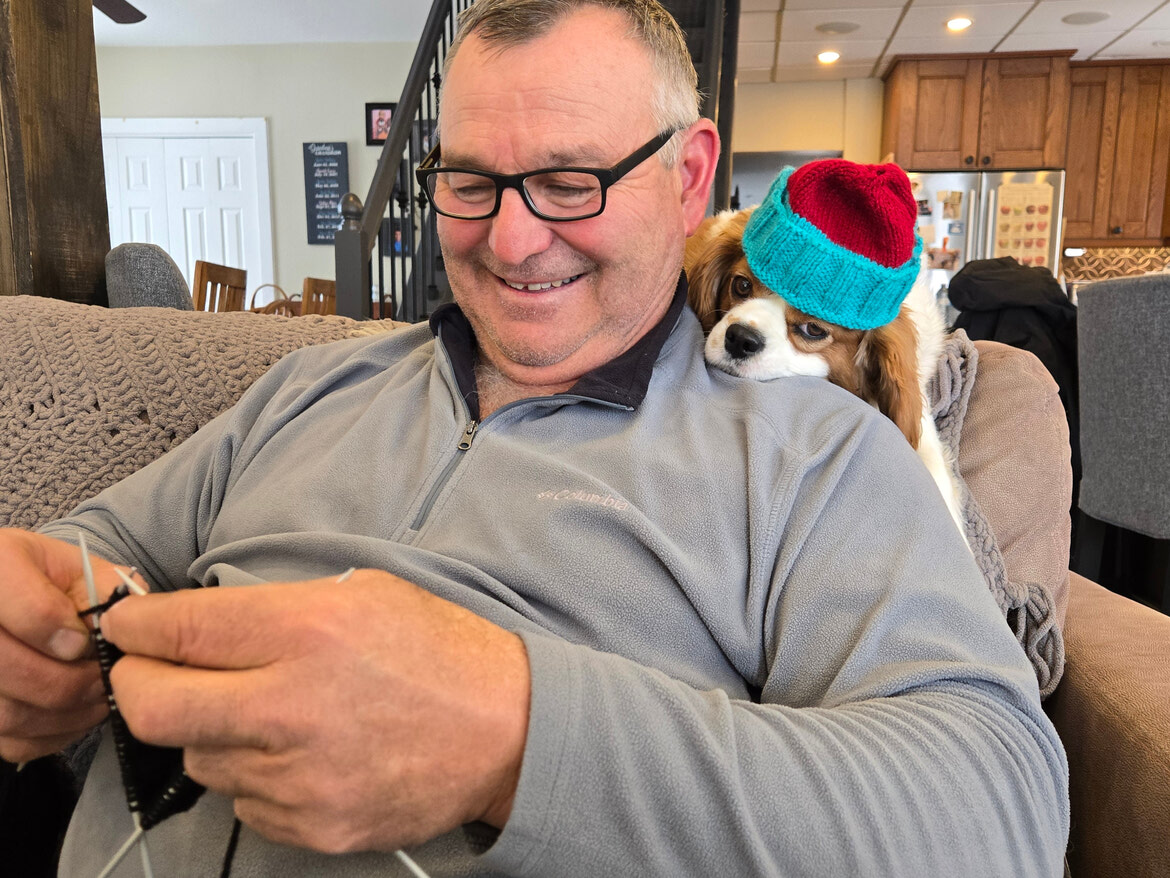
“I wonder what people would say, if they knew that a guy who pumps manure, does welding, and drives a Harley Davidson motorcycle made that hat,” laughs Larry, as he takes out four knitting needles and starts into a black hat during an interview with the Rural Voice.
His trusty dog Diesel jumps on his lap. Diesel is a purebred Cavalier King Charles Spaniel, which they bought from Larry’s right-hand man, Luke Clarke, who breeds them as a side hustle. Diesel doesn’t like the four-needle method – he often gets poked – but by using four needles, Larry makes a hat with no seams, perfect for delicate baby heads, especially with premature deliveries. It takes him about two evenings to make one hat.
But let’s start at the beginning. Larry and Karen were high-school sweethearts; they met through their youth group as their brethren Mennonite churches combined, and they married when they were just 19 years old.
“You should write a story about Karen,” says Larry, “she is far more interesting than I am.” Karen was adopted (from South Korea after the Korean war) by a prominent family in the Mennonite community that moved from Chicago to the Waterloo area when she was a teenager. Her father was John W. Miller (1927-2017), a theologian at Conrad Grebel College and her grandfather Orie O. Miller (1893-1977) was a key player in the founding of the Mennonite Central Committee (MCC).
Karen and Larry went on to have three daughters, Emily, Jessica and Stephanie, while Karen was working as a hairdresser and Larry was working as a tractor mechanic and a parts guy with some local businesses, even doing mobile repair.
He didn’t set out to become a manure contractor. He had done work for a manure business started by his brother-in-law and a business partner, Kevin Cressman. When his brother-in-law left the business, Larry came in as a partner in 1996 and they formed PUMPED (little-known fact, it stood for Proficient Ultimate Manurigation Professional Environmental Division.)
“With a buy-out clause,” Larry stressed. That became important when, a few years later, Kevin also wanted out. “He let me buy him out over the course of a few years, so I didn’t need to take out a loan,” says Larry. Pumped Environmental Services was born, and the two are still friends to this day.
Larry came into the manure industry just as it was changing dramatically. The Walkerton tragedy happened in 2000, and the Nutrient Management Act was in force by 2003. As manure irrigation through a high trajectory gun was banned, he fully moved into drag-lining. A lot of the equipment at the time – pumps and hard or soft hoses –were built for water irrigation and many manufacturers didn’t understand how to work with a thicker, more abrasive, liquid manure product. So, Larry started building new equipment that would do the job.
But the year that Larry took over the business was an extremely difficult one. His shop burned to the ground on November 15, 1996, while he was out spreading.
“All that was saved was my service truck with some tools in it. Everything else was gone,” he says. And that wasn’t all. There were the legal insurance battles for some of the neighbour’s equipment that had been inside for repair and other issues that led to many sleepless nights for Larry and Karen, with their young family.
“That’s the part of a fire that people don’t see,” says Larry.
It was a set-back that would have stopped most, but Larry got straight to work with some friends from church to rebuild the shop.
Larry and Karen stayed there a few more years but moved the business to their current property in 2002. Property taxes were going through the roof, as the municipality continued to zone the (newly rebuilt) shop as commercial. The move to Punkeydoodles Corners saved them on taxes but also put Larry more central to his growing customer base.
And it meant that Larry was back to building another shop, pouring heating tubes into the concrete floor, and a network of rebar and counterweights to hold a crane that he pulled off a truck.
“I don’t have to lift anything over 40 pounds,” Larry laughs. It makes it so that he can run the operation with just himself and Luke.
Before Luke, there was Ron Dietner. Ron had a prosthetic leg and couldn’t easily press the clutch. So, Larry rebuilt Ron’s tractor to have an automatic transmission and then they painted it pink, calling it the Pink Panther. The iconic tractor was even featured in a May 2014 article about Pumped Environmental for the Waterloo Region Record for their series on odd jobs.
The shop is heated through a do-it-yourself heat pump (a radiator and a fan) on the one side and the in-floor heating he installed on the other. An outdoor wood stove is gradually burning through a pile of dead ash trees he is splitting with an automatic wood splitter. When he borrowed his neighbour’s splitter, he automated it before he returned it.
“There needed to be a person there just pulling a lever all the time. How unproductive is that?” says Larry. “Anywhere I can automate, I will,” he adds. And then he went on to build his own wood splitter.
“My business philosophy is to be the tortoise, not the hare,” he says, “work steady, don’t rush and make mistakes.” Especially because manure is such a regulated and dangerous industry, they need to stay focused. Work smarter, not harder, Larry would say. And walk, don’t run.
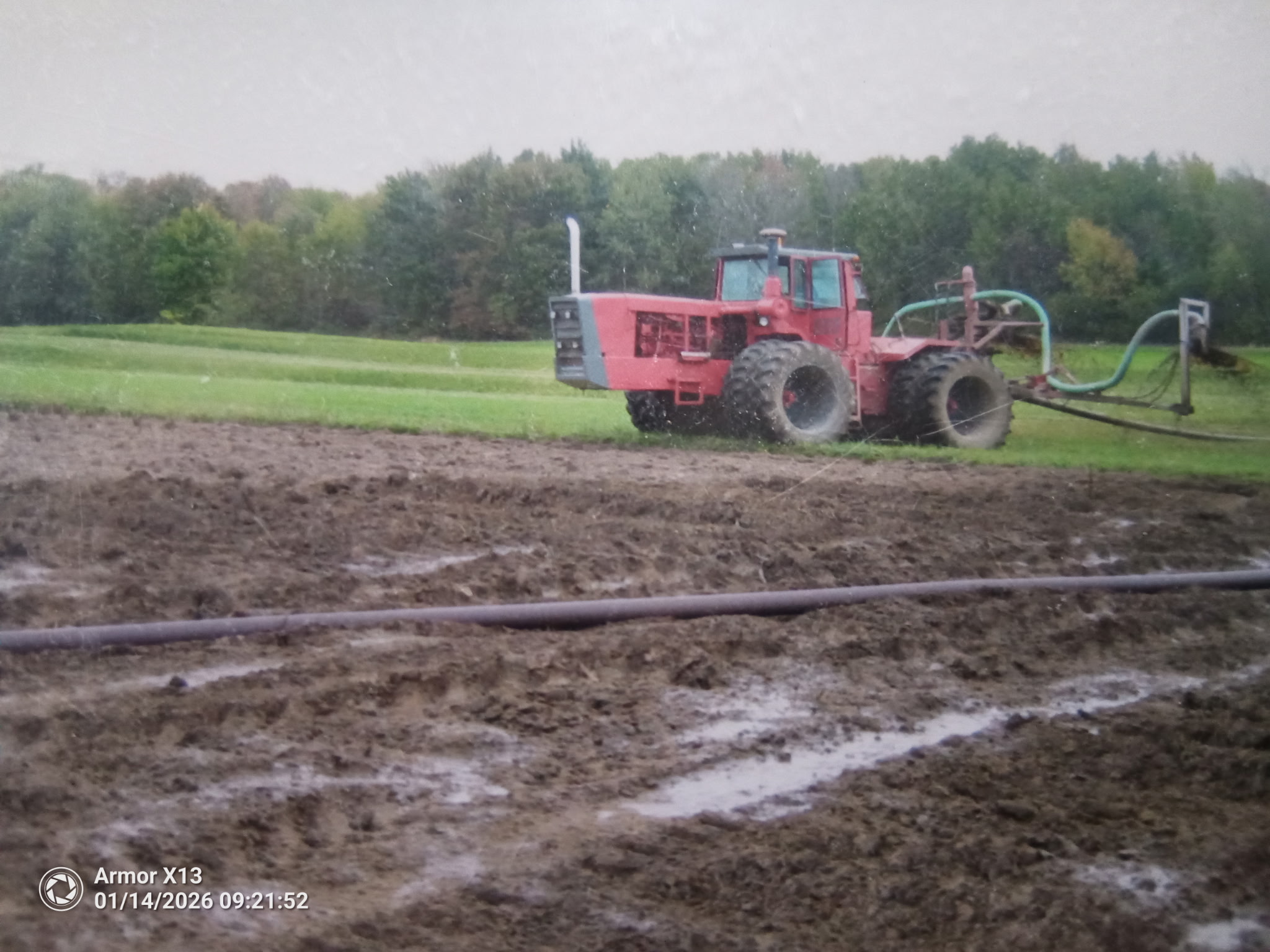 The Pink Panther, back in its heyday!
It is that on-farm ingenuity that Larry loves. When he saw a manure “bridge” that could pump manure safely over a road, he considered buying one but instead, he built one himself and improved some of what he felt were the design flaws, adding mechanical locking systems and improved stability under real-world wind, traffic and load conditions. The equipment is a game-changer, as the inability to cross (over or under) roads with drag hoses greatly restricted farmers’ application options.
Not just mechanical, he is also thinking about field logistics and how to set up a job to eliminate driving over manured areas and improving consistency of application rates on turns. He’s also thinking how to cover the greatest number of acres in a day. Luke drives the spreading tractor, and Larry handles all the pumps, agitating, and moving the hose around the field with the hose humper to save wear on the hose and minimize the weight the tractor is pulling.
“In manure, you get paid by the gallon. So, if I can do the same job in one day that used to take two, the farmer gets the job done faster and doesn’t pay more.” Larry explains that all this efficiency is a win-win for both the farmer and himself as the contractor.
But it means that his mind is always going, and that can be difficult to not have any downtime in one’s head. It means sleepless nights or waking up in the middle of the night, with an idea, says Larry. And he also admits that the fire and its aftermath still haunt him, and sometimes he needs a distraction just for his mental health. Larry likes to take his motorcycle out for road trips in the summer when he can, but the winters can be difficult.
That’s where the knitting comes in.
Larry’s mother was always an avid knitter and when, in the fourth grade, he was teasing the girls in his class that they couldn’t knit very well, they challenged him back.
“If you think it's so easy, then why don’t you do it?” So, he did.
His mom taught him and he took well to it. But it wasn’t until years later, as he was driving a propane truck on a night shift that he picked it up again. He explains that sometimes he would be waiting three hours to get the truck filled and he couldn’t leave the truck. At that time, his three daughters were having children of their own and so he thought he would knit some slippers for the grandkids.
He laughs as he recalls a guy hopping up on the truck to chat with him, but when the guy saw he was knitting, he just walked away without saying a word.
When he stopped driving for the company, he also stopped his hobby. It is only recently that he picked it up again, when he learned through the church choir (yes, this manure contractor also sings bass!) that the church ladies’ group that made these small hats for the hospital was dwindling away and their supplies were running low.
He thought he would try a few, but by the end of winter last year, he had made about 30 hats. And this year, his goal is even higher. The yarn is often donated, and no two hats are the same – different sizes, different colours. And now that he and Karen have a great-grandchild, he can knit him some slippers as well.
“I don’t knit in the summer, because my hands smell like manure all the time,” Larry says, who says he has already built up a callous from the knitting. Thank goodness, because he had injured his thumb in an airbrake several years back and he couldn’t find a thimble big enough to protect it, he laughs. At least for this winter, you’ll find Larry cozy on the couch with Diesel, just knitting away. ◊