


The next generation of farmers?
By Mel Luymes
Anyone who fears that society is doomed with the next generations could have changed their minds after walking through the AgRobotics Ontario Challenge at the London Farm Show on March 5.
Dozens of enthusiastic and extremely bright 16 and 17-year-old students brought their ag robots to the show, demonstrating a deep engagement with agricultural issues and keen minds for problem-solving.
This was the first year of the competition, a partnership between Ontario Council for Technology Education (OCTE), Innovation Farms Ontario and the Western Fair Association , and supported by Studica (a manufacturer of robotics kits and hardware). A call went out in November to Ontario high schools to compete in the AgRobotics Challenge and tackle real farm challenges with cutting-edge technology.
In the end, five robots came out to the London Farm Show. Students pitched to a panel of three judges, including Chuck Baresich (Haggerty Ag Robotics), Jana Tian (Upside Robotics) and Matt Stevens (Finite Robotics).
Readers may remember both Chuck and Jana from the August 2025 issue. The Western Fair Association has been supporting agricultural robotics and operates Innovation Farms Ontario, a network of farms testing automation, in collaboration with Haggerty AgRobotics and RHA Ventures. The Innovation Farms are funded by FCC AgExpert. This was their first time partnering with OCTE, which is a provincial organization started in 2002 which aims to advance technology education in Ontario schools.
Michael Gerrits is a teacher from Saunders Secondary School in London,where he teaches a robotics course. There, he says the students have access to the latest technology, including a CNC machine in the classroom. Nearly a dozen of his grade 12 students worked tirelessly on a robot that would pick rocks. It is a small prototype to demonstrate the software and the design.
“They worked on it through their lunches, and after school,” says Gerrits, proudly, “this was all them.”
The idea for a rock picker came from discussions with their community partner, Kevin Lee, a farmer and fellow tech enthusiast near Grand Bend. The connection was made through OCTE, as Kevin – founder of LeeVerage Integrations Inc. – also teaches Autodesk Fusion, a cloud-based software for 3D modeling, to secondary school teachers.
The team from Abbey Park High School in Oakville were there with their teacher, Stephanie Gigg, and their BuzzRover robot. They sported matching t-shirts and had also created a colourful printed poster, a website with design specs, software code and videos of the process. Their community partner was Karin Tomosky, of Willow Grove Heritage Honey near Milton. They built an autonomous robot that would transport honey frames from hives to the extraction room.
The BuzzRover has been tested on the farm; the students say it worked well for Karin and that she was even connecting them with the Ontario Beekeepers’ Association. They were excited to see their idea have an impact on the honey industry.
At Columbia International College from Hamilton, a diverse group of students from China, Hong Kong, Vietnam, Brazil and Nigeria worked with a local vineyard and created both the hardware and software for a crop scout robot that offers early disease detection, noticing variations of colour on grape leaves.
Students from I. E. Weldon Secondary School in Lindsay designed a robot for a strawberry operation to transport field-packed strawberries from the fieldworker to the truck, and then back to the worker.
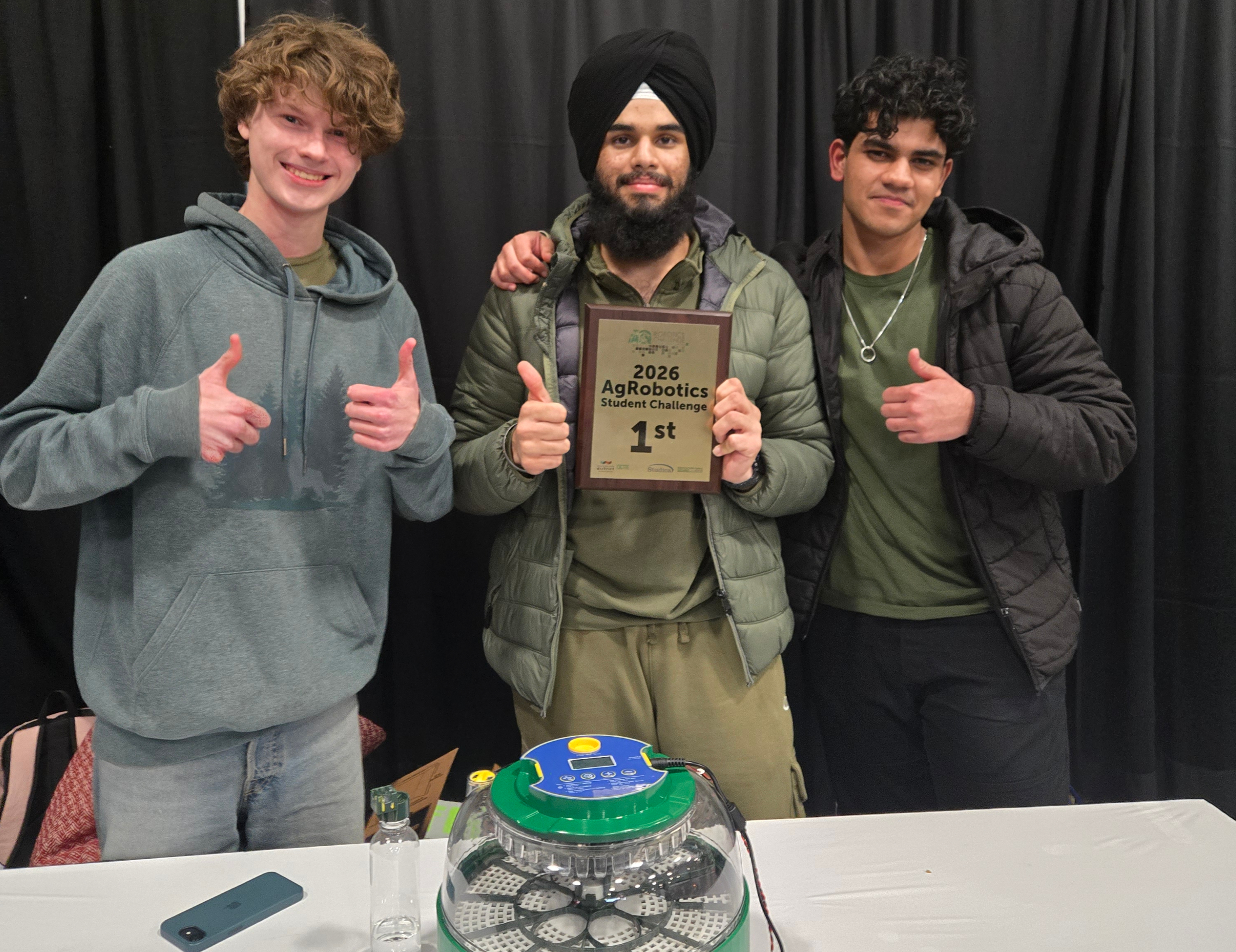
A small team from Milton District High School built a contained egg incubator called Lifeloop in partnership with Open Spaces Farm from Flamborough. They found that the farm was losing eggs in the incubation process due to inconsistent temperatures from opening and closing the unit when they candled eggs to determine their viability. The team bought a small incubator for its frame and then stripped its technology, adding computer vision to scan the eggs to determine viability and then removing the “duds” through a controlled chamber that kept the lid closed and temperatures consistent.
Chuck emphasized the importance of communication and crafting a good pitch, noting that someone could have the best design or solution, but if they can’t sell it, it won’t go anywhere. After the pitches, judges asked questions but also gave valuable feedback to students about their designs and about the field of robotics. In an intense huddle at the back corner of the show, the audience could hear the leaders of Ontario’s robotics industry and high school students wrestling with the questions that would drive the industry forward. Both students and teachers agreed that the feedback session was invaluable.
As the group broke for lunch, one student grabbed the microphone and gave a shout-out to the work that farmers did to feed them. For many students, this was the first opportunity they had to visit a farm, and they were excited by the opportunities to bring technology to such an important sector.
Over the break, judges also came to the schools’ booths with follow-up questions to students before they met to decide the winners. First prize was $750, second prize was $500 and third prize was $250. They said it was an extremely difficult decision because all of the robots were excellent and they strongly encouraged all students to continue their work, and gave them hopes of commercialization.
They addressed the strengths of each team before announcing the winners: Saunders’ rock picker placed third, Abbey Park’s BuzzRover placed second and Milton District’s Lifeloop placed first.
It was definitely a highlight of the London Farm Show to see young people looking around farm equipment with their mental gears spinning, thinking of what they could bring to the industry. We hope to see them back again and again!◊