

The farms behind the farm: Ontario’s network of research farms drive on-farm innovation
By Andréa Geleynse
When new agricultural studies, products or technologies become available the average person likely doesn’t give much thought to how they are developed or where they are tested. Products like seed and fertilizer have to undergo years of testing and research before they are deemed ready for use by growers and new agricultural methods don’t just appear out of thin air. Where then do these innovations begin? It may surprise you to learn that there are actually 14 different agricultural research centres scattered across Ontario, each of them dedicated to exactly this purpose – the development and testing of new agricultural practices and technologies.
The research centres are owned by the Government of Ontario and 13 of the 14 centres are operated by the University of Guelph under the Ontario Agri-Food Innovation Alliance. This alliance consists of a collaborative effort by the University of Guelph, the Ontario Ministry of Agriculture, Food and Agribusiness (OMAFA) and its agency Agricultural Research and Innovation Ontario (ARIO).
ARIO consists of a board of up to 15 members that meets several times over the course of the year. Their aim is to further the growth of agricultural research and innovation in partnership with organizations like the University of Guelph. The goal of ARIO is to establish programs and relationships that further the growth of agriculture and to positively impact research by working alongside and supporting researchers. ARIO was founded in 1962 and has grown to have a significant impact on the growth of agriculture, food and agribusiness in Ontario through their multimillion dollar research facility infrastructure – of which the research centres are a large part.
The centres in Emo, Winchester, Elora, Huron, Ridgetown and Woodstock are dedicated to research on field crops, while the centre in New Liskeard focuses on beef and horticulture crops in addition to field crops. Centres in Cedar Springs, Simcoe and Vineland focus on horticulture research, and Alma and Bradford deal with aquaculture and vegetables respectively. Vineland operates independently of the University of Guelph, and is instead run by Vineland Research and Innovation Corporation. Arkell’s research centre is dedicated to equine and poultry research, while Ponsonby is a general animal research centre with a focus on sheep. The centre in Elora consists of research related to beef, dairy and swine.
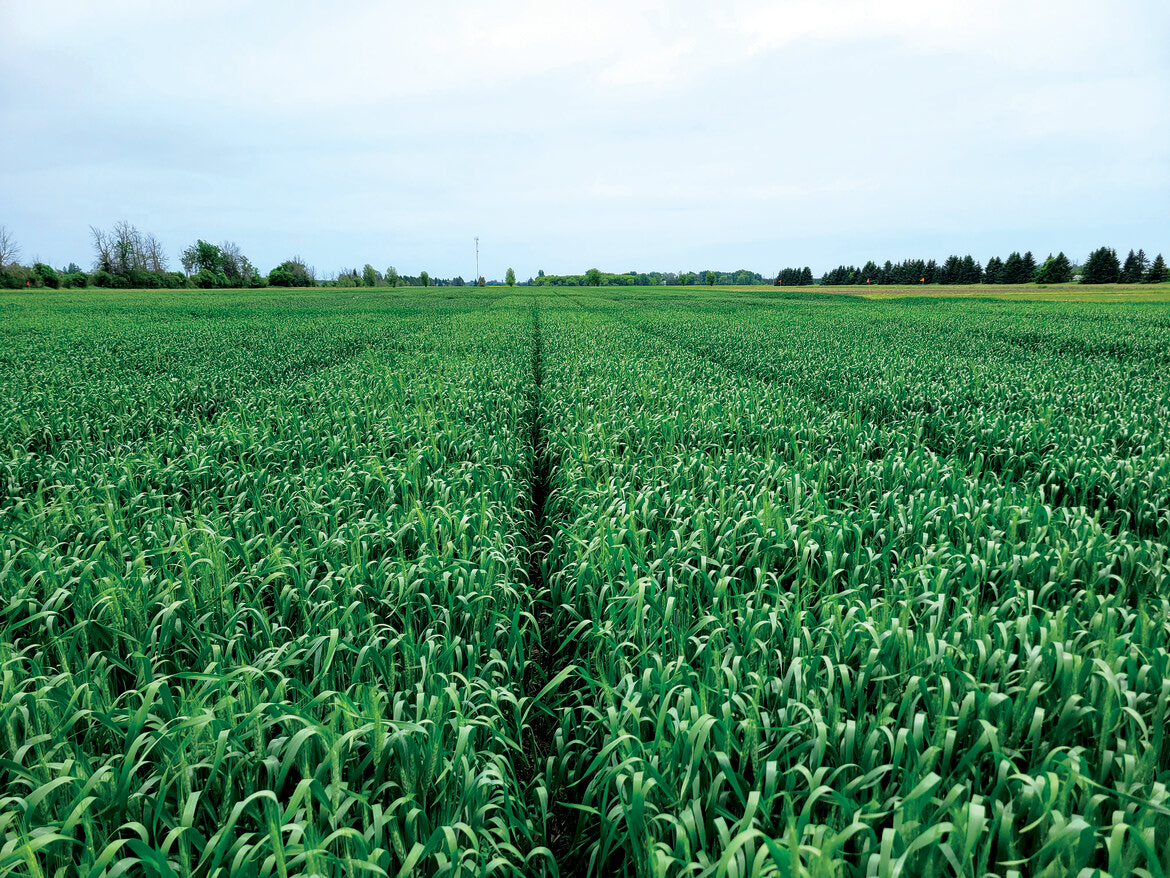
Each of the centres hosts several different projects over the course of the year or growing season. The field crops research centre in Winchester consists of 130 acres of clay loam soil, representative of a large swath of land in south-eastern Ontario. The soil is well suited to growing a variety of crops including corn, soybeans, wheat, barley, oats, rye, dry beans, and canola. One of the projects currently being conducted in Winchester is a drone seeding project. The project aims to address the challenge experienced by farmers in Eastern Ontario of an overlap in time between optimal soybean harvesting and optimal winter wheat planting windows. The experiment consists of seeding winter wheat via drone into standing soybeans prior to harvest.
This project is part of a collaboration with the University of Waterloo and Corteva Agriscience and is headed up by Dr. Joshua Nasielski of the University of Guelph and research technician, Ian DeSchiffart. For farmers in Eastern Ontario, the best planting dates for winter wheat are often several weeks before their soybeans are ready to be harvested, meaning that they must wait to plant winter wheat until several weeks after the most optimal planting date. Winchester’s drone project proposes a solution: use drones to seed winter wheat directly into standing soybeans.
While the main concept may sound simple, the project has already revealed several unique challenges. Drone seeding results in seeds being left on the soil surface, meaning that they are exposed to the weather and vulnerable to sudden changes in temperature. Lacking moisture, the seeds will fail to germinate resulting in loss of the crop. This particular challenge has been addressed by the research team through the creation of a special biodegradable seed coating, allowing the seed to retain moisture while avoiding the introduction of microplastics to the soil. These seed coatings were introduced to the project this past fall and results will be determined following the wheat’s harvest later in the summer.
Dr. Holly Byker, Agronomy Manager, Northern and Eastern Ontario Crop Research Centres, heads up the research centres in Winchester, Emo and New Liskeard and she spoke to the Rural Voice regarding the purpose and importance of the research centres to the future of agriculture and agriscience. When asked why the centres are necessary she said, “It [the research centre] is a space where the research or technology side of agriculture can meet some actual tried and true research method, and then can also get feedback from growers.” For many farmers the technological and experimental sectors of agriculture can feel far-removed from their day-to-day needs and concerns, and similarly, those who work in research and agriscience can often lose sight of the practical problems that they are working to solve.
The research centres provide a common ground where both sides of the industry can meet and work together to achieve the best results in a low risk environment. Byker explained that for a farmer, experimenting with a new method or piece of equipment can result in huge losses in yield and consequently significant financial loss, but for the research centres, a loss in yield is far from devastating, instead producing new data and technological improvements. In that way, the centres fill a niche that can’t be filled by every grower because not every grower can assume large risks in the hope of increasing yield down the road.
Byker also stressed the importance of having a place to conduct real-life research without any particular biases toward specific brands or companies,, “It’s a fun space that way, to be in the middle of it all, to be in a space that’s not trying to promote one company or anything.” Whether biases are present on the part of companies trying to sell a product or not, it is vital for growers to have access to a neutral testing ground where research can be conducted fairly and impartially in a risk-free environment.
Developments in seed, machinery, fertilizer, pesticide spray, and farming methods are more important to farmers and their livelihoods than many people realize. The research centres provide valuable knowledge and data for farmers to learn and draw from when making decisions about how and when to plant, harvest, spray and fertilize crops. Byker explained, “I think the research centres in general are a good mix of that [practical and theoretical]. It’s good for the researchers to hear directly from producers about what they need and what growers need, but then also for researchers, we need that [feedback] to advance agriculture.”
She also added that for new companies trying to produce seeds, sprays and fertilizers in a space that is often dominated by larger, more well-established companies, the centres provide a great opportunity to run trials and gain recognition. It is difficult for startups in the industry to gain traction and become recognized by growers without real-world evidence that their products are effective. “We’ve done a few trials for startups that are trying to get into the market and need to get some testing. It [the research centre] gives them an opportunity to have some contacts in the industry. I think that’s a great space for that to happen. It’s kind of a space where the research side of it or the technology side can meet some actual tried and true research method, and then can also get feedback from growers.”
Nevin McDougall, chair of the board for ARIO offered his perspective on the impact of the organization, “The network of ARIO research stations provides the spaces where innovation and technology can be developed for Ontario's unique farming needs and advance the agri-food sector. This ensures our local food networks meet the growing demand of Ontario consumers with a safe, nutritious and resilient source of food products.” The research centres are meeting a need that most people are unaware of, and few people understand the importance of the work ARIO is doing for and with the agricultural community in Ontario. If you live near one of the research centres, take the time to look into what they are doing, ask questions and learn more about the important work happening right on your doorstep.◊