
Remembering Wendell Berry
By Richard Bloomfield
It was just earlier this summer when I referenced one of Wendell Berry's essays in this magazine (Life is a Miracle, 2000) and on August 31st, 2026, the world lost this beloved farmer, writer, advocate, and agrarian contrarian in his 92nd year. As he hoped, Wendell’s time ended at home on his farm near Port Royal, Henry County, Kentucky where he had lived for much of his life along with Tanya, lifelong partner and wife of 69 years. It is fitting that he finished his life on the farm given how often he had written beautifully about his deep connection to that land. One of his earliest essays has stuck with me on this connection for some time.
A Native Hill (1968)
And suddenly I apprehend in it the dark proposal of the ground. Under the fallen leaf my breastbone burns with imminent decay. Other leaves fall. My body begins its long shudder into humus. I feel my substance escape me, carried into the mold by beetles and worms. Days, winds, seasons pass over me as I sink under the leaves. For a time only sight has left me, a passive awareness of the sky overhead, birds crossing, the mazed interreaching of the treetops, the leaves falling – and then that, too, sinks away. It is acceptable to me, and I am at peace.
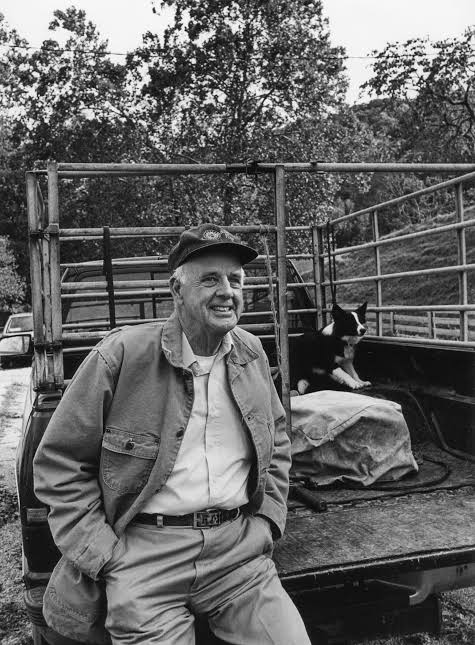
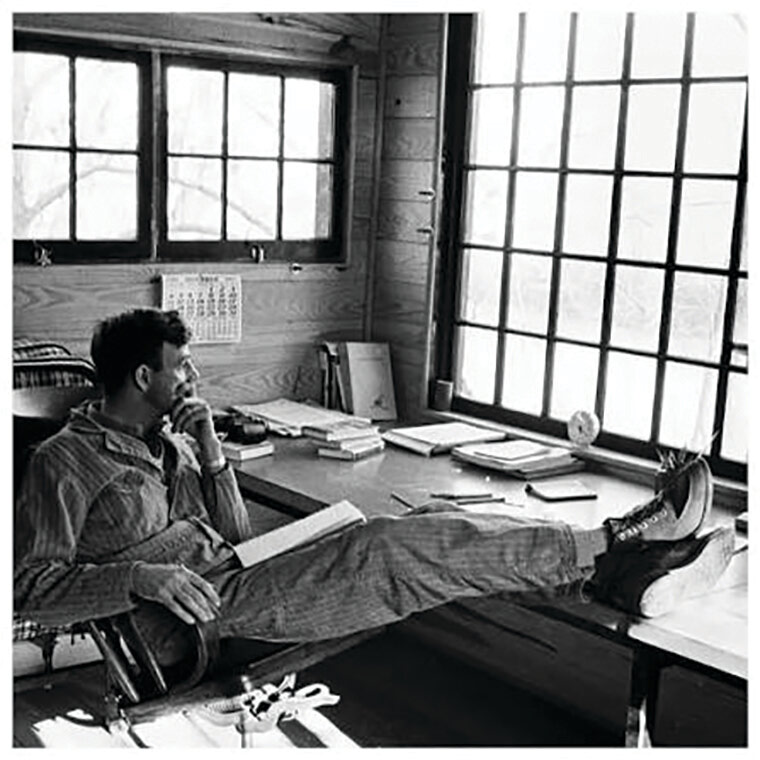
It is without question that Wendell Berry has made a profound impact on many, and I will do my best to capture some of his legacy in this piece. As someone who grew up on a farm, I felt neither drawn to it nor pushed away from it as a young person. Encountering his writing at age 18 changed my life's trajectory in fundamental ways. It would not be hyperbolic to suggest that his writing turned an agnostic farm kid into a believer. Certainly, his writing was beautiful—but his consistent contrarian call (not to be confused with cynicism), to respect agrarian life not only as the root of a thriving rural economy and community but also the basis for any city's existence, sparked something inside me. Wendell wrote about place, work, neighbourliness and the obligations of loving them in a way that drew me to care more about the place I am from and everything else around me.
The Advocate
After a brief time living in New York City and being appointed Assistant Professor at NYU, Wendell Berry returned home to his family's Kentucky farm in 1964. With an MFA from Stanford University, he had the standard credentials to become a successful writer, but his peers insisted that would only be possible in the big city. He would eventually prove them wrong by writing over 50 books and collections of nonfiction, fiction, and poetry almost exclusively from and about rural life in Kentucky. His writing was neither cosmopolitan nor flashy, but it was authentic. Even in his fiction writing there was an elaborate description of the physical world and people of rural Kentucky. From Nathan Coulter, 1960 to Jayber Crow, 2000, Wendell narrated the stories of rural life from different members of the fictional ‘Port William,’ while weaving in the important fabric of any healthy community: the feeling of belonging to a place.
By 1977 with the publication of The Unsettling of America, Wendell started to have a more public voice—despite his clear preference to stay out of the spotlight, including a public debate with the (in)famous Secretary of Agriculture at the time, Dr. Earl Butz. Secretary Butz was a staunch promoter of modernizing agriculture (which he often referred to as agribusiness) and perhaps was most well-known for telling farmers to “get big or get out,” in line with his Secretary of Agriculture predecessor (1953-1961), Ezra Taft Benson. Wendell had doubts that what industry and government leaders were selling would lead anywhere positive for farmers and rural communities. The alarms that he sounded 50 years ago applied to Canada and the United States alike and in many cases are as prophetic today as they were then. Although, as is often the case, the prophet is seen by many as a madman.
Wendell Berry pointed out that in order to care for the land, people would need to live on it and be able to make their livelihood from it. In other words, industrial agriculture would not help either of these imperatives, and its advocates were concerned mostly with managing more land with more inputs and less people while transforming the landscape to suit new machines. For Wendell, to be concerned with “the environment” meant understanding that our life is conditional on caring for the world as a gift we have been given, that we must learn all that we can about where we are in order to have common cause with that place. A rather stark contrast to both the likes of Secretary Butz then, and our current tech billionaires bent on moving to the planet Mars.
As he understood it, we all live at the expense of other creatures, both plants and animals, and so he believed it was important to do so with as minimal violence as possible. Therefore, taking ruminant animals off grass and putting them in large confinement spaces or plowing a steep incline to plant a season of corn while topsoil eroded, represented the same kind of industrial violence imposed on the world that gives us life. Wendell’s own farm was right on the Kentucky River, and he wrote often about the changes he witnessed in his lifetime along the riverbank. His concern extended beyond his writing into direct protest of anything that threatened the health of the river. This included a campaign to stop a dam, several campaigns against the ongoing highly destructive practice of strip coal mining involving blasting mountains apart (which he wrote passionately about in The Unforeseen Wilderness, 1971) and even an overnight sit in at the governor's office when he was in his 80s.
Perhaps most memorable was his swift exit from the University of Kentucky, where he taught for decades, when they accepted a large donation from a coal magnate. All of his archival work was moved from the university to what is now The Berry Center in Newcastle, Kentucky which I had the privilege of visiting in the summers of 2023 and 2024. For most, there isn't much to see in Newcastle, Kentucky, it is a small pass-through town with one stop light about one hour northeast of Louisville. The Berry Center itself isn't flashy, and it sits inside an old unassuming heritage building on the main street (aptly called Main Street). I took a tour and learned about not only Wendell Berry's activism but also his late brother's work (John M. Berry Jr.) in the U.S. Senate and his father's work establishing and leading the Burley Tobacco Growers Cooperative Association which Wendell wrote about often.
After one particularly bad harvest, Wendell remembered his grandfather and father returning with no payment for their harvest despite a year of hard work. The tobacco companies had too much power and therefore price control, and so with a great deal of mobilizing farmers in the region they began an allotment program to match supply and demand with an established support price which covered the farmers’ costs. The only government support came in the form of a loan made annually against the crop to provide cash flow for the cooperative to purchase, store and resell crops that did not receive the support price at harvest time. The farmer was paid right away, and there was no incentive to overproduce using poor practices as so many agriculture government subsidies have done and continue to do. The Burley Cooperative concept has repeated many times in farm history and continues to this day, though likely not nearly enough. It is not surprising given this lineage, Wendell Berry carried on practical advocacy beyond his writing.
The Agrarian Contrarian
Wendell Berry possessed a wry sense of humour which showed when his position was most contrary to the “normal” order of things. Commenting on a speech about agriculture that President Bill Clinton gave in 1995, he said: “He could not have meant what he said, because he was speaking without the benefit of thought.” I have a hard time not chuckling every time I read that line. He went on to make a valid point about politicians, executives, academics, for the most part being so far removed from use and care of the land that they could not think about such things in any detail. President Clinton believed at the time that the farm population had “bottomed out” but there was, of course, no reason to think this at all other than wishful thinking. The policies and trade agreements in place then (many of which continue today), acted to undermine farmer livelihoods and as we know, the farm population continues to decline to the present.
For some, Wendell Berry's contrarian ways were reason to consider him an old crank or a luddite extolling some romantic past. Take for example his famous essay Why I Am Not Going to Buy a Computer 1987, which received so much attention he felt a need to respond to the critics. Despite only ever using a pencil and paper for his entire writing career, he published more than enough work to be considered productive, perhaps even prolific by most any standard.
In Wendell’s honour I wrote this piece entirely by pencil. Writing in this way has been more enjoyable and I dare say not any slower, because I could pick up and put down with such ease I wrote more often. I think this is a good example of what Wendell called the sacrifices of modern life. For every new efficiency promised by the latest technology, we do not appear to live in a society with more free time. Perhaps more importantly, we ought to consider the implications when we quickly adopt new modern luxuries. Are we more fulfilled?
I imagine Wendell Berry might find some displeasure with my previous defense of his productivity, after all, another aspect of his contrarian position could be described with the phrase “what is the rush?” So often there is a great deal of enthusiasm to move fast and break things so that as a society we can maximize the greatest utility for all. Wendell Berry would describe this approach as something akin to ignorance. He pointed out often that one cannot know a place in one year or even 10 years. Instead, we should begin the thousand-year work of knowing a place. This position is well described by one of my all-time favourite quotes from Wendell “There are no sacred and unsacred places; there are only sacred places and desecrated places. My belief is that our life and the world in it are conditional gifts” (Given, 2005).
Moving fast with limited or no knowledge of different places or people is to inflict maximum violence and to be acting without the benefit of thought. To me, it is not hard to find a great deal of evidence for such reckless decision-making today. Oftentimes the need to move with urgency is well intended to protect our future—something our culture has grown rather obsessed with discussing/shaping/worrying about/transforming and so on—but good intentions without care, thought, or good knowledge tend to create more of the same problems we already have. Perhaps this was why Wendell Berry was not fond of speaking about the future since it does not exist and we can know nothing about it anyway. He believed that we need restraint in the context of our obsession with limitlessness, which is one of the most dangerous attributes of the future since we can freely project whatever we want onto it, and talk endlessly about it while distracting ourselves from the only moment we are alive. In some cases, we defer payment of our unpayable ecological debts and waste onto the future. I don’t think this should be misunderstood as apathetic or fatalistic, quite the contrary, Wendell Berry believed we need to act now within limits in ways that are good for all living creatures, and communities, things that very much do exist.
In his rejection of many of modern life's luxuries and its obsession with speed and the future, he was possibly most clearly an outlier in his rejection of the notion that bigger was ultimately best. This is what put him directly in conflict with Secretary Butz, as mentioned earlier, who argued that larger fields, machinery and ultimately farms were the only way U.S. farmers could thrive as efficient and modern. Of course, the definition of efficiency here was highly selective and notably Secretary Butz rarely said anything about the quality of work or the impact on rural economies. The sort of efficiency that Secretary Butz and several industry leaders to this day are usually referring to is greater output per acre with less labour. In other words, increasing yields while making typically larger machinery to plant and harvest or more animals to fit in larger confinement spaces etc. What this definition of efficiency consistently ignores are the ecological processes by which all life is sustained.
What could possibly be more efficient than self-generating, solar powered “things” that convert CO2 into breathable oxygen and stable building materials (trees)? Or properly cared for topsoil which can regenerate forever? Certainly not a system that can only sustain high yields with an ever-growing volume of external inputs (fertilizer, chemicals, diesel fuel) which are extracted from our same world often out of sight. To put it another way, just because we can extract value at large scales in new ways does not mean it is good for us or the world. In fact, Wendell Berry rejected the push for big scalable solutions to be imposed, even those in response to industrial agriculture since it is exactly this sort of thinking which has put us in our current predicament. For him, big silver-bullet answers for the future of agriculture will necessarily be abstracted from present realities of place and therefore because of the uniqueness and fragility of each one of the world's myriad of small places, land-based economies must instead involve a creaturely affection and care or we will create a series of new problems.
Someone reading this might be asking: “Then what ARE we supposed to do?! I will address that more in the final section but first I think Wendell Berry would respond in a couple of ways. First, with his contrarian questionnaire below which reminds us that trade-offs for the “greater good” should at least always be carefully considered.
And second, when Bill Moyers asked Wendell if he feels like he's “standing in front of the locomotive of history waving his hands shouting stop?” he answered quickly “oh sure,” then with a long pause, and a smile he continued; “and you can do that quite comfortably if you're willing to be run over.” He was a contrarian motivated by hope not ego.
The Writer/Poet
In all his writing, Wendell was attempting to map out grounds of legitimate, authentic hope. He believed that if you can change yourself and make certain requirements of yourself that you can then fulfill, you have a reason for hope. He often spoke about his admiration for people who simply saw something that needed to be done and started doing it, which is not to say some grand quick “scalable” plan, but rather good work when no one is watching or even when one doesn't have any power. Wendell had hope from some people: those who got to doing the work needed in their community, for their neighbour and family. For some readers, that might feel much too narrow a view for hope because we live in a big world, but Wendell Berry encourages us to see just how big our own little place in the world is, and once we do the real work begins.
The Real Work (1983)
It may be that when we no longer know what to do, we have come to our real work
and that we no longer know which way to go we have come to our real journey.
The mind that is not baffled is not employed.
The impeded stream is the one that sings.
I think it is worth clarifying that Wendell Berry did not promote hyper individualism despite seeing hope in individual people and their actions. It was precisely the failings evident in the free market (and government) that led him and his family to work tirelessly to preserve the Burley Tobacco Growers Cooperative Association as a model for land users to work together and earn sufficient income especially as commodity producers. In his words: “It ought to be obvious that an economy that works against its sources will finally undercut the law of supply and demand in the most fatal way, that is, by destroying the supply” The Art of Loading Brush, 2017. That is, once again a call for limits, or an “impeded stream.”
To think and work in this direction was at the center of an agrarian economy which, for Wendell, was almost always in tension with an industrial one. For him, this is why a good education should always be more than a set of skills acquired, lest we all eventually become useless. “If farming is no more than an industry to be unendingly transformed by technologies, then farmers can be replaced by engineers, and engineers finally by robots, in the progress toward our evident goal of human uselessness” The Art of Loading Brush, 2017). Rather, education should deepen our curiosity and reverence for what we do not and cannot ever know, helping us separate which things matter more than others. And if we are so lucky to receive such an education then we might each learn to arrive where we started.
At this point I have far exceeded my original word count expectations, and I need to conclude. While I do not feel as though I have yet covered a significant amount of Wendell’s impact on me and so many others, I hope that I have piqued your curiosity to pick up some of his writing. I think we can all learn something from someone who wrote so honestly about not only what he saw, but also what he felt. Below is one of his most widely shared poems, where his heart is on full display. ◊