

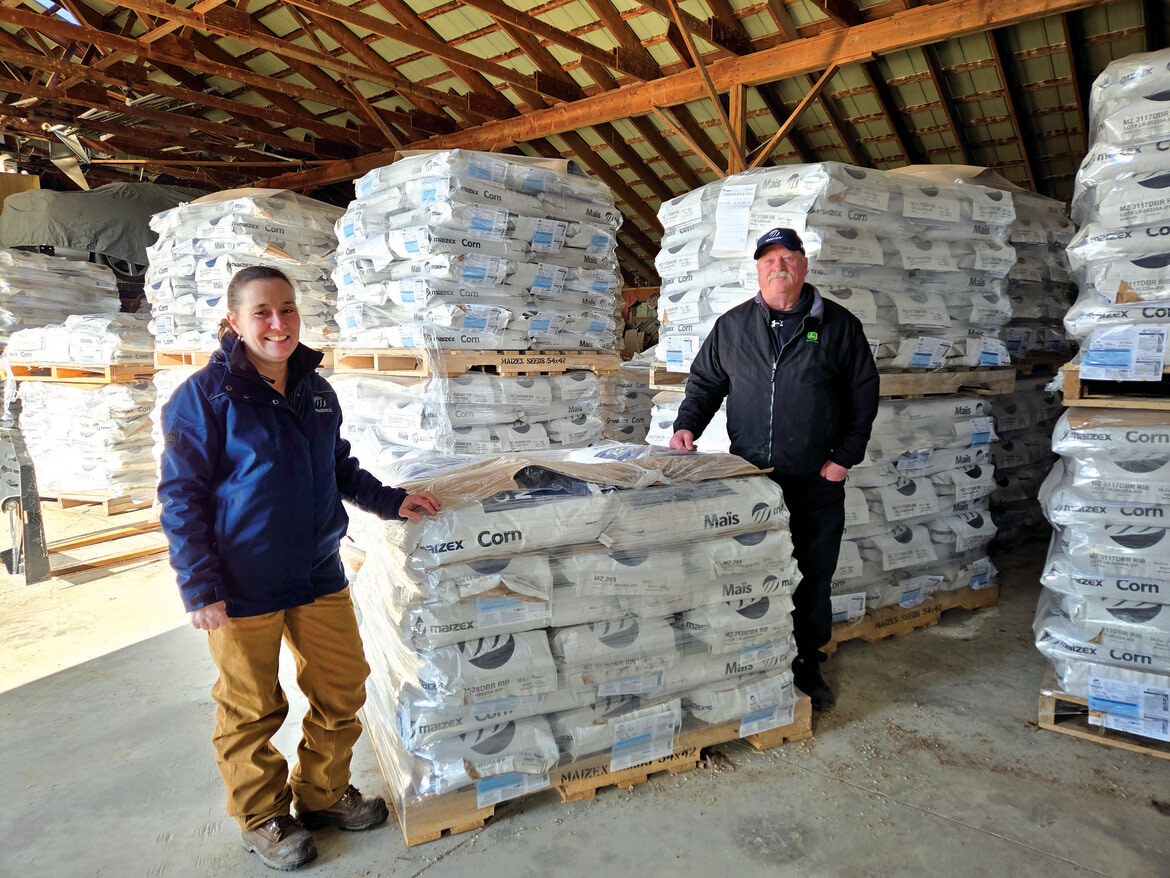
Planting a vision: Shannon Bieman leads at the heart of Canada’s seed industry
By Ralph Pearce and Mel Luymes
At any farm show, it is apparent that Shannon Bieman – currently working with Maizex Seeds – is in high demand among farmers, as they wait around to chat with her about a challenge they may be facing. And she’s equally accessible when she’s home on the farm, spending time on the phone with growers between trips to the barn or the field, on the road to board meetings or volunteering with 4-H.
Over her stellar career, Bieman has worked her way into the heart of Canada’s seed industry.
Bieman grew up on a small cash crop farm in Prince Edward County and was part of the last class of Ridgetown College of Agricultural Technology before it became a campus for the University of Guelph in 1997. She completed an Associate Diploma in Agriculture from the new U of G campus and served as student council president that year, working closely with Dr. Gary Ablett, a dedicated teacher and mentor, as Ridgetown underwent some major changes. For her two years there, she was awarded the Best All-Round Student Award, an award sponsored by W.G. Thompson & Sons.
After getting her feet wet at Thorndale Farm Supplies just after graduation, she was recruited by Thompsons in 1998. Starting in Blenheim, she moved to the Mitchell location and then eventually to Port Albert, working as an agronomist and sales representative. During this time, she married her college sweetheart, Blair; they moved to Belgrave and had two children, Emily and Austin. Blair works for Masterfeeds in Wingham.
In 2007, she made the switch to Snobelen Farms near Lucknow, where she managed the company’s seed division for ten years.
“I had such a good team at Snobelens,” says Bieman, acknowledging everyone involved in the program, from the truckers and processors to the marketing team.
In 2010, she and Blair bought his great uncle’s farm outside of Belgrave and moved there. In 2013, they built a new house on the property and in 2016, a new barn.At Maitland Lane Farms, they have a cow-calf operation with some sheep, a corn-soy-wheat-hay rotation, and they also started growing soybean and cereal seed.
Growing seed is a whole new level of management and there is little room for error, Bieman says. She and Blair are select growers, they have been trained and have the experience to grow pedigreed seed, including select, foundation and registered seed. They need to remove off-type plants (roguing) and keep the crop extremely clean to maintain uniformity and high quality.
Bieman is clearly hooked in the seed industry. She spent eight years working for SeCan as a marketing rep serving customers across the province. She started working for Maizex Seeds in the past months, a move that allows her to stay closer to home, focus more on the farm and on her leadership.
Leadership in the seed industry
Bieman got involved in the Ontario Seed Growers’ Association (OSGA) board of directors in 2013, working her way up to President in 2020. The OSGA represents its members with research, networking, education and advocacy. According to its website, Ontario’s pedigreed seed industry has a farmgate value of $462 million and employs 15,000 people.
One of the most important issues the board recently worked on was getting crop insurance for pedigreed seed soybeans and pedigreed seed wheat. “That was a feather in our cap,” Bieman says.
As OSGA is a branch of the Canadian Seed Growers’ Association (CSGA), Bieman became involved at the national level where she is currently serving as Vice-President. Bieman says it is an interesting time to be involved because they are currently working on a large project, led by the Canadian Food Inspection Agency (CFIA) on regulatory modernization for the seed industry. They are working with other industry stakeholders – including Seeds Canada, the Canadian Federation of Agriculture and the National Farmers Union, among others – to update seed certification and standards to be more modern, efficient, and reliable.
It is a complicated project, Shannon explains, ultimately designed to reduce complexity and to increase responsiveness and consistency. It tackles topics like variety registration, imports and exports, grading standards, etc, and it involves working groups of industry stakeholders, producers, breeders and commodity groups, each looking at various parts of the regulations.
“We’re not only making them current, but we want them to be practical for the future,” she says, hoping that the regulations can become more adaptable and flexible to address new innovation and future advancements in technology.
The CSGA is building on the tools to improve traceability for seed, putting all the paperwork in a single digital window, to align with the coming changes to the regulations. They have also changed their membership structure to allow for associate and affiliate membership, including crop advisors, processors and other parts of the seed industry. The CSGA works collaboratively with the CFIA and hopes they can take more of a leadership role on seed regulations in the future.
Bieman encourages others to become involved in industry leadership. Male or female, young or old, from different political stripes or religious denominations, she maintains there’s a place for everyone around a board table.
Doug Miller, former Executive Director and CEO of the CSGA, hopes that Bieman will take that next step to CSGA President later this year. Miller isn’t surprised to hear of her accomplishments or her regard for a group she’s addressing. He’s known her for more than 10 years and remarks that her passion – for learning, sharing and agriculture, in general – stands out.
“She’s a small person by stature, but once she gets up and speaks, you stop and pay attention,” says Miller in an interview with the Rural Voice. “It’s because she leads with such authenticity and truth. Whenever she gets up to the microphone, you know you’re going to hear something that’s going to provide a lot of value to the room,” he adds. Miller says that Bieman leads from the middle, and that her experience from the retail and processing side, along with being a grower, means she has fewer blind spots.
Early leadership
Bieman’s leadership started early. “I wrote an essay on quota cuts under the new trade agreements back when I was in Grade 10,” she recalls. The teacher had her present her essay to the class and it turned into an hour-long discussion.
“The class was extremely engaged in it, but what concerned me was one of my friends asked if brown cows made chocolate milk,” she says. Despite the school’s rural location, Bieman decided to fill the information void, speaking to teachers and developing a Grade 9 geography component. She spent some time in her final years of high school teaching Grade 9 classes, which counted as her co-op placement.
Her confidence in high school led to her running for student council president at Ridgetown and she hasn’t looked back when it comes to leading. And she is also training the next generation of farm leaders,
lending her expertise and time to local 4-H projects, including the Vet Club, Crops Club and the North Huron Sheep Club. No doubt, her own kids will become leaders in their own right. Emily (22) is just finishing an Animal Biology program at the University of Guelph, and Austin (20) is working with Huron Tractor in Walkerton and completing John Deere’s mechanical program at Fanshawe College.
To this day, Bieman loves doing presentations that are grounded for people to understand, she says. Ultimately, her goal is to make her audience – farmer or non-farmer – understand the content and tone of what she’s doing and her passion for sharing. To understand, she adds, is to create a feeling of inclusion, regardless of the subject matter or the audience.
“We assume people read literature or listen to what we’re putting out there,” she adds. “You have to have the ability to listen, and you have to have honesty and trust, and admit you never have the right answers all the time.”
Shannon Bieman is one of those who seem to defy time’s usual limits, sneaking an extra two or three hours into the clock. What makes her more admirable is her genuine desire to share her knowledge and experience with others. She is a teacher – in the truest sense of the word – who’s realized that giving of her time and experience is part of what she wants to do. And the industry is better for it. ◊