

OSCIA Summer Tour showcases ag innovation
by Cory Bilyea
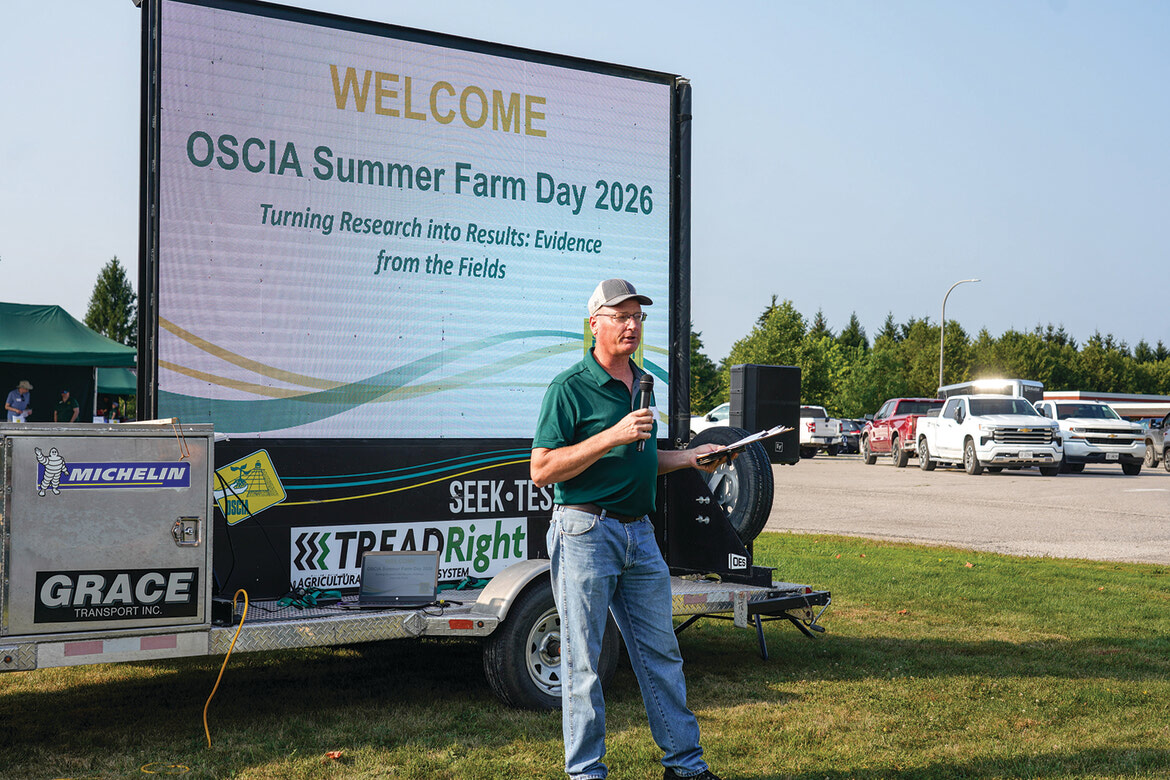
The Ontario Soil and Crop Improvement Association (OSCIA) held its 2026 Summer Farm Day and Tour event in Huron County, highlighting local innovative research and demonstrating evidence-based results.
The first day at the Huronview Demonstration Farm in Clinton set the tone, focusing on practical field trials, soil health, and fertility strategies that farmers could see underfoot rather than hear about in a meeting room.
To explain how this year’s theme came about, John Poel, First Vice-President of OSCIA, pointed back to a previous winter gathering.
“It all stems back from last February’s Residue Smart meeting and what was going on there,” Poel told the crowd. “We had BW Fusion speaking, and Keith Reid said, ‘extraordinary claims require extraordinary proof.’ We all laughed — but I thought we’ve got to chase this down a bit more.”
On Friday, August 14, that challenge — turning bold agronomic claims into field-scale evidence — was on full display in Clinton.
Later that morning, Rick Kootstra of Kootstra Farms Ltd., farm manager of the Huronview Demonstration Farm, operated by Huron County Soil and Crop Improvement Association (HCSCIA), invited farmers to look closely at the no-till, strip-till, and cover-cropped fields around them.
“What you see here is no-till,” he said. “If there’s naysayers to cover crops and no-till, bring them over. I’m not a scientist, but this is right on — that’s what you want to do.”
Kootstra reminded visitors how until recently this ground looked very different. Until 2019 it was not tiled, fully worked, and prone to erosion; now it’s run under a disciplined system of no-till, strip-till, and cover crops. Kootstra said he’s on the farm “every second day” and doesn’t always notice the change, but anyone who saw it five or six years ago wouldn’t recognize it in the even stand and calmer soil profile on display during the tour.
From the conservation side, Ausable Bayfield Conservation Authority (ABCA)’s Mari Veliz explained why Huronview became a demonstration site. Under intensive tillage, runoff used to cut visible channels through the field, prompting concern from ABCA, Huron County, OMAFA staff, public health, and farm groups.
Early projects focused on the edges — wetlands, a treed floodplain, and other erosion controls — but local farmers pushed to go further and test practices on the field itself. That led to a three-way partnership between Huron County, ABCA, and HCSCIA to install innovative tile drainage systems and monitor what happens to water and nutrients as management changes.
Kootstra also linked the day’s discussions to a much longer history on this piece of ground. The farm sits at the edge of Clinton on land once owned by Henry Ransford, who held roughly 5,000 acres in the area and operated what’s believed to be the first salt works in Huron County from a brine well at the back of the property. When Ransford eventually sold, the County took over the land and, in the late 1800s, it became a House of Refuge where residents grew their own food; a small cemetery on the farm still marks that chapter. After the refuge closed, the land was rented out and farmed intensively for decades before being re-imagined in recent years as a demonstration site.
From that starting point, the shift to today’s carefully managed plots is striking. Together, Kootstra and Veliz now describe Huronview as a long-term “living laboratory” for soil and water, where innovative tile drainage, no-till, strip-till, and cover crops are tested under real farm conditions—and questions about erosion, runoff, and fertility are answered with local data and field-scale evidence rather than theory alone.
The tour of the Huronview farm put those ideas into context on the ground. Participants walked through a network of innovative tile drainage systems, including control gates, a contour system, and sub-irrigation designed to hold and re-use water during certain times of the year. Monitoring setups collect real-time data on water flow and water quality. At the same time, a subsurface irrigation system is managed alongside cover crops following grain corn and soybeans, showing how drainage, water management, and soil health strategies can be integrated in one field.
For many, this is where the ‘evidence from the fields’ theme became tangible: side-by-side comparisons showed how different layouts and management choices influence moisture, nutrient movement, and crop resilience under changing conditions.
To make the most of the morning, organizers split the crowd in two. While one group headed into the field with Kootstra and Veliz to see the tile drainage layouts and water-monitoring systems up close, the other stayed near the tents for sessions on on-farm innovation, including robotics and farmer-led research. Partway through, the groups switched, ensuring everyone saw both the infrastructure beneath Huronview's soils and the broader research and technology pieces that support the ‘evidence from the fields’ theme.
Fertility was the next piece of the puzzle. As a platinum sponsor, LaSalle Agri used the Huronview stage to introduce an incinerated biosolid fertilizer aimed at easing both cost and environmental pressure. Dave Buurma, president and owner of LaSalle Agri, described the product as an odourless, heat-treated biosolid with a high phosphate content — no odour and “great opportunities for us as farmers,” he told the crowd.
Buurma’s message was mainly economic. With MAP running as high as $1,400 a tonne, he said the new product can deliver phosphorus at roughly half the cost per pound, once delivered to the farm. Each tonne contains about 330 pounds of phosphate, plus zinc, sulphur, potash, magnesium, and calcium, and is priced in the low-$200-per-tonne range.
He also stressed that the Canadian Food Inspection Agency regulates this fertilizer-based biosolid, with additional scrutiny of heavy metals and PFAS (“forever chemicals”) compounds. In his view, it closes a loop: phosphorus that leaves farms in food and waste streams is recovered, stabilized, and brought back to the field, fitting neatly with Huronview's broader focus on making better use of soil, water, and nutrients.
During the first session after lunch, the audience heard from Shawn Brenneman and Jake Gregory of CanGrow Crop Solutions. The duo shared what five years of working with biologicals in Ontario fields have taught them. Their core message: soil biology is an asset to manage, not a mystery to ignore.
They described how carefully selected microbial “teams” can cycle nutrients, support stronger plant stands and health, and speed residue breakdown, especially below ground. But they urged farmers to demand clear answers before buying any biological: What is it? What does it do? How does it change my fertility plan?
A key concept was Water Extractable Organic Carbon (WEOC), highly available carbon that feeds microbes and is strongly linked to nutrient release and soil structure. Practices like cover crops, manures/composts, and sensible nitrogen rates help build WEOC and let the soil supply more of its own fertility.
Their final takeaway: treat biologicals as living tools. Protect them from harsh conditions and pair them with good agronomy and modern soil biology testing when possible.
Dr. Kokulan Vivekananthan, Water Quality Specialist with OSCIA, presented findings from OSCIA’s On-Farm Applied Research and Monitoring (ONFARM) and Lake Erie Enhanced Analysis of Agricultural Practices (LEEAAP) research programs, which evaluate how best management practices (BMPs), especially cover crops and no-till, affect soil health and water quality in Ontario’s agricultural systems.
Much of the focus is on agricultural runoff via surface flow and tile drainage, with the research suggesting that tile drains account for roughly 75 percent of runoff and that most nutrient losses occur in the non-growing season (October–April).
While tile drainage dominates total water volume and soluble reactive phosphorus (SRP) losses, even relatively small amounts of surface runoff can carry disproportionately high total phosphorus due to sediment-bound (particulate) phosphorus.
Studies at sites such as Exeter and Huronview Farm show that well-managed cover crops (e.g., winter wheat, oats), especially when left unharvested through to spring, can greatly reduce surface runoff, sediment, and nutrient losses, and that combining cover crops with no-till can lower particulate phosphorus in subsurface drainage.
“When we left that crop until April, rather than harvesting it in December, the unharvested yield gave more than a 50 percent reduction in surface runoff volumes… total suspended sediments, total phosphorus losses, nitrate losses, everything was down,” Vivekananthan said.
However, the results also show that broadcasting phosphorus fertilizer, particularly under no-till and in structured soils prone to preferential flow, can increase dissolved phosphorus losses and offset some water quality gains.
Long-term trials further confirm that while no-till reduces suspended sediments, frequent broadcast phosphorus applications keep SRP and total phosphorus losses high.
Overall, Vivekananthan emphasized that to achieve meaningful water quality benefits, farmers must pair strong cover crop establishment and no-till with careful nutrient management (right source, rate, time, and placement, known as 4Rs), avoiding surface broadcasting and instead using application methods that better integrate fertilizer into the soil profile.
Ontario's Living Lab is reshaping on-farm climate research by putting producers in the driver's seat. Samantha Earl-Goulet, Agricultural Climate Modelling Specialist with OSCIA, told the audience that the project works with about 46 farms across the province under the federal Agricultural Climate Solutions (ACS) program.
Earl-Goulet said, “If the data we collect isn’t useful for real farm decisions, we change the research. That’s the whole point of the Living Lab approach.”
Farmers and researchers co-design trials on real farms, testing practices like reduced nitrogen rates, nitrification inhibitors, and grazing cover crops. Early results show stacked nitrogen strategies can cut greenhouse gas intensity by nearly 20 percent. Still, yield and profit impacts vary widely by farm, soil type, and local conditions, proving there's no one-size-fits-all solution.
Instead of chasing averages, the Living Lab focuses on what works in each unique system, with a dedicated team ensuring those findings reach producers through events, meetings, and direct outreach.
The final session included a presentation from Dr. John Sulik, Associate Professor at the University of Guelph, who explained how drones, satellite imagery, and on-farm research are helping producers make smarter, data-driven decisions and improve crop performance.
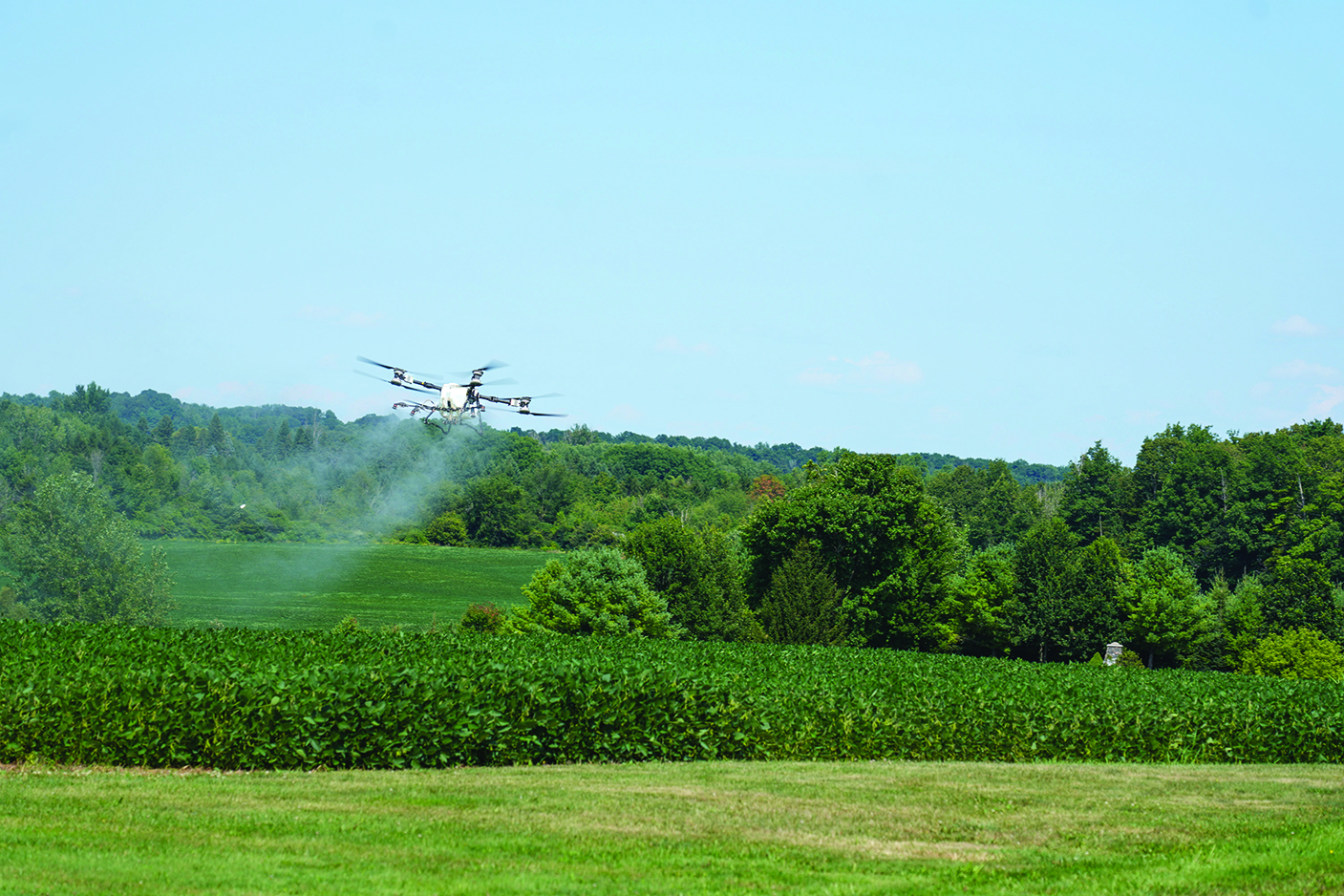
The first day ended with a demonstration by Drone Spray Canada, which brought two models: the DJI Agras T100 and DJI Agras T70P. Flying the DJI Agras T100 over the soybean fields of Huronview Demonstration Farm was a highlight for the audience.
The Summer Tour continued the next day with a bus tour to visit several science, research, and processing facilities.
The day at Huronview brought OSCIA’s Summer Tour message full circle: better farm decisions come from asking questions, testing ideas and measuring what happens in the field. The demonstration showed that there is no single solution for every farm.
Instead, the value lies in building evidence under real Ontario conditions and giving farmers the information they need to decide what works for their own operations. ◊