

N rates on corn - how low can you go?
By Mel Luymes
Nitrogen (N) is a busy element. It is all around us, an inert gas that makes up 78 percent of the Earth's atmosphere and joins with other elements to make molecules that work through the nitrogen cycle - moving through air, water, soil and all living things.
As readers will know, corn requires a substantial application of nitrogen. An common rule many growers use is a pound of N for a bushel of corn. So, for a 200 bushel/acre yield goal, they’d apply 200 lbs/ac of nitrogen.
It’s a bit more complicated than that, however. Nitrogen can be applied at a much lower rate, but it will depend on the farm. Matthew Wagenaar, farming some heavy clays near Wyoming, ON, did a N rate trial on a corn crop last year. With a lot of heat last season, he was almost ashamed to admit that he got good rains in that part of the province. Optimal conditions led to a 243 bu/ac corn crop, and with only 150 lbs/N in his trial strip, compared to his regular 195 lbs of N, which got him 228 bu/ac. As it turns out, timing is everything, and a pre-side dress nitrate test (PSNT) pays!
Nitrogen is costly, both to the farmer and to the environment.
Let’s start with the economics. Dr. Josh Nasielski, Assistant Professor in Plant Agriculture at the University of Guelph, headlined Crops Day of Grey Bruce Farmers Week back in January with a talk on nitrogen rates and corn populations.
He began by highlighting how the costs of nitrogen and price of corn change decision-making for application rates. The long-term (pre-pandemic) average cost of urea (N) was $450/tonne (t) and corn was $6/ bushel (bu) – a nitrogen-to-corn-price ratio (P.R.) of 6.2 – but the current cost is $700/t of urea and corn prices are $5/bu (P.R. of 7.5). Based on University of Guelph research trials, the most economic rate of nitrogen (or MERN) at the Elora Research Station has been 182 lb/ac historically, but with the current prices, it is 172 lb/ac.
Each farm has its own MERN, however, because organic matter, including manures and residues, is converted to plant-available nitrogen (called “mineralization”) at different rates based on the soil type, past management and microbiology in the soil.
So how does one determine their MERN? “The answer, and I don’t know if you guys will like it,” Nasielski warns, “is simple, validated on-farm trials.” Farmers can do a series of nitrogen rate trials, but the easiest perhaps is a technique developed at the University of Guelph, called “Delta Yield.”
Nasielski explains the trial; do a strip with a low rate of N (30-60lbs/ac) and another one with a high rate (250 lbs/ac) and then put the yield results into their handy spreadsheet, along with current prices (P.R.) and it will determine the ballpark for your MERN. (The spreadsheet is available by searching Ontario Optimum Corn N-Rate Estimator Tool online).
He also suggests a simpler trial that can give farmer’s some data.
“If you see a yield decline if you go 50 lbs less, then you know you’re probably in the ballpark already,” he explains, “but if you go 50 lbs less and you don’t see a big yield difference, that should give you more confidence the next year to reduce N rates.”
What about the weather?
But while field management and soil type are known ahead of time, the weather can make all the difference for nitrogen uptake in corn. Too dry and the nitrogen can’t move to the plant. Too wet and it can leach away from the roots. Too hot and windy and the nitrogen can be lost to the air.
Considering that corn uptakes about half of its nitrogen between V8 (8 leaves) and VT (corn tassel) – according to Pioneer Seeds, and they would know—it is important that the nitrogen is in the right place at the right time. That’s why many farmers don’t put apply all their nitrogen up-front. They prefer to apply twice or even three times.
Or, as Dr. Nasielski suggests, farmers can use inhibitors or stabilizer to slow the rate of denitrification and/or ammonia loss.
“Inhibitors work, in every case” he stresses, but again, he takes it back to the economics and suggests thinking about it like an insurance premium. If an inhibitor costs $80/tonne of N and it is protecting 130 lbs of N applied on a field, that means that it needs to save at least $15/lb to see a return.
Farmers will see the biggest returns when their application practices are the riskiest, which includes broadcasting, applying in warmer conditions (over 15°C), or on soils with a cation exchange capacity (CEC) of under 23 meq/ 100 g. He went on to explain that soil CEC will influence soil pH and while it is true that higher pH soils are more at risk of N loss, CEC is a better measure. pH buffering capacity is also an important measure, with the higher the better for reducing N loss, he explains.
Where does the lost N go?
While the economic factors are important to consider for a farmer, so are the environmental ones. Nitrogen doesn’t just disappear, it is either leaching into water resources, or it may be off-gassing (volatilization) and leaving in the form of nitrous oxide, a greenhouse gas that is 300 times more potent than carbon dioxide in the atmosphere.
Not only are N losses a waste of farmer’s money and a risk to the environment, but it is a waste of the energy required to synthesize nitrogen and transport it, all of which is calculated into a crop’s carbon footprint.
That is why, in 2020, the Government of Canada set a national target to reduce nitrogen-related greenhouse gas emissions from fertilizer by 30 percent by 2030. Note, this was a target to reduce nitrogen emissions, not nitrogen use.
While Fertilizer Canada concluded that this reduction was “not realistically achievable” and most agricultural businesses and organization were equally critical, there was a new farm group in town that rolled up its sleeves and got to work.
Farmers for Climate Solutions (FCS) is a national coalition that began in February 2020 and now includes nearly 30 member organizations from across Canada. Funded by private philanthropic grants, the coalition has been working to create progressive programming and policy for climate solutions. And they have already had success in their efforts. Their 2021 federal budget recommendations were titled A Down Payment for a Resilient and Low-GHG Farm Future: $300 million to reduce agricultural GHGs by 10 Megatonnes and lay the groundwork for widespread adoption of climate-friendly farming in APF 2023.
They got (nearly) what they asked for. The On-Farm Climate Action Fund (OFCAF), which many readers may recognize as a funding stream from Ontario Soil & Crop Improvement Association (OSCIA) was part of a $200 million commitment from the federal government to support farmers to improve their nitrogen management, plant cover crops and use rotational grazing.
In fact, another round of funding applications through OSCIA opened February 24 and will remain open until the funding is allocated. The funding for nitrogen management, in this case, covers 65-75 percent of costs (up to $30,000) of soil sampling, analysis and mapping that leads to a demonstrated N rate reduction or a first-time use of N stabilizers or synthetic fertilizer substitutes. Information is at programguides.ontariosoilcrop.org.
Alternative insurance
FCS didn’t stop there. They are interested in more than just cost-share programming and have begun digging deeper into alternative de-risking tools.
In 2025, FCS partnered with Smart Prosperity Institute and the Nature Investment Hub to implement on-farm pilots in Ontario. Considering that best management practices (BMPs) may cost money in the short-term but can save money and improve farm resilience in the long-term, they are currently looking at a few tools that can incentivize BMPs in a novel way, including:
- Profit guarantees that will pay farmers if a BMP results in a yield or profit loss
- BMP insurance that would protect profit or yield when a farmer adopts a BMP
- Premium incentives that either subsidize premiums or increase coverage for farmers using BMPs
- Sustainable finance solutions that reduce interest rates, lengthen amortization periods or repayment schedules for farmers using BMPs
And this is where Matthew Wagenaar comes back in. He first heard about the opportunity to pilot a profit guarantee program through the Farmers for Climate Solutions program from the National Farmers Union (NFU) e-newsletter.
2025 pilot project
A full-time millwright (and NFU member), 29-year-old Wagenaar still makes time to farm and do some custom work for neighbours, working with his parents John and Margot Wagenaar, his wife Kristen, and his grandparents. He is an avid learner, keeping up with the latest agronomy research online.
“We finish our own cattle as well, so we need the corn,” he explains. He was interested in reducing N rates on corn but not at the expense of hungry cattle. He was intrigued with the profit guarantee. “If we were to run shy on grain, at least we could always purchase it, he says.
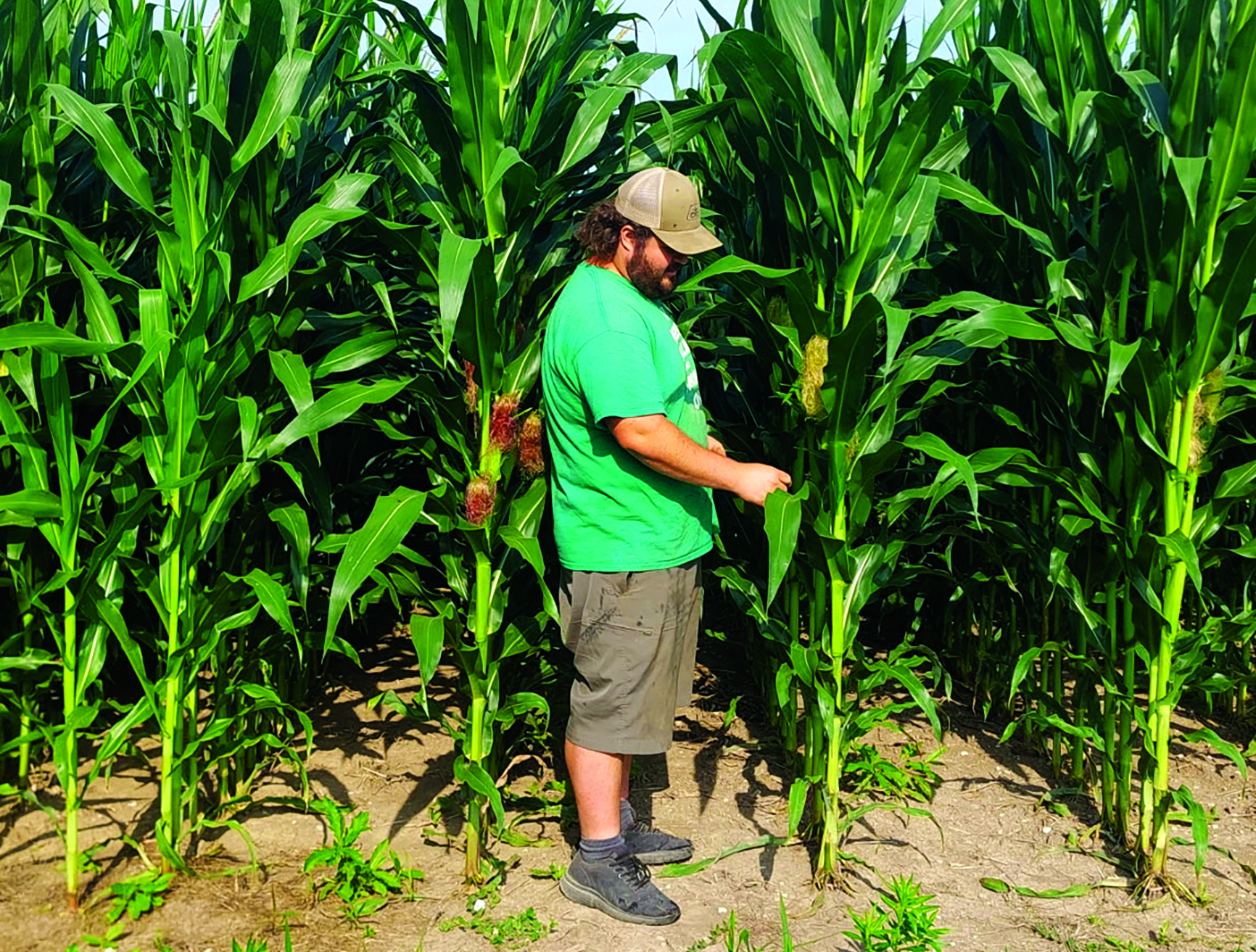
He ran a side-by-side trial of 11 acres each with his conventional rates and a prescribed program from the on-farm pilot. Typically, Wagenaar would apply 105 lbs of N up front of a corn crop and another 90 lbs as a side dress for a 200 bu/ac yield goal. For the trial strip, however, he was required to only put 30 lbs/ac up front and then to do a pre-side-dress nitrate test (PSNT) and follow the recommended rate at the V6 (6-leaf) stage.
The pilot project involved some expertise; in this case, Wagenaar hired local agronomist Ryan Benjamins to do the PSNT and a recommendation, which ended up being a 120 lb/ac side-dress application. The soil test also indicated the crop could use some boron, so they added that to the application.
“To be honest, I was a little worried. I was walking that field several times this summer,” laughs Wagenaar. He explains that the season started out a bit cold and that the corn wouldn’t have taken up much N at the early growth stages anyways.
But when it came time to harvest, the plots looked neck and neck in the yield monitor, but with weigh wagons, they compared the two 11 acres plots and the side with 45 lbs/ac less of N yielded 15 acres more bu/ac. Suffice it to say, Wagenaar did not get a pay-out from the pilot program. Not only did he save money, but that was 495 lbs of nitrogen that wasn’t manufactured, wasn’t shipped to the farm, and didn’t have the chance to leach or volatilize into the environment.
Farmers for Climate Solutions and their partners are pleased with the results of the first few on-farm pilots in 2025 and they are running them again in 2026 for 40-50 participants across Ontario.
Farmers can choose to enroll between 1–3 fields in the program, each with a 20–25-acre trial area, which will cover corn yield losses up to 10 percent or 20 bu/ac based on current corn and nitrogen prices. If weather prevents a second application of N, the coverage may be raised up to 20 percent. As Wagenaar attests, there was minimal paperwork and he appreciated the agronomic support included in the program.
If anyone is interested in participating this season, the deadline to apply is March 15 at farmersforclimatesolutions.ca/profit-warranty-to-optimize-nitrogen-rates.◊