

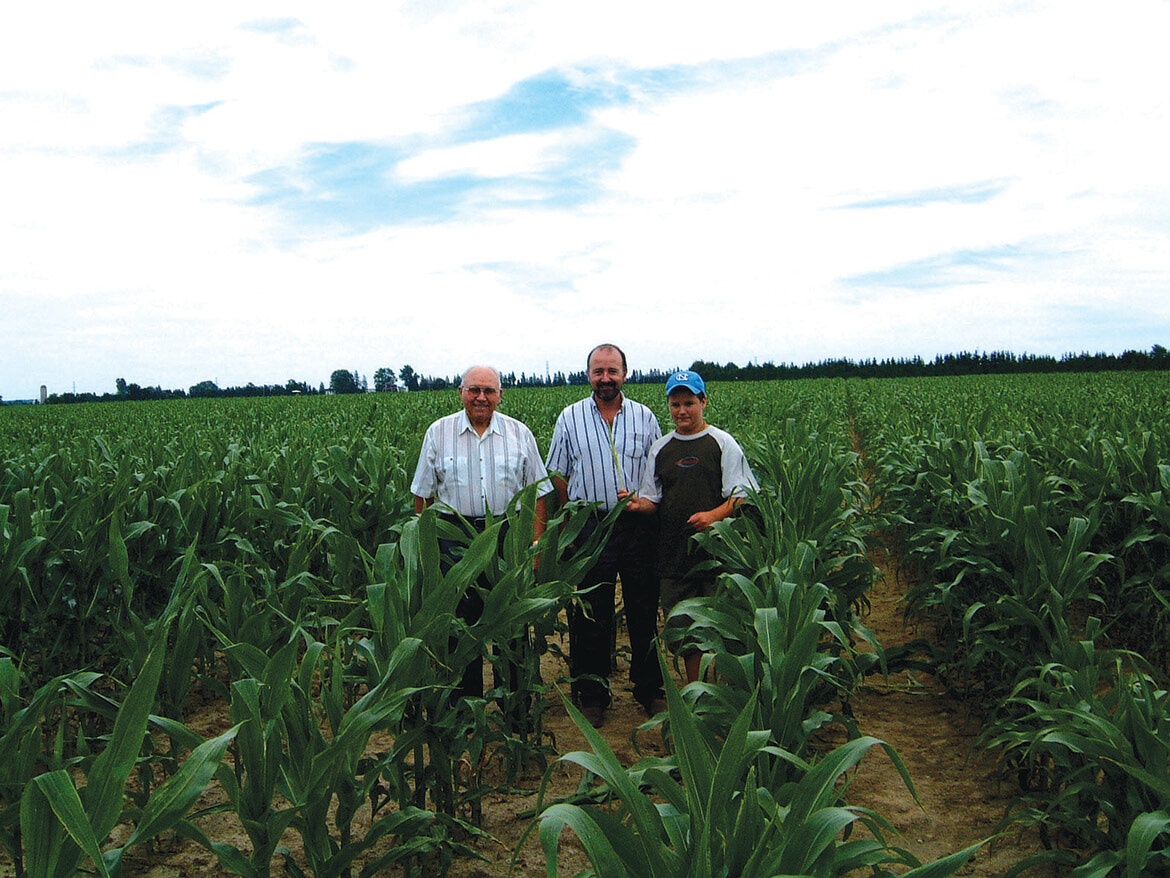
In the bag: Years of work behind De Dell corn seed
By Mel Luymes
When you rip open bags of corn seed this month, do you ever wonder about all the work and science that goes into it?
It’s a wonder really. While a corn hybrid will take several years to breed and bring to market, it is also part of a much longer history. And you can bet we’re going to dive into it. The Rural Voice caught up with Will Trudell, Vice President of De Dell Seeds, who was kind enough to walk us through their breeding program.
Every seed is the product of a decade of work, explains Will.
De Dell Seeds is an independent seed company that started in 1999, when Vince Trudell and Adrian de Dreu left a larger seed company to start up their own. Combining their strengths, and their last names, De Dell was born. Adrian had a strong breeding background and though he went on to another seed company, he and Vince Trudell stayed connected.
“Adrian said there would be no money starting a seed company from scratch,” laughs Vince, “and he was absolutely correct about that.” His wife supported the family as he put his head down and got to work.
Vince ran De Dell Seeds out of his basement in London, ON, doing all the corn breeding, along with the sales and deliveries. He remembers his deliveries were 27 bags at a time, because that is all he could fit inside his Volkswagen Jetta.
But for Vince, he felt the seed industry was heading in the wrong direction; he felt very strongly that seeds should not be genetically modified, that they were not going to make farmers more money.
While the business has since grown, it is still a grind, says Vince. He has been grateful to customers who have been loyal since day one.
“They like what we do, and what we don’t do,” he said, as they have focused on growing clean, fast-growing, high-yielding seed corn, with low levels of vomitoxin.
As for Will Trudell, Vince’s son, he was born into the business; he and his four siblings recall summer vacations spent in corn fields, detasseling and pollinating corn. Will left for school, studying history and later an automotive degree, before he came back to the business in 2011. Working alongside his dad, the business has grown leaps and bounds over the last 15 years. They now grow conventional (not genetically modified) corn seed and certified organic corn seed for farmers across North America.
As for corn seed, its history goes back much further. Modern corn came from wild grass – from what is now southern Mexico – and it was domesticated thousands of years ago, cultivated across the Americas long before European explorers arrived.
Corn is self-pollinating. The tassel at the top produces millions of pollen grains that fall to fertilize the ears, midway down the plant. Each silk strand in the ear is part of the female flower, connecting to a single kernel that will not grow unless it is fertilized by pollen.
And while corn can thus inbreed, it does better when wind cross pollinates it with other genetic lines of corn. This discovery – now referred to as hybrid vigour – led to a breakthrough in the early 1900s as scientists began strategically breeding corn. For reference, 100 years ago, corn yields in the U.S. were only about 25 bushels/ acre.
Hybridizing has evolved to the technique that De Dell uses today to produce seed corn for their customers.
It starts with developing an inbred line, explains Will. That means selecting for the traits they want and then growing a field of only that genetic line for eight generations, using the climates of South America (growing in Chile during the winter) to squeeze in two generations a year.
“You’re selecting for different characteristics – yield, standability, or root strength – through those generations,” explains Will. Over time, the yields get very low from inbreeding, and the plants are only a few feet tall.
But then, they take that inbred line, along with another, and strategically cross-pollinate them. Typically, they plant the field with four rows of what will be the female (used to grow the seed) and one row of the male (used for its tassel), repeating.
The next part is timed very carefully. The tassels of the designated female rows are lopped off before they start to develop pollen. While the industry is now largely mechanized to do this, many people will have memories of detasseling corn by hand. A hot, sticky, itchy job, as Will can attest to. He notes that people are still needed to detassel corn in the field because machines may have missed shorter or late-tasselling stalks.
After that, they let the wind cross pollinate the field and before harvesting the corn seed, they must knock out the male row so that its corn doesn’t contaminate the batch.
The result is a hybrid seed corn that they trial with growers across the province, ensuring they got what they were looking for. Then it goes to market. Seeds are dried, treated and bagged for customers for the next season. And while they grow seed for areas with less heat units, most seed is grown south of the 401, says Will.
De Dell’s organic corn seed is untreated, of course, but it also means that the seed corn was grown without the use of commercial fertilizers or crop protection products. And, of course, organic corn does not include genetic modification (GM).
In a sense, all corn has been modified genetically over the centuries, but in the 1990s, scientists learned they could insert traits into corn’s genetic code in a lab, saving decades of breeding. The most common traits in corn are resistance to herbicides (i.e., glyphosate tolerance) and/or insects (i.e., Bt corn, which includes genes from bacillus thuringiensis bacterium).
Like for identity preserved (IP) soybeans, there are markets for non-GM corn, says Will, whether it is for organic livestock feed, medical-grade sanitizers, or premium alcohol or other food products.
“There have always been spot markets that have popped up,” he says, “but there have been more consistent demands as of late.” In Eastern Ontario, Ingredion often pays a premium of $35/tonne and forward contracts, while others could pay a premium of $0.90 to $1.25 a bushel. He notes that more recently in Southwestern Ontario, The Andersons, Hensall Co-op and Snobelen Farms have all been purchasing non-GM corn.
Still, most corn seed sold in Ontario is GM and it is estimated that the big two corn seed companies make up 60 percent of the market share. Will notes that the U.S. is a different ballgame. There are many smaller seed companies competing south of the border. For Will, he doesn’t see much good in fighting against consolidation in the industry. They’d rather just put their head down and breed good corn, he says.
For De Dell, being a niche corn seed company means that they can listen to their customers. They often spend time with farmers and listen to the traits they want.
“We see organic growers want more of an open leaf architecture on the plant, so that the leaf extends open, rather than stays upright, which is the style of more modern hybrids,” says Will. He explains that it covers in the row more quickly and provides more ground cover for weed control. Organic growers also want hybrids with strong spring emergence, which is a bit more complicated to breed for.
All this investment in research and development is included in the cost of the seed, says Will. There are no additional GM Trait license fees, making the seed more cost effective than GM corn. They don’t have their customers sign an agreement that they won’t replant the seed. But, for corn, he explains, if farmers save and replant the seed, they will start inbreeding the line and see yield reductions quite quickly.
While the team at De Dell have gotten quite good at plant breeding over the last decades, they are thrilled to have their original corn breeder – and the “De” in De Dell – Adrian de Dreu come back to the team. When Syngenta was restructuring before selling to Chem China, Adrian was let go in the shuffle.
“It feels like it has come back full circle,” says Will. The company now has nearly 10 staff, and a strong network of dealers around North America. Vince Trudell remains active in the company, out on the road doing deliveries and still doing sales. He has been outspoken about some of the issues he sees in mainstream corn production, including the overuse of glyphosate herbicides.
Will takes a more moderate approach than his father, though he still sees the importance of their work breeding non-GM corn and staying close to their customers. He looks forward to continuing to serve the industry.
Yield data and product information is available at dedellseeds.com.◊