

From Pitchforks to GPS: A century of Maplevue Farms headlined at the Rural Urban dinner
By Mel Luymes
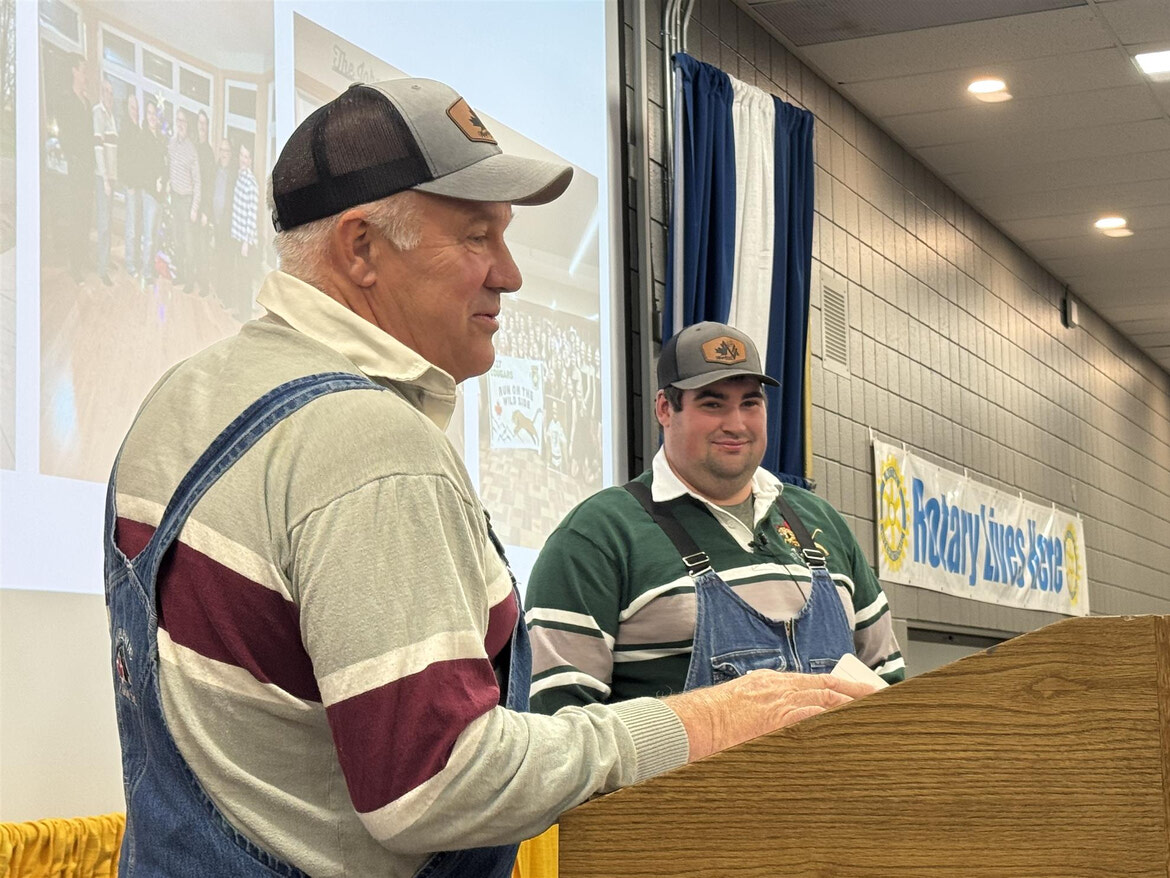
On April 16, the Rotary Club of St. Marys held their 100th Annual Rural Urban Night, drawing 270 people to the Pyramid Recreation Centre. Doug and Devin Johnston of Maplevue Farms headlined the evening with their family’s story, Pitchforks to GPS: A Century of Rural-Urban Change.
The Johnston Farm, just outside of Listowel, is more than 100 years old. It was first bought by James Johnston in 1893, and five years later, it went to Sam and Lizzie Johnston, to Maurice and Isabel Johnston in 1926, and then to Sam and Marcie Johnston – Doug’s parents – in 1958. They brought the farm through the 1980s farm crisis by the skin of their teeth.
“The bank told my dad to sell some land,” Doug explained. “Over my dead body, he had said.” Instead, after two years of paying no principal, they sold the cows in 1988 and walked into the bank with $100,000 cash to pay down some debt. Doug remembers milking their four remaining cows that evening, and they slowly built the herd and quota back up.
“Since that day, the bank changed their tune with us,” says Doug, saying that they still have the same bank account. They built a new addition on the barn the following year, in 1989.
Doug and his brother Dave became partners in the farm with their parents that year as well, and in 1997, Maplevue Farms Inc was born.
But in 1998 – six weeks after Doug was married – Sam Johnston had died of a heart attack while doing chores one night. When Dave found him, there was a broom in his one hand and a cigarette still lit in the other. The next year, Marcie passed away as well – of a broken heart, Doug adds.
“We didn’t have 1-800-Gramma and Grandpa to babysit the kids,” he explains. “We raised seven kids in that barn.” Doug married Laura, who now runs Hodgins Home Hardware in Lucknow, and they had three kids – Brooklyn, Lexi and Devin. Dave married Christine, who works at the Palmerston Hospital, and they had four children – Sam, Seth, Kaleb and Hannah.
“And we all got a ride in the stable cleaner by accident at least once,” jokes Devin. They were put to work in the barn as soon as they could, and they all learned an exceptional work ethic, he adds.
Together, the Johnstons built the farm and herd over the years, with Dave and Christine on the home farm, and Doug and Laura just down the road. Doug managed the field work, feeding and manure, while Dave did the milking in a tie-stall barn.
“I took care of the front and the back of the cows, and Dave did the middle,” jokes Doug, who says that he and his brother have worked very well together over the last decades. He says the secret is to not let the other one know what you’re thinking about them in the moments of anger, but to just walk away. Usually within an hour or so, things are back on track.
In 2018, they sold the original bank barn: the water bowls, the equipment, everything. Someone bought the barn for $1000 and removed it from the property. Just days later, they were pouring concrete for a new free-stall barn with a robotic milking system, where they milk 70 cows.
As their children got older and wanted to keep farming, Dave and Doug have grown the farm for succession. They now have 2,000 acres of farmland, and bought another dairy farm near Lebanon where Dave’s sons milk cows.
As for 21-year-old Devin, he hopes to farm, too. He is heading into his final year at the University of Guelph; he will be an OAC ’27 graduate. For the last two summers, he has worked for Premier in Listowel, but this summer, he is working for Cargill in Saskatchewan. Together, Doug and Devin drove to Saskatchewan at the end of April, and Doug flew home.
“It is the first time he won’t be with me every day working together,” says Doug. “He was out plowing snow with me when he was five days old,” he adds, and they have had plenty of cab time together since then.
At the Rural Urban Night, Devin was comfortable on stage with his dad as they went back and forth, explaining how technology has changed on the farm.
“My dad used to think 80 pounds of milk a day was excellent production for a cow,” says Doug, and goes on to explain that their Holstein herd now averages 88 pounds a day per cow. And while the robot might have something to do with it, Doug also explains his breeding program. He has used AI for 43 years, he explained to the crowd. He raised his left hand and said that the bull at Maplevue Farms has never hurt anyone. Not everyone got the joke, he said.
He explains that, if they don’t need a replacement calf for their herd, they breed cows with beef calves for the beef market. Especially with beef prices so high and so few beef cow-calf operators, he is concerned that there will be a serious lack of dairy replacement heifers across the U.S. and Canada in the coming years. Forty percent of beef cows fattened here are born from a dairy cow, he explains.
He also uses sex-sorted semen in their breeding program. This means that the semen has been sorted to select for the X-chromosome. While it is 20 percent less effective at making a heifer pregnant, Doug explains that, if she is pregnant, there is a 90 percent chance that it will be a female calf they can use in their herd. It is estimated that over half of the Holstein industry is now using sexed semen.
But now the industry is leaning towards protein instead of butter fat, Doug explains. People want yogurt and cottage cheese, so the industry is changing both feed and genetics to meet the demand.
“Dad’s version of AI is very different from my AI,” says Devin, who uses Artificial Intelligence more than Artificial Insemination.
Not only have the genetics and production changed but so has the technology in the barn. They now use a Lely robot to milk the cows, a Juno feed pusher, two manure collectors (Doug named Poop and Poop-E), and an automatic calf feeder (named Bertha). Collars on the cows can show their activity and production levels, so we can see if a cow is getting sick right away, explains Devin.
The Johnston’s were early adopters of no-till. It goes back to 1984, when Doug was still in university and told his dad he wanted to try no-till wheat. His dad let him do 30 acres of wheat without tillage and he did 30 acres his way beside that. When Doug’s plot came back with 72 bushels/ acre and his dad’s plot went 70 bu/ac, they never looked back. Of course, that would be a crop failure by today’s standards, Doug explains, because 100 bu/ac is now a standard wheat yield.
But the first fall after his father passed away, Doug spent a month in the tractor, plowing up corn stalks. His new wife Laura asked him if he couldn’t think of anything better to do with his time than plow a field.
“Well, we have three kids, so you figure it out,” laughs Doug. He sold the plow and they went to minimum tillage on all the rest of the crops from then on. They now use a Väderstad hi-speed disc. The kids have never used a plow.
“When we bought the Lebanon farm, I had two kids with me when we crossed the field in a pickup truck, and they nearly hit their heads on the roof when we drove through the dead furrow,” laughs Doug. “They didn’t even know what that was.”
Other types of field work have changed as well. Instead of following marker lines made by the planter, now there is GPS; one only needs to press a button in the tractor for it to auto steer and follow straight AB lines.
Doug also remembers the days when they spent all summer doing hay, making 20,000 small bales. But now, they make haylage, stored in pit silos and can harvest 20 acres an hour. They have all hands on-deck running the forage harvester, trucks and packing down haylage in the pit. And by the end of the day, they work together to cover the pit and end with pizza and beverages.
“Never before the pit is covered,” Doug laughs.
Doug also started summer seeding alfalfa and in 2008, he won the Forage Master competition with a summer-seeded field. He started doing it in the back field, to be sure, but now it is the standard way he gets hay into the rotation. He plants after wheat, taking off the straw and giving it a quick pass with the disc before planting the alfalfa. “It has to be planted before August 15,” he says. He puts grass – rather, fescue – into the alfalfa in the spring with some fertilizer and the field is ready to cut at the same time as the second- and third-year hay.
“It also means one less thing to do in the spring,” says Doug, who says he doesn’t believe in spreading liquid manure in the spring either. With 400 days of liquid manure storage on each farm, the manure is applied after wheat before a cover crop, or in the fall after harvest.
The Johnstons are big proponents of soil health; they plant windbreaks on as many farms as they can to stop topsoil from blowing away and they even have their own special cover crop mix named after them at Speare Seeds. The “Maplevue Mix” is oats, peas, radish, sorghum, turnip, clover, sunflower. They also grow 100 acres of oats and peas in case they need emergency forage, or they will sell it to a neighbour.
“When you’re growing a cover crop, you’re growing it for the roots, and not the top,” he says. They often trade straw for manure, getting hog manure, bull manure and biosolids as well. They soil sample regularly and have grown organic matter levels about one to two percent over the last 20 years. This means more worms, better water holding capacity and infiltration, better residue decomposition and nutrient cycling, and less nitrogen requirements.
Record-keeping has also changed. Doug shows a photo of the little black book he used to keep his notes in, but Devin discusses John Deere Operations Centre and how every detail is recorded and can be tracked to see where they are making and losing money. Doug shares that the level of investment is another thing that has changed dramatically in the last 100 years. While $2,000/ac would buy you a farm a few decades ago, now land is worth well over $35,000 in his area. The cost of inputs, machinery and labour have also gone up and every detail matters in farm decision-making.
Devin also likes Operations Centre because he can see all the field work being done in real time from his phone in Saskatchewan. He is excited about farming the future with autonomous technology, drones, etc.
“We were taught to work hard, play hard,” Doug and Devin conclude their presentation, as they outline their commitment to fun, and to their community as well. Dave has also had a long career on North Perth Council and still serves his community as the Elma Ward Councillor. It takes a family to support someone on council, says Doug, and the whole family is dedicated to community service, supporting 4-H, Junior Farmers, the University of Guelph and many community initiatives. Doug’s daughter, Lexi, was the Listowel Fair Ambassador and went on to win the 2025 CNE Ambassador of the Fair competition and was also named the 2026 Rural Youth Leader by the Rural Ontario Municipal Association. Doug laughs that around town he is just known as Lexi’s dad.
For June 1 - World Milk Day – Listowel’s radio station (The Ranch 100.1 FM) did their broadcast with Doug from the top of the old silo. Just for kicks. They have also done a calf give-away for a few years. This year on June 1, you can also catch Doug and Dave Johnston hosting for part of the day on the radio.
Doug says he is surprised to be quoting stories that he now remembers from his dad, as he becomes more like him. He is so proud to be working with his family and continuing to build the farm legacy into the sixth generation.
The Rotary Club of St. Marys presented the duo with a donation for their time, but they told the crowd they would be using the funds to support Farm 911 (The Emily Project), putting up 911 numbers on their farms and neighbours’ farms. Currently, only properties with buildings are numbered at the road, but for farmers who have an accident in a field without buildings, these places are difficult for first responders to locate. More details are at www.farm911.ca.
This was the 100th anniversary of the Rotary Club of St Marys’ Rural Urban night. Ron Aitken, who chaired the event this year, says it was a great success and the Johnstons’ presentation was well-received. Ron especially appreciated the way Doug and Devin played off each other, compared then to now, and how Maplevue Farms has evolved to sustaining soil. The connection to the Johnstons had been made through Len Hawkins, who had organized the event for several years, and was a friend of the family.
The Rural Urban dinner has brought together the local rural and urban communities for a night of connection for 100 years now. Ron notes that they like having humorous speakers who give participants an opportunity to laugh together while learning about their neighbours.
Dozens of people came up to Doug after the presentation, and he was truly honoured to give the talk. He says he’d happily give the talk again! ◊