

From green bins to the field: Walker Industries turns waste into a resource
by Mel Luymes
Driving near Arthur, you might get the occasional whiff of the Walker compost facility, previously known as All Treat Farms, but there isn’t much that can be seen from the road. So, if you get an invitation to tour the facility (like I did), it is well worth your time. It’s an impressive facility, harnessing the power of nature to turn wastes into soils.
I followed a truck from the City of Toronto as it pulled into the laneway and stopped on the weigh scale.
As we rounded the corner, there it was – the whole process from beginning to end. There were piles of manure, leaf and yard waste, a sealed building that received the organics, long concrete alleys under tarps, and of course, piles of the finished product: beautiful, rich compost.
While many people think of compost as a gardening product, Walker sees agriculture as one of its fastest-growing markets because of growing interest in soil health and organic matter.
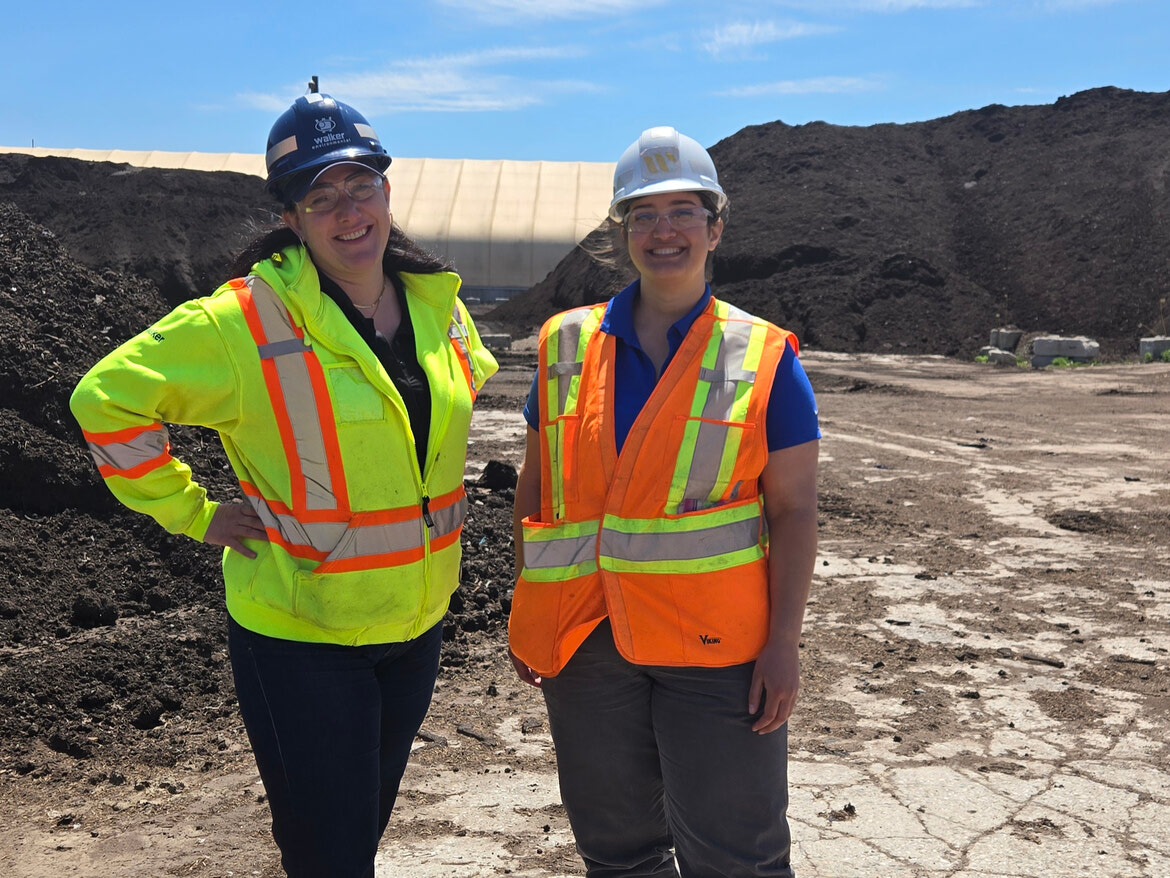
Walker Industries’ Erin Agro (Director of Product) and Hannah Kalra (Quality Assurance Manager) were my tour guides of the Arthur facility for the afternoon. What a hoot. Three 6-foot-tall gals, University of Guelph graduates in high vis and hard hats, gushing about waste resources.
It now takes green bin material from several cities in Southern Ontario – including most of the Greater Toronto Area (GTA) – and processes 95,000 metric tonnes a year of food waste and an additional 80,000 tonnes of leaf and yard waste that would have otherwise gone to landfill.
In an anaerobic environment – like if buried in a landfill – organics break down very slowly and release greenhouse gases – methane and carbon dioxide – as well as leaching liquid nutrients through the pile, requiring a long-term waste management strategy.
Composting, on the other hand, is a (much quicker) aerobic decomposition process that stabilizes organic matter which produces a nutrient-rich soil amendment. When applied to the soil, it increases its organic matter levels, supporting plant growth and, in turn, sequestering more carbon from the atmosphere.
There is quite a science to composting, and especially at scale.
After a truck weighs in at the Walker facility in Arthur, it unloads into a sealed building, which is under negative pressure, scrubbing the air to reduce odours.
The first steps involve inspection of the load, sorting and eventually a shredding process to break up the compost bags and larger material, as well as a screening process to remove larger non-compostable items that are thrown in the green bin.
Staff shake their heads as they recall what some people have put in their green bins: a motorcycle helmet, used car batteries, tires and the like. But the worst, they say, are glass bottles – often empty jars or beer bottles. They can hear them shatter and know it will be difficult to remove small glass shards from the final compost product. The non-compostable products are removed from loads through magnets, vacuums or mechanically and are moved to a separate (and veritable) pile of “overs.”
The cleaned piles of compostable materials are moved by a loader into an aerated static windrow, called a GORE® cell. An ideal ratio of carbon-to-nitrogen (browns-to-greens) for the process is 50-50, which means that staff must blend the municipal organics with leaf and yard waste (browns) with the food waste and manure (greens) to create the ideal conditions for aerobic decomposition. There is some seasonality to incoming yard waste, like pumpkins after Halloween, leaves in the fall, trees after Christmas and branches in the spring.
There are two types of GORE® cells – long, concrete alleys that are roughly eight metres wide, three metres high and 50 metres long. Each of the 64 cells can hold approximately 550 metric tonnes of material and is covered in GORE-TEX membrane to reduce odours. There are small holes in the floor of the cell through which air is forced to keep the pile aerobic, or water may be added to adjust the moisture of the pile. These holes also facilitate drainage of the liquid that leaches from the pile. This leachate is collected, treated in an engineered wastewater system and later re-used in the process or irrigated on the adjacent hayfields.
During active composting, the material will heat to 70° C to 80° C, even in the winter. These temperatures break down weed seeds and pathogens.
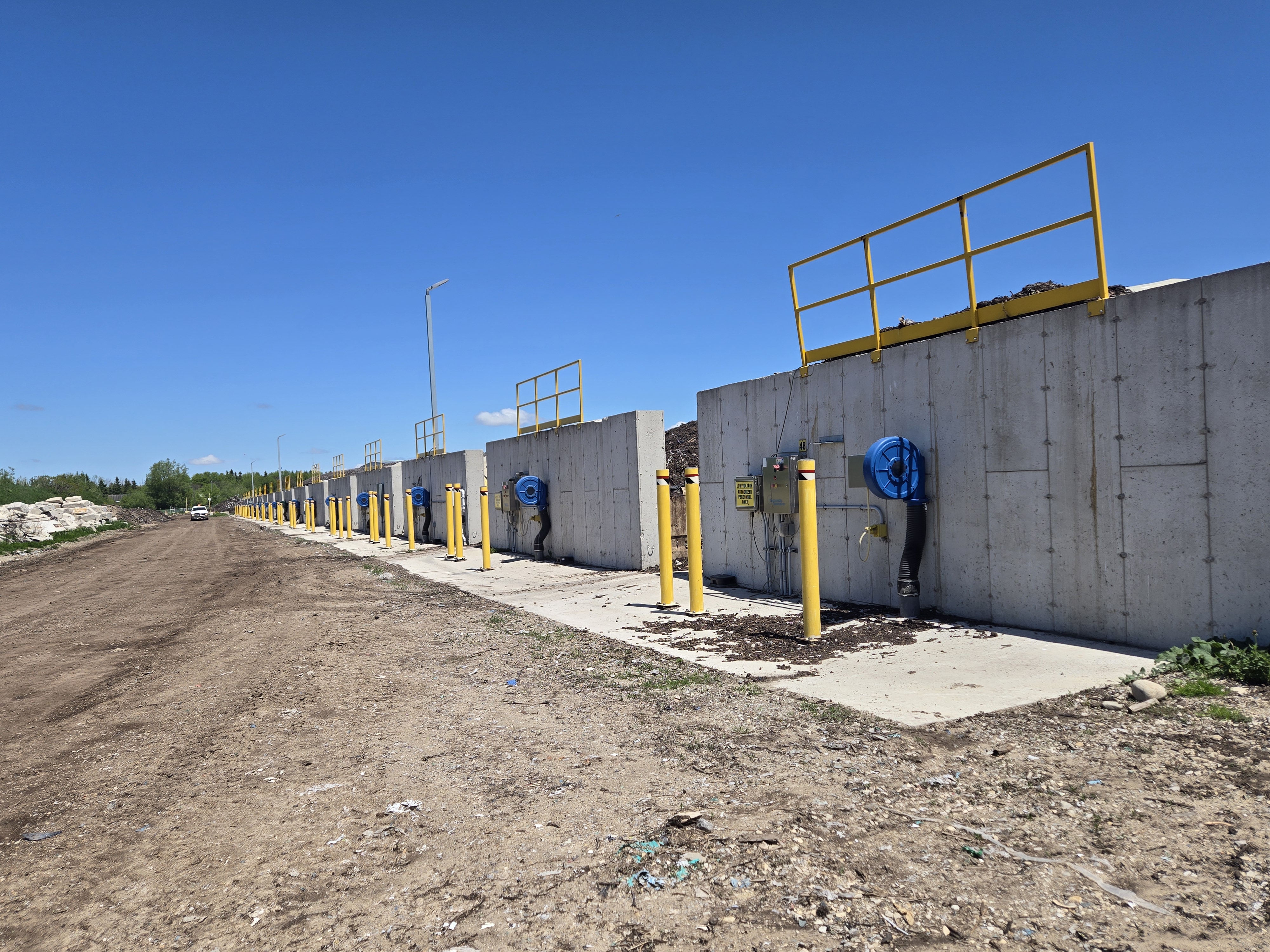
After four weeks in the first cell, the material is emptied by a loader and transferred to another cell for two weeks, and then one last time for an additional two weeks. Each transfer takes a few hours, using a nine cubic yard bucket. After the third stage, the material has completed the compost process and is placed in a large pile to cure. After this, it is screened to remove stones or over-sized debris.
Walker Environmental (a division of Walker Industries) bought the Arthur facility in 2016. It was previously known as All Treat Farms, which was started in Arthur in 1955 by farmers LaVerne and Freda White. They dehydrated manure using alfalfa feed processing equipment and bagged it, selling to customers as their “Garden Treat” brand, introducing several lines of “Treat” product, hence the name “All Treat.”
Walker Industries, on the other hand, has a much longer history, and was started by John Walker as a limestone quarry near Niagara Falls in the late 1800s. His sons grew the business, crushing stone in the early 1900s for road construction, including for North America’s first superhighway, the Queen Elizabeth Way (QEW). In the 1970s, a waste management company – Woodington Systems – was developed by a fourth generation of Walkers and by the 1980s, they were using mined out quarries as landfills. In 2006, they partnered with N-Viro® Systems Canada to handle Niagara Region’s municipal biosolid waste. After their purchase of All Treat Farms in 2016 and Gro-Bark in 2017, they became the largest organics recovery company in Canada. The business also includes a line of anaerobic biodigesters. In 2019, as many readers will know, Walker Industries also purchased Harold Sutherland Construction near Owen Sound and now has a presence across the Bruce Peninsula.
The facility recently expanded to include a state-of-the-art bagging line. The finished compost is blended to make various products for the market and sold under the original All Treat Farms™ brands available at Home Hardware stores and independent garden stores. They also have a GrowBetter Gardens™ line, found exclusively at Canadian Tire. These products are all tested to ensure no contamination of e.coli, coliform or other harmful bacteria, as well as a nutrient analysis.
Their compost product is a sustainable alternative to peat for potting mixes and other horticultural uses. Peat (or peat moss) is beloved by gardeners for its light weight and incredible water-holding capacity. It is a product of slow, anaerobic decomposition in wetlands over thousands of years. It is estimated that one metre of peat takes 1000 years to form and that it stores 500 tonnes of carbon per hectare. When it is harvested, however, it is drained and the carbon oxidizes, releasing greenhouse gases.
Walker’s compost products have many of the same properties of peat, but without the carbon footprint.
As for the agricultural market, Walker’s compost is sold by the tonne and currently brokered by several parties, including the Schaus Group. It is a relatively new market for them, but it is growing quickly.
Erin hopes to undertake local field trials to demonstrate to farmers the value of their material. Other trials have been conducted on Ontario farms, including Ontario Soil & Crop Improvement Association’s ONFARM trial, which have concluded that compost improves soil health and crop yields, especially in dry years. Research also shows it is especially beneficial on sandy ground, where it builds organic matter and soil microbiology.
Farmers like the product, says Dylan Vinckx, owner-operator of Barnhem Farm Service, near Mildmay. Dylan farms with his father, Herman, and they’ve been ramping up custom farming over the last six years, as they got out of pigs. They do some combining and baling, but most of their work has been solid manure (and now compost) hauling and application.
The Barnhem crew now truck solid beef manure from Schaus barns to the Arthur facility and bring loads of finished compost back to farmers across Bruce and Huron County. They also do land application, typically applying 5-6 tonnes of compost per acre after wheat harvest.
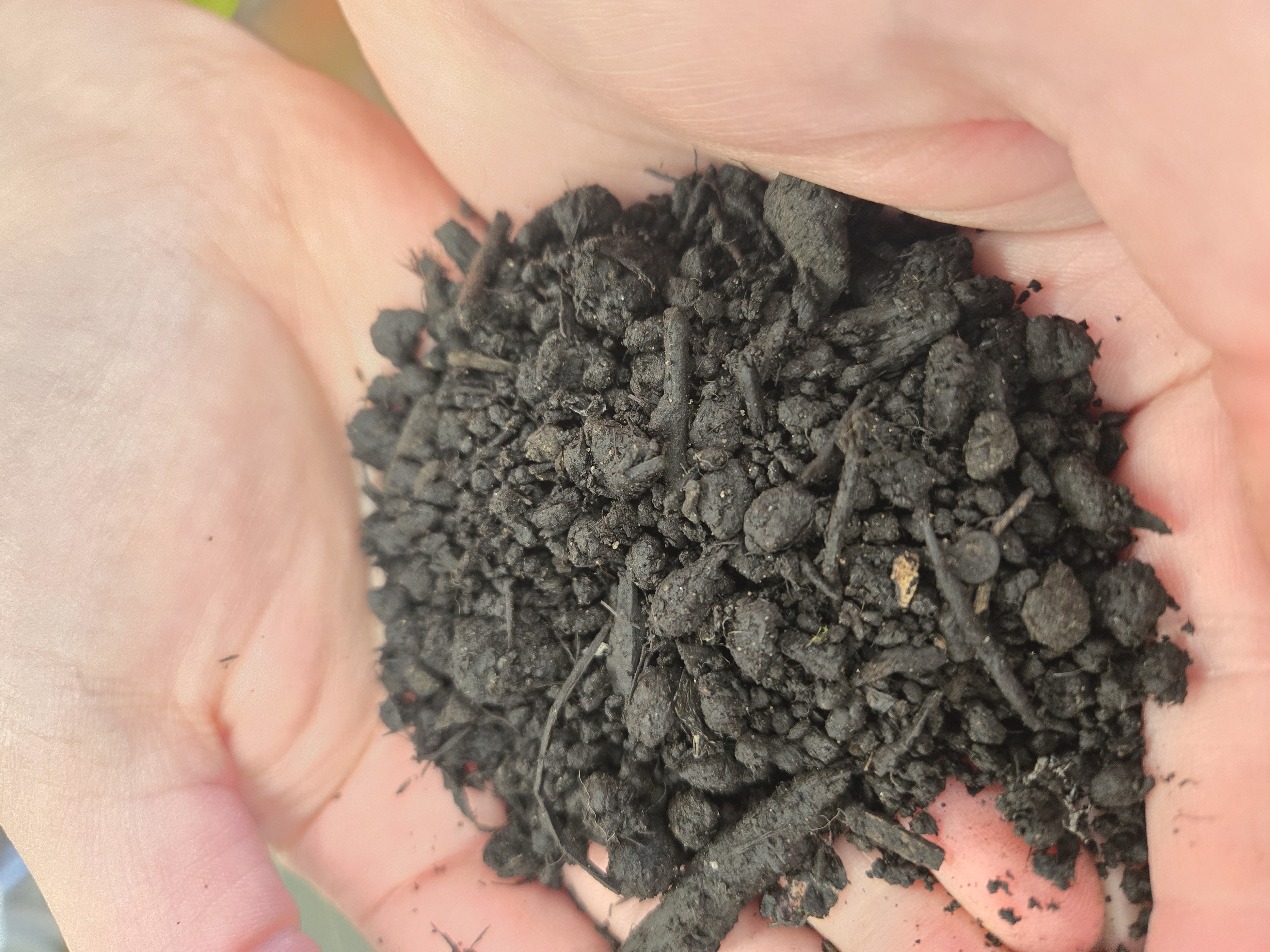
It is more expensive than manure, especially considering the trucking, Dylan admits. Compost costs around $34-38/tonne including trucking, depending on the distance. But farmers don’t need to apply as much product as manure to see the benefits of the organic matter, microbiology and nutrients.
For the Vinckx family, they use the compost themselves on their hay ground and have been pleased with the product.
“It is one of the best examples of the circular economy in action,” says Erin. “We're taking materials that many people would consider waste and transforming them into products that support agriculture, horticulture, and healthy landscapes.” She enjoys working at the intersection of science, innovation, and sustainability.
Watching loaders move mountains of leftovers, it becomes easy to see compost differently. Rather than waste, Walker treats organics as a resource—returning carbon, nutrients and organic matter back to Ontario soils instead of burying them in landfills. For farmers looking to build healthier soils, that circular approach may become an increasingly important tool.
For readers interested in learning more about Walker compost products, go to walkerind.com or reach out to Kerri Cavell at [email protected].◊