
For the love of soil
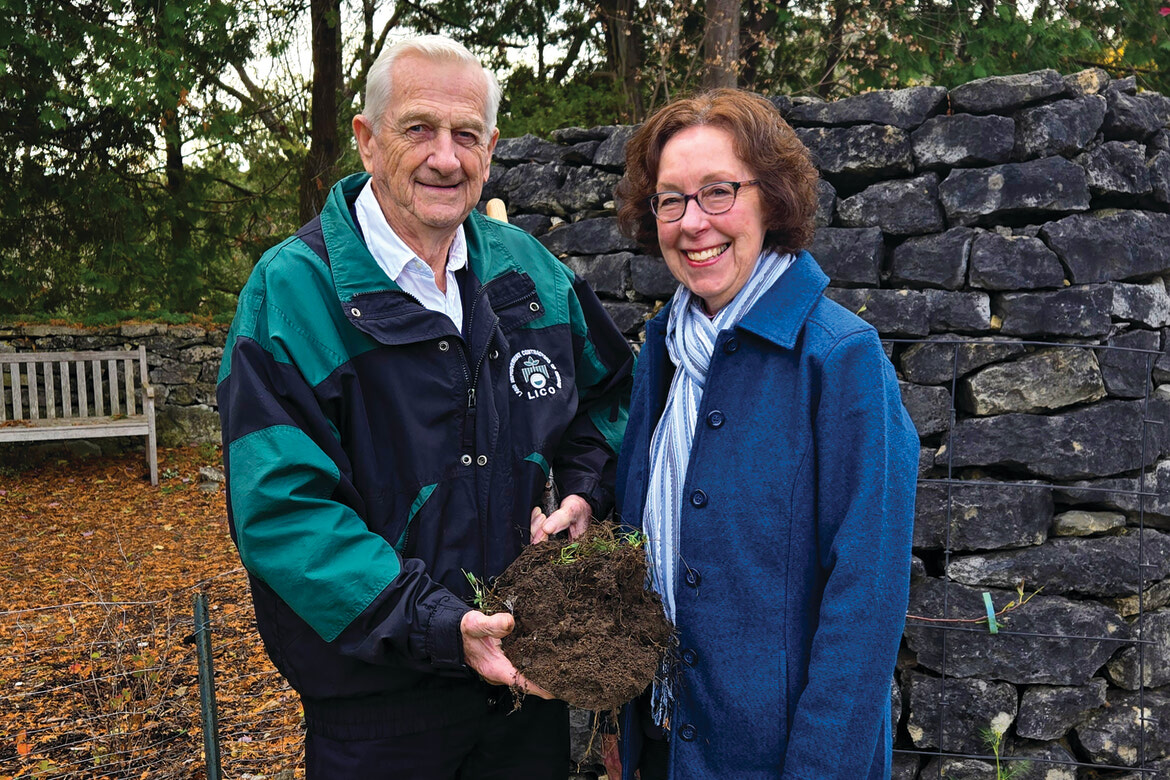
Don Lobb and Lillie Ann Morris, lifelong soil advocates
By Mel Luymes
When Don Lobb fired up his tractor to start planting in the spring of 1980, he wasn’t quite sure what was about to happen. He had spent the winter in his shop near Clinton, setting up his White planter to add wavy coulters that he had ordered from Radford’s, the White dealer in Londesboro.
Ever curious, Don had paid attention to practices used on farms across the U.S., and he had seen no-till in action. At the time, the advice was to plant into a rye cover crop and then apply Roundup to the field the next day. So that’s what Don did on a few acres. But he also did a side-by-side trial with a section of just bean stubble and a section of a long-term hay field.
John Heard, now a soil specialist at Manitoba Agriculture, years later told Don that he’d been sent there to advise that no-till planting wouldn’t work in Ontario.
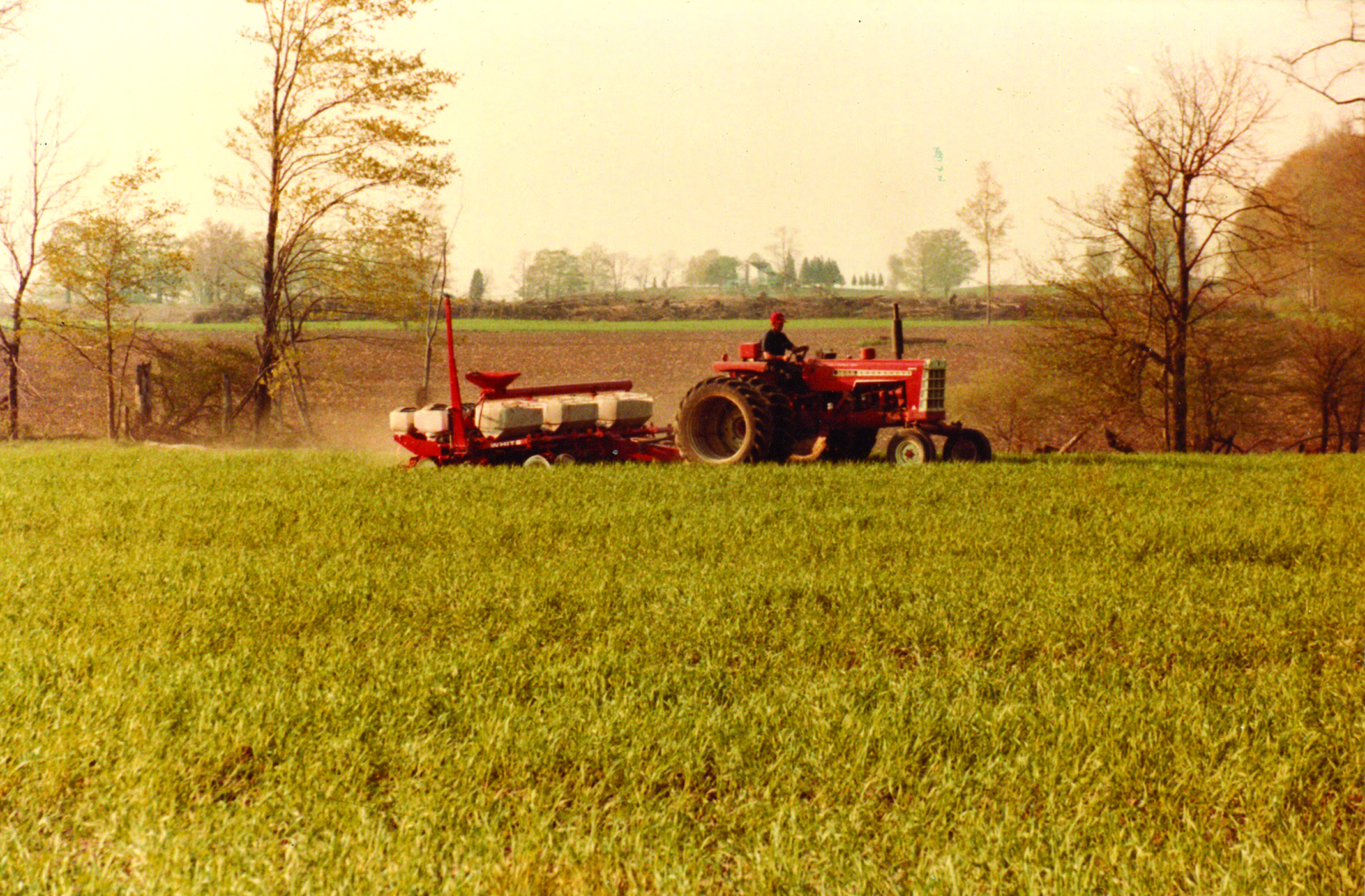
Don Lobb planting in the early 1980s (submitted)
Don began by testing every aspect of no-till on a small scale because years earlier he had a costly experience with innovation. On that occasion, he had followed advice and built the first hog barn in Canada with slats and a liquid manure system. But the recommended ventilation system wasn’t good enough and he had major issues with disease and air quality.
“I was too far ahead of the learning curve,” Don admits, and goes on to say that his banker was sympathetic and was his biggest asset at that time.
“Once burned, twice shy,” adds Lillie Ann Morris, Don’s wife of many years. Lillie Ann grew up on a farm in Kentucky where terracing and other soil conservation practices were just second nature. Through a connection at The Women’s Advertising Club of Toronto, she found herself working in advertising sales at Country Guide. She would connect with Don a few years down the road when she worked for the Innovative Farmers Association of Ontario (IFAO) as Executive Director and together they would go on to be a force for soil health in the province. But we’ll get to that later.
“It’s not that I was determined to make no-till work,” Don explains, “but I wanted to see if it would.”
“And that no-till hay field provided my best corn yield that year, regardless of tillage practice,” says Don. That’s when he realized that this wasn’t just about eliminating tillage, it was about building healthy soil structure through a systems approach. Systems are complex, but Don became devoted to understanding the relationship between soil moisture and drainage, tillage type, compaction, weeds and diseases, varieties, fertility, residue, etc. And when he took a big-picture look at history around the world, he saw that when crop production and populations increased while soil quality decreased, it led to civilization collapse. The stakes suddenly got very high.
For Don, building soil structure and water-stable aggregates in the soil is key; the answer is minimizing disturbance and keeping living roots in the soil as much as possible. As well, the carbon and nutrient gap must be closed by returning human, food and animal waste to the soil, he says.
“We have the technology and tools to do it now,” Don adds, and he is frustrated with the amount of tillage he still sees around Ontario. “Farmers and agronomists want to make the biggest yields they can this year. But no-till is always about bigger yields next year.” He points out that the world record corn yield of 623 bushels per acre was set in 2023 on land that was converted to no-till in 1987.
He understands the issues that farmers face and believes that soil health is the responsibility of all of society. Especially considering that an average of 45 percent of farmland is rented, he is keen to have programming that implicates landlords for the treatment of their soil, with incentives built right into property taxes. He has brought proposals to farm organizations and governments alike, however, they are reluctant to budge from the status quo. He asks, “Why would farmers and landowners not welcome profit incentive opportunities for good soil management?”
Still, everything comes around again, and in 50-year waves, says Don. He has studied the Kondratiev wave theory and wonders if we will soon see a breakdown like the 1980s interest rate crisis, and the depression of the 1930s, and the 1880s following the Civil War.
Back to the future
The early 1980s were an extremely difficult time for many farmers, but they say necessity is the mother of invention. It became an exciting time for farmers as they adopted soil conservation practices.
In 1981, Don packed a large van with some local farmers and extension staff and took them to a conservation day in Michigan. The next year, there were eight others that were trying no-till planting – Tom Hayter, Bruce Shillinglaw (1943-2022) and Jack McGregor, to name a few. They hosted a Conservation Day and field tour of their own in Huron County in 1982. The tour included the terraced farm with rising inlet structures that brothers John and Hugo Maaskant had recently done with John Hickenbottom of Iowa.
Many people did research on Don’s farm, notably Jane Sadler Richards, and it contributed to some provincial programs, including the Soil and Water Environmental Enhancement Program (SWEEP) and an early version of the Environmental Farm Plan (EFP). The farm started generating some incredible data that revealed the extent of tillage erosion, the importance of crop rotation, planter set-up, variety, nitrogen application and cover crop management. At the end of each season, he would flip over the seed variety sign at the road and simply write the yield per acre. That got people’s interest, he says.
A community developed around no-till and soil conservation, including a small group of farmers and government extension staff that became the Huron Soil & Water Conservation District in the early 1980s. Tom Prout, General Manager of the Ausable-Bayfield Conservation Authority and Don Pullen, the Huron County Ag Representative were extremely important contributors at that time. Over the next few years, as more farmers around Ontario were adopting no-till, they created the Innovative Farmers Association of Ontario (IFAO). Don even went on to join American farmers, academics and extension workers in forming the Great Lakes No-till Discussion Group in 1987.
“Back then, the price of admission to these groups was that you had to give a presentation about what worked and, more importantly, what didn’t work,” says Don. “No passive observers allowed.”
Don connected with Senator Herb Sparrow (1930-2012) for the creation of the groundbreaking Soils at Risk report in 1984 and went on to be a founding member for Soil Conservation Canada, later re-branded as the Soil Conservation Council of Canada and in creating the Canadian Conservation Hall of Fame, to which Don was soon inducted (and in 2015 into the Ontario Agricultural Hall of Fame).
There was a growing movement of no-till in the 1980s, but it slowed down when crop prices went back up and many went back to tillage. A series of cutbacks then led to the near decimation of public agricultural extension. Across the province, OMAF offices closed and retail agronomists became the go-to support for grain farmers and with that, a trend to short-term soil management objectives.
Don didn’t let up though. Besides all the meetings, speaking engagements, consulting, and research, he was planting and harvesting 1100 acres at one point in the 1990s, yet his largest tractor was 70 HP. He stayed extremely busy and says this can take an extremely heavy toll on family life, yet Alison and the kids all contributed in their own ways. Dr. David Lobb, his second oldest, went on to study soil science and is now a professor and widely acclaimed soil researcher at the University of Manitoba.
The IFAO continued to grow and diversify to different farm innovations. It developed partnerships with industry and attracted key agricultural players, including Lillie Ann Morris, who had recently left an advertising sales role at County Guide to form AgRelations Inc. with Kerri-Sue Lang. With strong industry connections, Lillie Ann became the Executive Director of the organization from 1994 to 1996 and would go on to form L.A. Morris & Associates, specializing in advertising sales for farm publications for Top Crop Manager, DHI and Le Bulletin des agriculteurs, and back to Country Guide in 2011, with Glacier FarmMedia.
Lillie Ann is a force of nature, and, to her, failure is simply not an option. In a time when there were very few women in media or in agriculture, she was a leader and a connector. She went the extra mile for farm organizations, getting space in the glossy pages of Country Guide for the Soil Conservation Council of Canada (SCCC), Ontario Soil & Crop Improvement Association (OSCIA), Land Improvement Contractors of Ontario (LICO), the Ontario Soil Network and the IFAO (which unfortunately ceased operations in 2024).
“Lillie Ann put a lot of time and energy into this,” says Don. “She did this voluntarily to support these organizations, and without compensation.” He has a deep respect for her and for the work she has done (often behind the scenes) to promote soil conservation in the media. Lillie Ann at the end of June this year and Glacier FarmMedia organized a large gathering to celebrate her career and her contribution to the industry.
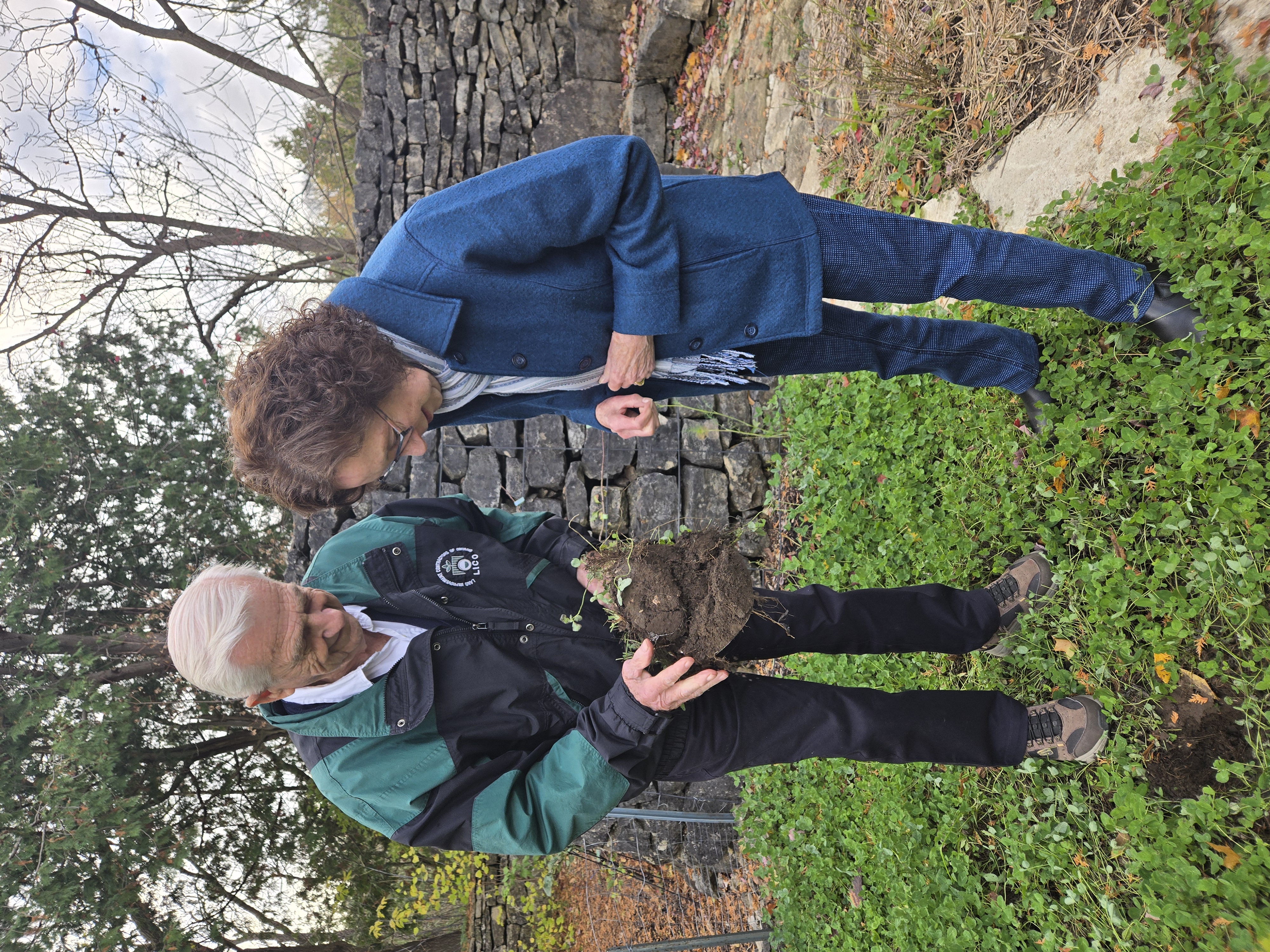 Don and Lillie Ann in their cover cropped garden in Rockwood
Soil health revival
Soil health gained momentum when the United Nations declared December 5 as World Soil Day in 2014, and declared 2015 the International Year of Soil. Don and Lillie Ann have been at the centre of a more recent revival of soil health. In 2014, after Don wrote a letter of concern to Gord Miller, then Environmental Commissioner of Ontario, and Dr. Deb Stark, then Deputy Minister of OMAFRA, soil health seemed to become a priority for the province. OMAFRA began a provincial soil strategy soon after that and published New Horizons: Ontario's Agricultural Soil Health and Conservation Strategy in 2017, followed by the formation of the Soils Action Group.
Concerned by the soil degradation she was witnessing in Ontario fields, Lillie Ann took action. In 2018, she made a donation to the University of Guelph’s Ontario Agricultural College to help launch a soil care outreach effort. Her gift, matched by Glacier FarmMedia along with support from Bob and Moira Kerr, helped establish Soils at Guelph. With all the incredible long-term trials and soil research being done at the University, this was an effort to bring back some of the extension capacity and get research into the hands of farmers, decision makers and the public. Soils at Guelph is co-directed by Dr. Laura Van Eerd, Dr. Kari Dunfield and Dr. Claudia Wagner-Riddle with Heather White as the Knowledge Mobilization and Communications Coordinator.
Heather is passionate about soil health and connecting it with more than just farmers. Like Don and Lillie Ann, she believes that soil health is everyone’s responsibility and is making a concerted effort to increase soil health literacy in those who regularly work and interact with farmers - like municipal staff, agricultural lenders, and farm insurance companies.
“We’re not trying to make them agronomists,” says Heather. “But we want to give them enough soil knowledge to confidently be able to ask their farming clients, ‘How’s your soil?’ and understand the answer.” She says that even some in the agricultural industry don’t know the value of soil or that soils vary across a farm and will respond differently to management practices.
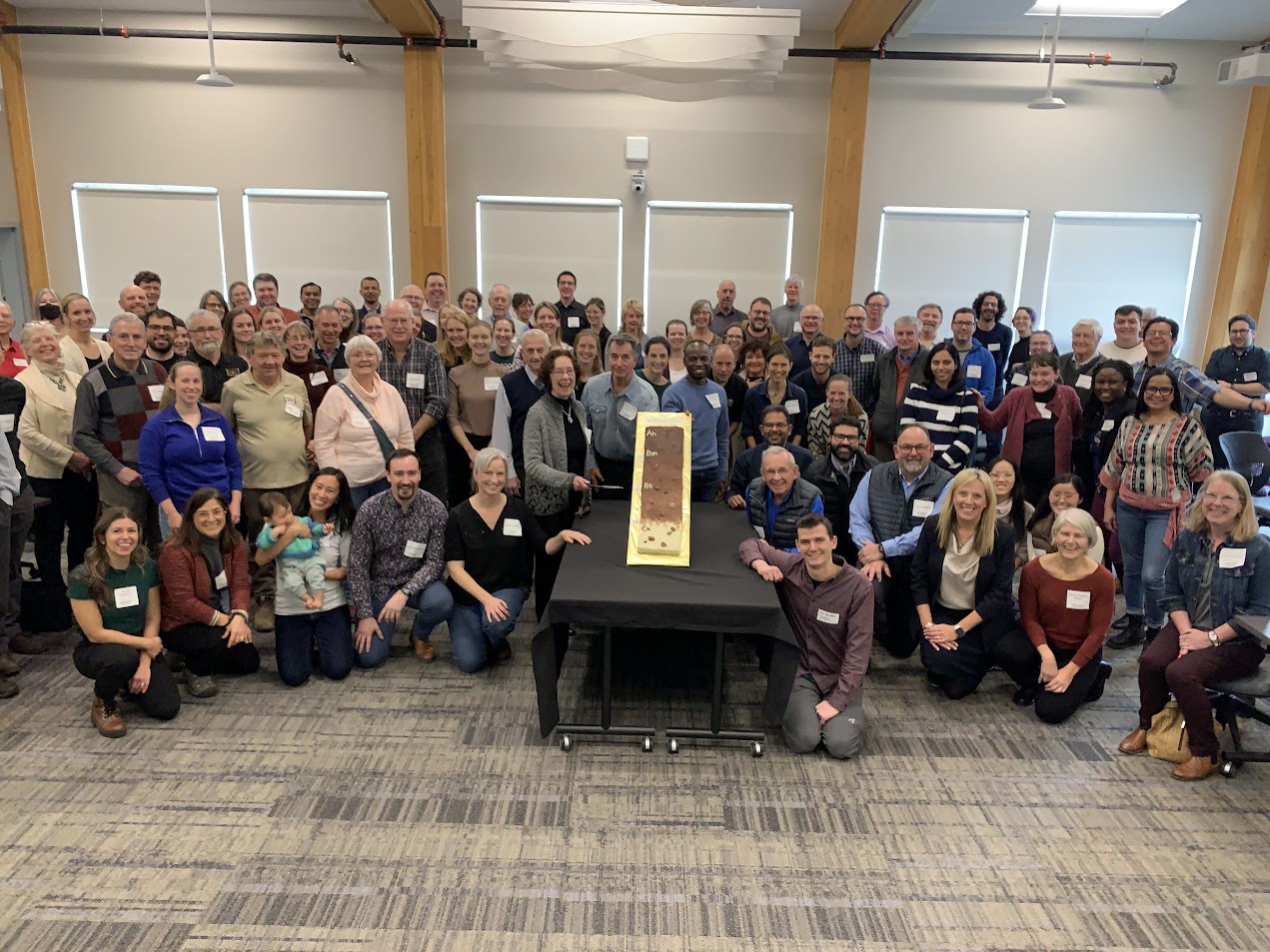 Five year anniversary of Soils at Guelph
Soils at Guelph is actively looking for invitations to share soil resources with municipal staff, agricultural lenders and farm insurance companies. “We can join staff teams for a lunch-and-learn, speak at delegations or meetings, or just share our print materials,” Heather offers.
In 2023, Ontario launched a three-year $9.5 million investment that has (so far) resulted in the Ontario Soils GeoHub online (ontario-soils-geohub-ontarioca11.hub.arcgis.com) which allows farmers to access soil information, with the Canada Land Inventory (CLI) rating, slopes, etc., and includes a (pilot) digital soil map near Ottawa. According to Ross Kelly, manager of the Soil, GIS and Technologies Unit at OMAFA, they are currently working on renewing all the province’s soil maps and will be making them available at the GeoHub site as they become available.
Also at the site, is a dashboard of the Ontario Topsoil Project (OTSP) which sampled and analyzed soil and management practices from 500 farms across southern Ontario and determined there were widespread issues of soil compaction, low organic matter, and tillage erosion. They saw the best soil health on the 27 percent of farms that had perennial crops (i.e., hay) in their rotation. They also found 63 percent of farmers had three or more crops in rotation, 43 percent used at least one cover crop in rotation, 51 percent used manure, compost or biosolids, and 13 percent used low disturbance tillage practices.
Is this good enough to save our soils? When Rob Black was appointed a senator, Lillie Ann encouraged him to make soil his special cause, and Senator Black has enthusiastically done so. In 2022, Senator Rob Black initiated the two-year study on the state of soil health in Canada, revisiting the Soils at Risk report. Don Lobb was invited to have both the first and the last word in the hearings. The report is titled Critical Ground: Why Soil is Essential to Canada's Economic, Environmental, Human and Social Health and is now available online.
Senator Black went on to sponsor Bill S-230, An Act Respecting the Development of a National Strategy for Soil Health Protection, Conservation and Enhancement, which is now in its second reading. If it passes, it will mandate the Minister of Agriculture and Agri-food and other Ministers to finally develop a soil health strategy for Canada.
Meanwhile, there is still plenty going on in Ontario and several ways that farmers can connect with (and participate in) soil health research. Soils at Guelph has just wrapped up the Soil Health Assessment and Plan (SHAP) Tool, which offered a free comprehensive soil tests to farmers, and will now be developing resources based on the SHAP GroundTruthing Project. Email [email protected] for info.
As for Don and Lillie Ann, they restored a historic home in Rockwood over the pandemic (which involved building several dry-stone walls by hand!) and have since moved in. They built up a vegetable garden on the property which they manage with cover crops and without tillage. They are both “retired with a purpose” and it is clear they still have plenty of work they want to get done.
For this World Soil Day on December 5, they will be celebrating at an event co-hosted by Soils at Guelph, the Ontario Agri-Food Innovation Alliance and OMAFA. If you’re interested, find details at uoguelph.ca/alliance/events/2025/12/celebrate-world-soil-day
But Don and Lille Ann know, as do Rural Voice readers, that soil conservation is not just an event, it is important to consider and drive action every single day of the year. ◊