

Fight for Farmland, two years on
by A.S. Compton
Two years ago, we were blindsided. On March 9, 2024, two representatives of Canacre, an American company, visited six farms and six residential homes in Wilmot township, Waterloo Region, Ontario. They told each landowner that they had to sell their property and offered below-market value compensation. They finished their visits with the ultimatum that if the landowners didn’t sell, they would be expropriated; they had 10 days to decide. The Canacre representatives had been sent by the Region of Waterloo.
At first, no one believed it. How could they?
The municipal council of Wilmot was known as Wil-NOT. Will not approve development or new buildings or industry on farmland whatsoever. And Waterloo Region was the envy of regional planning across the province. The land in question was among the most protected farmland in Ontario.
In Waterloo Region, we had what was called the Countryside Line. This was a hard line that said development may go this far but no further. There were farms on the unprotected side of the Countryside Line who understood they may come to be developed in the future. However, our comprehensive Regional Official Plan laid out what areas would be considered for development over the next several years, always with the Countryside Line holding fast. This clarity allowed for farmers to plan and invest in their farms appropriately. It also protected farms from land speculation.
The farms under threat of expropriation were on the protected side of the Countryside Line.
Farmers Build Community
Neighbours called one another to ask if they had been threatened with expropriation. Within days of the Canacre visits, Stewart Snyder, one of the affected farmers, gathered everyone who had received a threat. Since Regional Council had refused to answer any of the questions the affected landowners or local journalists asked, the farmers decided to figure out what was going on themselves.
Together, they concluded that the Region was trying to gather approximately 770 acres of land, bordered by Highway 7/8, Wilmot Centre Road and Bleams Road, with Nafziger Road running through the parcel. Each farm is designated prime farmland, class one and two.
The landowners quickly mobilized. They sent back a unanimous NO to the Region’s threats and began meeting weekly to keep one another informed and to figure out how to fight back. They called themselves Fight for Farmland.
I had finished my seasonal work on the cabbage farm a few weeks earlier. I grew up on a 100-acre vegetable farm in Wilmot. My parents had recently retired, passing the farm duties and sauerkraut business on to a friend and colleague. My parents still live on the farm and help out. I live in the city, about 20 minutes away, but I love to get my hands in the soil in my spare time.
My dad told me all the neighbours had been given threats of expropriation. Our farm, directly across Bleams Road from the land in question, was speculated to be next because the hydro corridor runs through our front lawn.
The Region of Waterloo
Waterloo Region is one of the fastest growing regions in Canada. The Region has been building a “One Million Ready” plan, with the estimate that the population will hit 1,000,000 residents by 2051. All those people will need employment. This land assembly in Wilmot, and its unknown mega-industry, is supposed to be one of the solutions to that need.
The Regional Council has an impossible job. The region is vastly diverse and varied with profitable farmland, several small towns, three cities, three major post-secondary institutions, a strong manufacturing industry, internationally recognized farm-to-table food establishments, and we have a reputation as Canada’s Silicon Valley. There are many competing demands, needs and expectations for a regional council; not to mention the lower-tier municipal councils having to find consensus and work together within those differences.
The Region has a well-earned reputation for innovation. Recycling curbside pick up was pioneered here over 40 years ago, with a priority of conserving farmland. Kitchener-Waterloo is the smallest city to build a light rail system, again with the priority of densifying city centres and conserving the surrounding farmland. This move to expropriate prime agricultural land doesn’t fit with the region’s identity.
Under pressure from the affected community, Regional Council chair Karen Redman finally made a statement in May 2024, to a closed room of hand-picked journalists; the landowners were not invited. Redman said this assembly of land was needed for a “mega-industrial site.” She also said there was “no end-user” waiting for this land to be assembled. She pointed to the industrial opportunities the region had missed over the past 10 years because they didn’t have a mega-site available. She also stated they could not discuss things further because the Regional Council had signed a Non-Disclosure Agreement (NDA) regarding the site. She would not disclose who the Council signed with.
Fight for Farmland
The group is led by Alfred Lowrick and Kevin Thomason. Lowrick’s mother-in-law is one of the farm owners under threat of expropriation and Lowrick owns a farm next to the land assembly. Thomason is a local environmentalist with significant knowledge of regional planning and is vice-chair of the Grand River Environmental Network. We’re in regular contact with Mark Reusser of the Ontario Federation of Agriculture (OFA) and with Jenn Pfenning, president of the National Farmers Union, who farms a few kilometres from the land assembly too.
When Fight for Farmland was established, the group agreed to only take actions that were unanimous among the threatened landowners. Those of us who weren’t landowners were there to support but not make decisions for them.
I joined the Fight for Farmland team during the summer after speaking at Regional Council on the need to protect farmland and the flaws of their mega-industry plan.
In June 2024, Fight for Farmland made 21 Freedom of Information (FOI) requests to the Region of Waterloo, and 19 FOI requests to the Township of Wilmot. Every FOI was denied except for three that were answered with “no record” of information.
During Regional Council meetings, we regularly have at least one person speaking about the importance of farmland in our community, or how the land assembly threatens our need for water protection, or how undemocratic this process has been. We understand the importance of often overlooked rural voices united to protect the prime farmland that will feed our rapidly growing region.
Destroying corn
During those early months, three residential properties were sold under pressure to the Region.
A farm followed suit in July 2024. Later that month, the 160 acres of field corn (worth approximately $160 000, according to the OFA) on that farm was cut and chopped back on the fields. The Region had authorized this destruction of corn, and it was executed by a contractor from outside Waterloo Region.
The neighbouring farmers saw this action as intimidation. The surrounding community was aghast that the Region would waste so much food in a time of food insecurity.
The Region stated the corn destruction was necessary to conduct their studies on the suitability of the land. It stated that waiting the four weeks to silage or two months to mature corn was not an option for their studies.
But that was not justification for the community. Fight for Farmland organized a protest, a parade of tractors drove from the site of the land assembly, along highway 7/8 through Kitchener to arrive at the Regional Council chamber for the next Council meeting. Over a kilometre of tractors participated in the parade, along with hundreds of people.
As a result of the protest, the Regional Council promised to never destroy a crop again. They never answered why the timeline had to be so tight; none of the other farms had sold, and as Council stated, no company was “waiting in the wings” for this land assembly.
The taxpayers still paid the bill for the corn crop, and for its destruction. None of those studies have been made public.
Vic Fedeli, then Minister of Economic Development for Ontario, stated in August of 2024 that the province would pay for the land to be acquired, confirming that the province is part of this land assembly plan. However, the MPP for Wilmot, Mike Harris Jr., had repeatedly denied the province’s participation in the land assembly up to this point.
When asked about the Region forcing farmers off their land, Premier Doug Ford stated that while he thinks it is a great idea for small communities like Wilmot to create land assemblies for mega-industry, the community must be “a willing host” for the industrial site. In response, the community has taken up the slogan of “not a willing host.”
Originally, Rob Flack, the Minister of Agriculture, Food and Agribusiness at the time, had said that these industrial sites would be “not one inch of prime” farmland. He later rescinded that statement and has been quiet on the subject, despite Fight for Farmland reaching out to the Ministry for support or comment.
Two years on
It has now been two years since those first threats of expropriation. No farms have been expropriated, but pressure has mounted continually.
In May of 2025, two more farms entered into a contract with the Region, allowing the Region access to their land to complete studies. The ownership of those farms is set to transfer to the Region in early spring of 2026. I know those farmers: it was a very difficult choice.
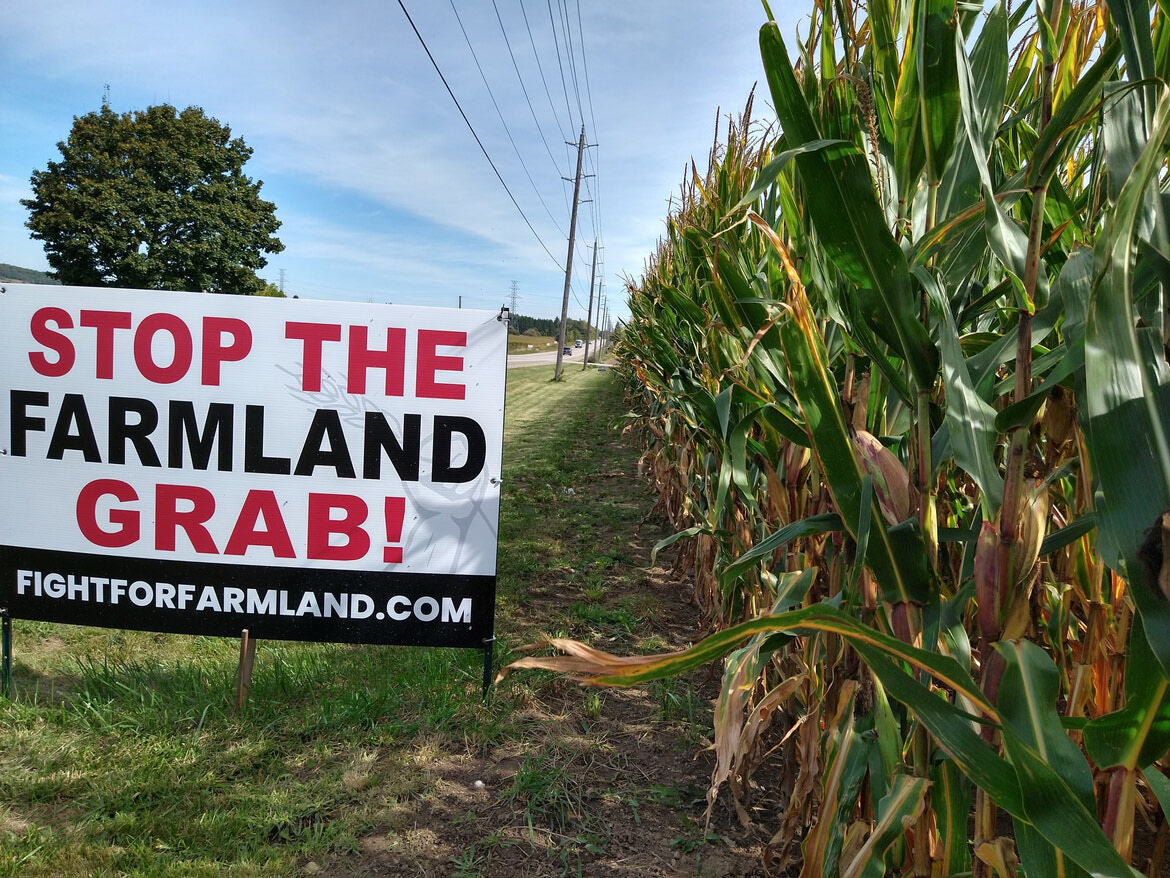
Pushback from the community is still active and strong. Lawn signs against farmland expropriation dot every corner of Waterloo Region. Wilmot’s drinking water is sourced from underground aquifers, currently under investigation due to already depleting water tables. Water conservation and environmental groups are drawing connections between this land assembly and the area’s potential for water shortage.
The NDA is still active. Members of Council cite it every time someone asks what is planned.
Meanwhile, back on the farm, we’re seeding cabbages. We’re concerned for the future of our wells and the health of the fields with potential runoff from this unknown mega-industry. The fight isn’t over. Two of the farms and three of the residences have said they will wait to be expropriated. We hope to stop this before that happens.
One of the greatest experiences from this fight has been our meetings in Lowrick’s kitchen or Snyder’s barn. We all sit down together, we share a plate of baked goods and someone brings chocolate milk. We share news, build plans, discuss flaws. We are people of very different political stripes and this has been highly political, but we’ve stuck together and not let one another’s differing opinions divide us. We keep our common goal of saving our farmland at the centre.
This isn’t about the political left or right being right or wrong. This is about our food sources. And we all eat three times a day. ◊
________
A.S. Compton is a writer based in Waterloo, Ontario. She grew up on a vegetable farm in Wilmot.