

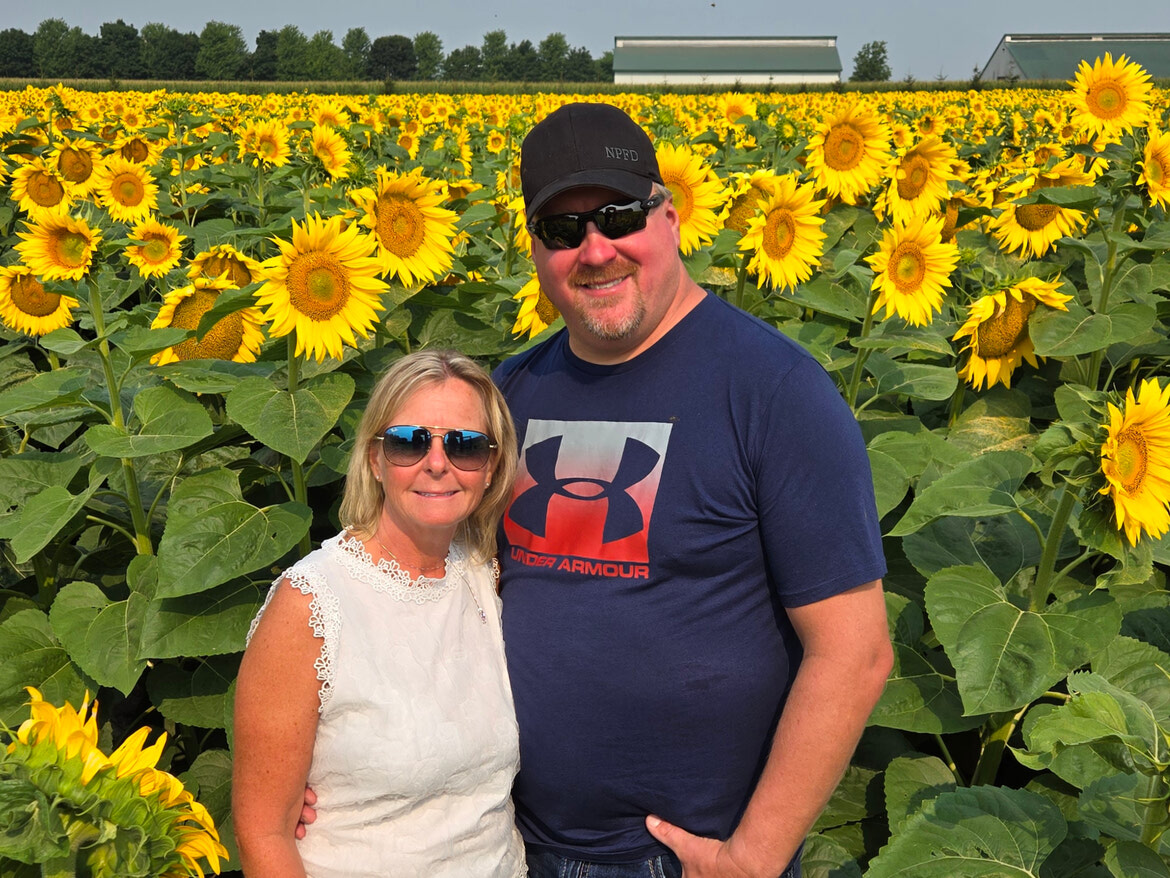
Fields of sunshine: Kadylack Farm Sunflower Walk opens for its fifth year
By Mel Luymes
There’s nothing more inviting than a field of sunflowers in bloom on a sunny August day. Farmers across Ontario can’t do much to stop passers-by from parking along the road and snapping a few photos. Safety can be a big concern. Not to mention the trespassing.
So, some farmers have embraced visitors, building pathways through their fields and charging admission or donations to raise money for a cause.
Kadylack Farm, near Atwood is now in its fifth year of hosting their sunflower walk. When Steve started growing sunflowers in 2021, he just wanted to try his hand at a new crop. He liked the look of them and with birdfeed mills nearby and Jason Persall (Persall Fine Foods) taking non-GMO sunflower seeds for oil, he felt the market was there.
“Prices go up and down, like every other commodity,” says Steve, but the input costs are lower than corn, for example. The seed is expensive, he explains, but at 19,000 seeds/acre, one bag can plant 10 acres.
He likes to get them planted as early as he can in the season, with a residual herbicide pre-plant. Grown on 30-inch spacing, the crop goes in with a corn planter and is harvested with a corn head. But being non-GMO, herbicides and weeds are an ongoing challenge in sunflowers. The best success he had with weed control was when he no-till planted sunflowers into a corn field.
By his second year, Dianne DeJong convinced him to cut a path through their sunflowers and invite people over. It was a near last-minute decision. The flowers were almost headed out, and they remember it being a slog to cut down with a lawnmower.
But they made a path and the people came.
Steve thought they could get about 200 people through and raise some money for a local charity.
“We had 2300 people through the path our first year, with no advertising,” Dianne says. Charging ten dollars a person, they raised money for various charities and community events.
They decided to do it again the next year. The planting plan got a bit more sophisticated. The path is planted using GPS and automatic shut-offs, then, the rest of the field is planted normally. Later, the path is cultivated, stones picked, rolled, and planted with grasses for a smooth, accessible path which will not get as muddy if it rains.
And it has only grown over the years, raising over $100,000 over four years for the Canadian Mental Health Association (CMHA), Tanner Steffler Foundation, Wellspring, Huron-Perth Centre (children’s mental health), London Health Sciences Centre, Atwood Canada Day Kid’s Games and many more. In 2024, they won North Perth Chamber of Commerce’s Business Excellence - Community Impact Award and in 2025 Dianne was recognized with a North Perth Inspiration Award for their work.
It is a beautiful walk where Dianne puts up signs around the field filled with inspirational quotes and over the years they keep adding photo attractions like two bridges into the trail (for a better view), a big red chair and photobooths.
In 2025, they had about 6800 people through within the two-week window that the field is in full bloom. They host events and Steve and Dianne also tied the knot in the sunflower field in late July 2025. They welcome free visits for Early On Programs, libraries, local daycamps, community living, and nursing homes.
While they plan to have 25 acres of sunflowers near the shop for visitors, there are typically another 150 acres or so in rotation. Steve noted that sunflowers do best in a five-year rotation, because there is a mite that can stay in the soil that will hurt yield. While it doesn’t hurt the blooms, it will attack the seed.
Come August, the sunflowers fix their beautiful yellow heads towards the east, but before then, the buds are heliotropic, following the sun from east to west in the sky each day.
Sunflowers typically grow 10 feet tall, though the tallest ones have grown 30 feet (not without support!) They are native to North America and have been grown for thousands of years for food and oil. Sunflower seeds contain healthy fats, protein, fibre, vitamin E, magnesium and selenium.
As tall as the plants are, their roots grow deep to stabilize them, up to six feet deep. And they can scavenge toxins from the soil (phytoremediation), including heavy metals and even radioactive isotopes.
If that wasn’t enough, sunflowers also support pollinators! Steve and Dianne host beekeepers amongst the fields and sell the honey on site, along with their own Kadylack Farm branded cold-pressed oil and bird feed.
The Kadylack Farm Sunflower Walk will run about two weeks at 5572 Perth Line 72 in Atwood. They hope to open in late July daily from 9am to 9pm (last entrance at 7:30pm). Follow them on Instagram, TikTok, Facebook, Twitter or YouTube for details.◊