
Farming the forest... indoors
By Mel Luymes
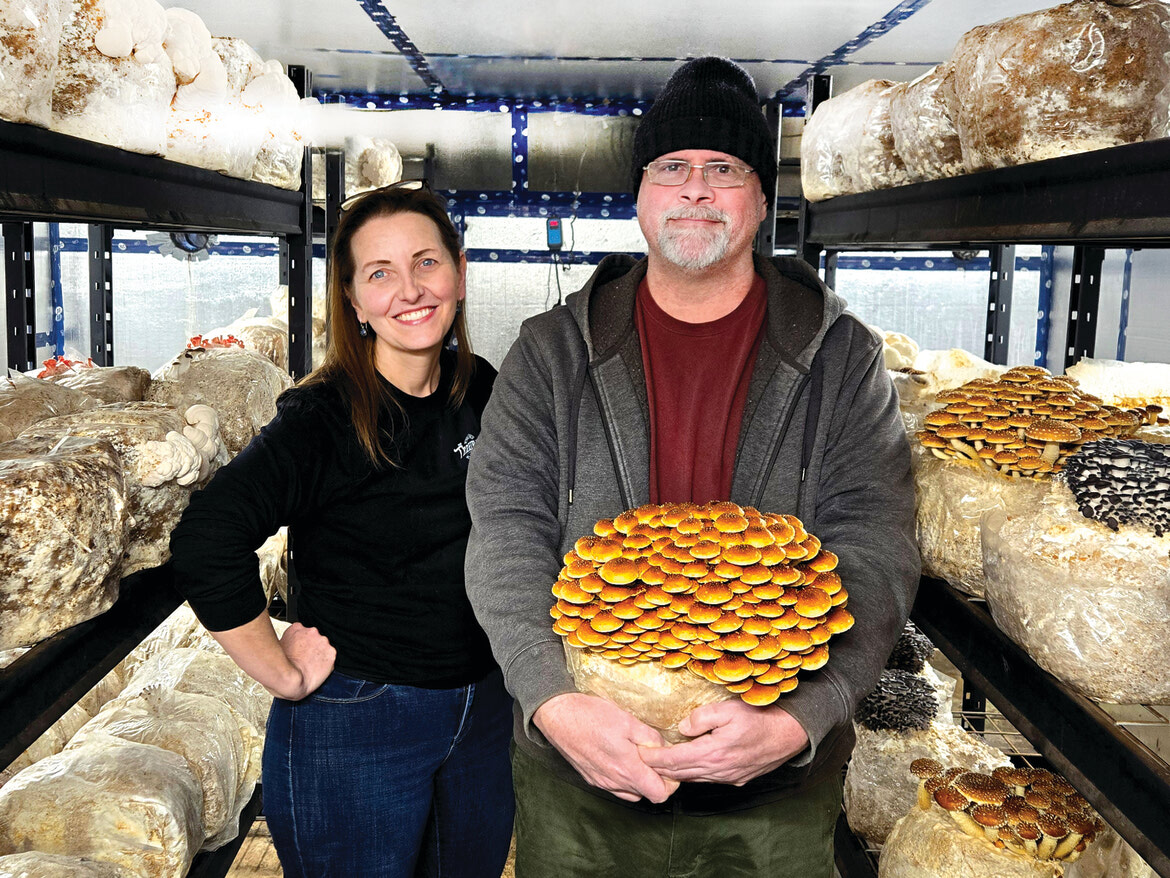
I’ve toured a lot of farms; and I’m no stranger to biosecurity protocol. But after I stepped through the bleach bath for my boots, there was a white lab coat and a mask for me. This was no ordinary farm tour! For Darin Kelly and Deb McKee, of Frontier Mushrooms, every step of the growing process is precise and controlled, and there is no room for error in the lab.
“This is the cleanest air you’ll ever breathe,” explains Darin. The room is pressurized, and the air blown in is run through a Hepa filter that removes any particles and microbes greater than .5 microns (for context, a hair is 30-50 microns in width). Petri dishes are stacked on a shelf, growing all the strains of mushrooms that they produce, and labelled with codes.
“These are the initials of their Latin names,” says Darin, along with the date and the number of times the mycelium is removed from the original spore “parent.” Frontier Mushrooms is producing about ten types of mushrooms: Several varieties of oyster mushrooms (the Pleurotus family), including Pink Oyster (Pleurotus d'Jamor), Blue Oyster (Pleurotus Ostreatus), Italian Oyster (Pleurotus Pulmonarius), and Black King Trumpet (a hybrid pleurotus variety), as well as Lions Mane (Hericium Erinaceous), Shiitake (Lentinula Edodes), Chestnut (Pholiota Adiposa), Turkey Tail (Trametes Versicolor), Maitake (Grifola Frondosa) and Reishi (Ganoderma Lucidum). Other species are always being tested in the lab as well.
The farm can produce 400 pounds of mushrooms a week from a 12-by-18 foot “fruiting room,” and it is all contained in a refurbished barn outside of Holstein that Darin and Deb set up in 2023.
This wasn’t their first rodeo, however. The two have been committed to farming for 20 years, starting in Deb’s hometown of Terre Haute, Indiana in 2006. They began with a market garden but started leaning towards indoor growing over the years, growing hydroponic, organic lettuce in a greenhouse.
“Darin is really great at engineering solutions for indoor growing,” says Deb. She laughs that she harnesses his fixation issue in a good way. “He is my secret weapon,” she smiles. While the couple is no longer married, they remain good friends and business partners.
When they got into mushroom growing, they were hooked. In 2017, they sold their farm in Indiana and moved to Ontario, where Darin is originally from. The next year, they participated in an intensive cultivation course with the legendary mycologist Paul Stamets and started Kelly's Gourmet Mushrooms on Wolfe Island, selling fresh mushrooms at local markets.
But everything changed in early 2020, when the farmers’ markets and tours ground to a halt due to the pandemic. They quickly pivoted to supplying mushroom growing kits for home use, as well as dried mushroom products and an online store, known as the Fungi Connection.
When they wanted to get closer to the southwestern Ontario market, they sold the business and moved to Grey County to start Frontier Mushrooms in 2023.
How does one set up a mushroom farm? For Darin and Deb, it involved creating four separate, insulated rooms that need to be controlled as different climates. The first, the sterilization room, is to make the growing blocks. Darin shows the growing media – hardwood pellets and soybean hull pellets – that they mix with water and put into polypropylene bags. The bags of media are put in (basically) a steam bath to sterilize them and, once they are cool, they head into the lab.
In the lab, they get a dose of grain that has been previously inoculated with the particular strain of mushroom from the petri dishes. Darin gets the oats from a local co-op and he chuckles at the irony. Farmers spend so much effort drying down grain and keeping it free of mold, but the first thing he does is soak and inoculate it.
The inoculation is all done on a long counter in the lab in front of forced, filtered air. This is all in their best attempt to ensure no foreign spores or microbes get into the petri dishes, the grain, or the growing media. Ambient air contains millions of particles per square foot, let alone the microbes that live in and on the human body. Hence the masks, the filters and the sterilization of the room before use. The lab also has an autoclave (a high-pressure sterilizer) which is where the grain and agar for petri dishes are sterilized before inoculation.
Once inoculated, the bags are sealed and taken to the next room to sit on shelves. Kept undisturbed at room temperature, the media will be colonized by mycelium over the next week or so, depending on the strain. Mycelium is the network of (often white) strands (called hyphae) that will run through the media, decomposing the wood, soy and grain. Peering into the clear bags on the shelves gives a sense of what is hidden in the soil, taking place in the ground below our feet.
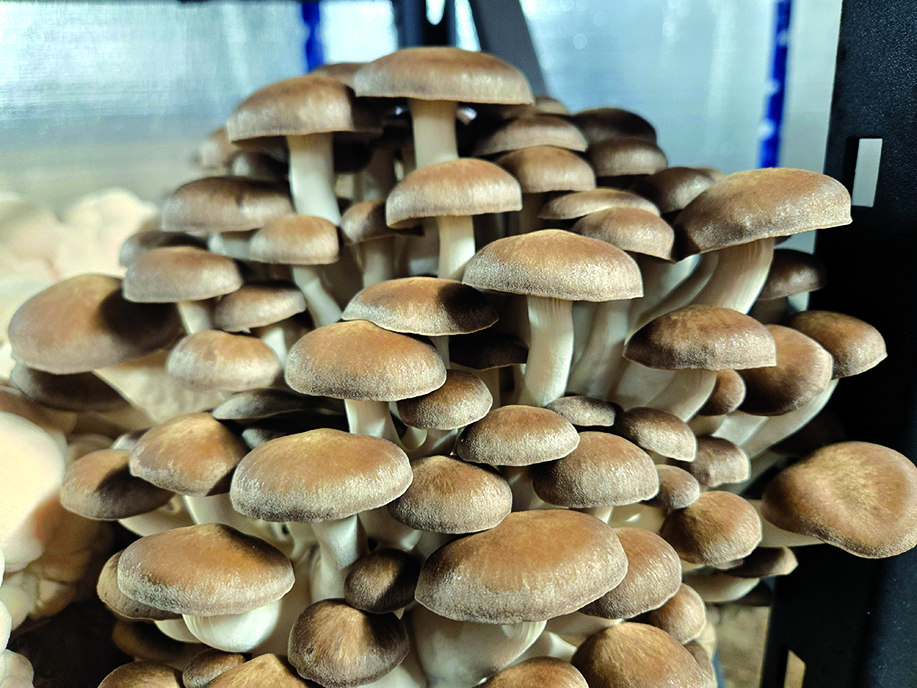
All of this happens in a very low oxygen environment within the bag, but then they will be transported to the last room, the fruiting room, and the bags will be cut with an X, out of which will grow a veritable bouquet of mushrooms. The fruiting room is climate controlled for humidity, temperature and carbon dioxide, all automated.
Darin explains that the growing process mimics how mushrooms grow in nature. Mycelium will spread under leaf litter in low oxygen levels and then, when the mycelium senses an environment conducive to reproduction, they will send up pins looking for the surface. When they reach oxygen, they will make a cap, and that is where the spores (“seeds”) are released.
It is easy to compare mushrooms to plants, but really, we shouldn’t. They are a completely different kingdom. In fact, mushrooms are more closely related to humans than to plants. As you’ll remember from science class, plants are autotrophs, making their own energy from the sun through photosynthesis and needing carbon dioxide. Mushrooms, on the other hand, are heterotrophs, meaning they get energy from digesting food through enzymes. They need oxygen, they live underground or in hardwood trees and only surface temporarily to “fruit” and spread their genetics. The largest organism in the world is a mycelial network in Oregon spanning 2,385 acres underground – called, get this, Humongous Fungus (Armillaria ostoyae) – and it is between 2,400 and 8,650 years old.
Mycelium decomposes organic matter and cycles nutrients; it connects with plant roots in a symbiotic relationship to transport nutrients to them. Mycelia can even decompose plastics and chemicals. Working quietly out of sight, it is key to life on this planet.
And mushrooms are also delicious. Well, some of them. Others are deadly poisonous. Others are wonderfully mind-altering. But we’re talking about the yummy ones here.
Deb and Darin are still fascinated by mushrooms even after so many years of growing them.
“It’s a common misconception that mushrooms are grown on sh*t and kept in the dark,” says Darin.
He explains that button mushrooms (Agaricus Bisporus) – which we most commonly see in a grocery store – are secondary decomposers, which means that they grow on compost media that has already been broken down. And it also means that these kinds of mushrooms can be grown at scale. Large farms growing mushrooms will have long, stacked beds of inoculated media and many steps of production that can be automated.
But the mushrooms that Darin and Deb are growing – gourmet and medicinal – are forest mushrooms and are primary decomposers. In nature, they grow directly on trees and in forest canopy lighting.
“It would be nearly impossible to grow these types of mushrooms at scale,” he says. They are very particular in the timing, sterilization, climate and steps to grow them. Many wild mushrooms, despite years of effort, just can’t be “farmed.” Morels for example, which fruit underground, can only be found in the wild and that makes them exceptionally expensive.
Mushrooms are a great source of B vitamins and Vitamin D2, minerals, antioxidants, and fibre, great for heart health and boosting immunity. They are food that is medicine, though some are more medicinal than others. Lions mane (which looks like a smooth cauliflower head) improves memory and cognitive function, while shiitake (think of a perfectly roasted marshmallow) helps fight cancer, says Deb.
Deb sells fresh mushrooms at farmers markets for about $20/ lb. Frontier Mushrooms also sells grow kits, which include a seed block (inoculated bag of media) and humidity tent, that anyone can fruit on their counter. They also dehydrate mushrooms into powders that people can use in their morning coffee, for example. And while Frontier Mushrooms has had success at farmers markets, they are pivoting their business to focus on supporting a network of mushroom producers in Ontario and beyond.
“All a market gardener would need is a small room like this, and they could bring their own supply of fresh mushrooms to the market every week to sell,” explains Darin. He would love to help local farmers set up rooms for climate control and provide the seed blocks each week, saving them the need to have a sterilized lab on the farm. They also sell myceliated dowel plugs that anyone can put into logs to grow these mushrooms outdoors, and they are keen to tour folks around their facility.
“These grow best on a small scale, and I kind of love that about these mushrooms. It’s for everyone to do,” says Darin. “As demand grows, there’s enough business to go around. We’re not taking from each other — we’re enriching each other.”
Just like a symbiotic mycelial network, Deb and Darin hope to grow their connections with farmers in the area. Their storefront near Holstein is up and running, and their online store is always open for ordering dried mushrooms and grow kits, and to book your own tour at frontiermushrooms.com. ◊