

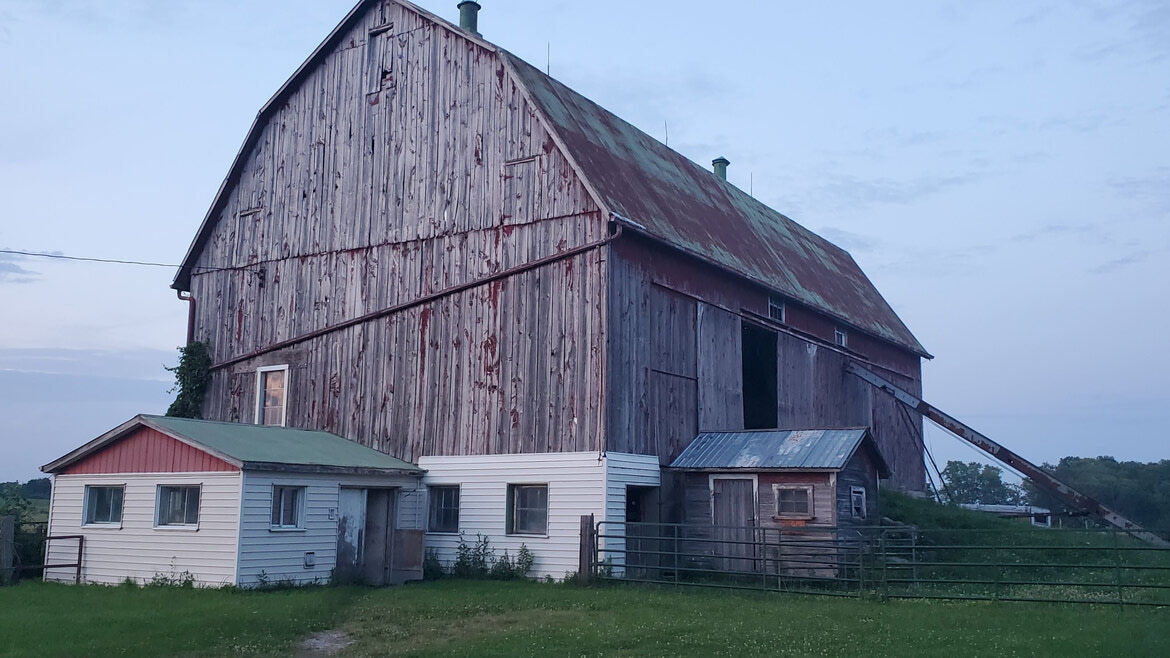
Every barn has a story: Ontario Barn Preservation ensures we won’t forget our old friends
by Mel Luymes
Pulling into the laneway near Duntroon, there is a stunning black building on the hill, with solid lines of windows across it. It is only after a longer look do you see it is actually an old barn.
The building is now the office of Jim Campbell, an architectural designer and principal of Rockside Campbell Design. He works there with his wife, Suzanne Wesetvik, and a team of three others. They specialize in sustainable, modern architectural design, with a flair for using historic timber-framed barns and reclaimed materials for custom homes and renovations.
“For my birthday one year, my brother gave me a rusty old hinge,” says Jim, and his brother then added that the hinge came with a barn he had found for him. It was a barn built on the smaller side, within a nearby village.
“It was free,” says Jim, “but it was a tonne of work.” These barns can be taken down in pieces and re-erected, he explains They are like a kit of parts, like Meccano, and moving them helped him appreciate the craftsmanship and the joinery.
For the barn’s re-raising, he invited 50 neighbours over to help.
“That was a mistake,” he laughs, “because no one knew what to do.” Turns out, he only needed four people and a crane to put a barn back up.
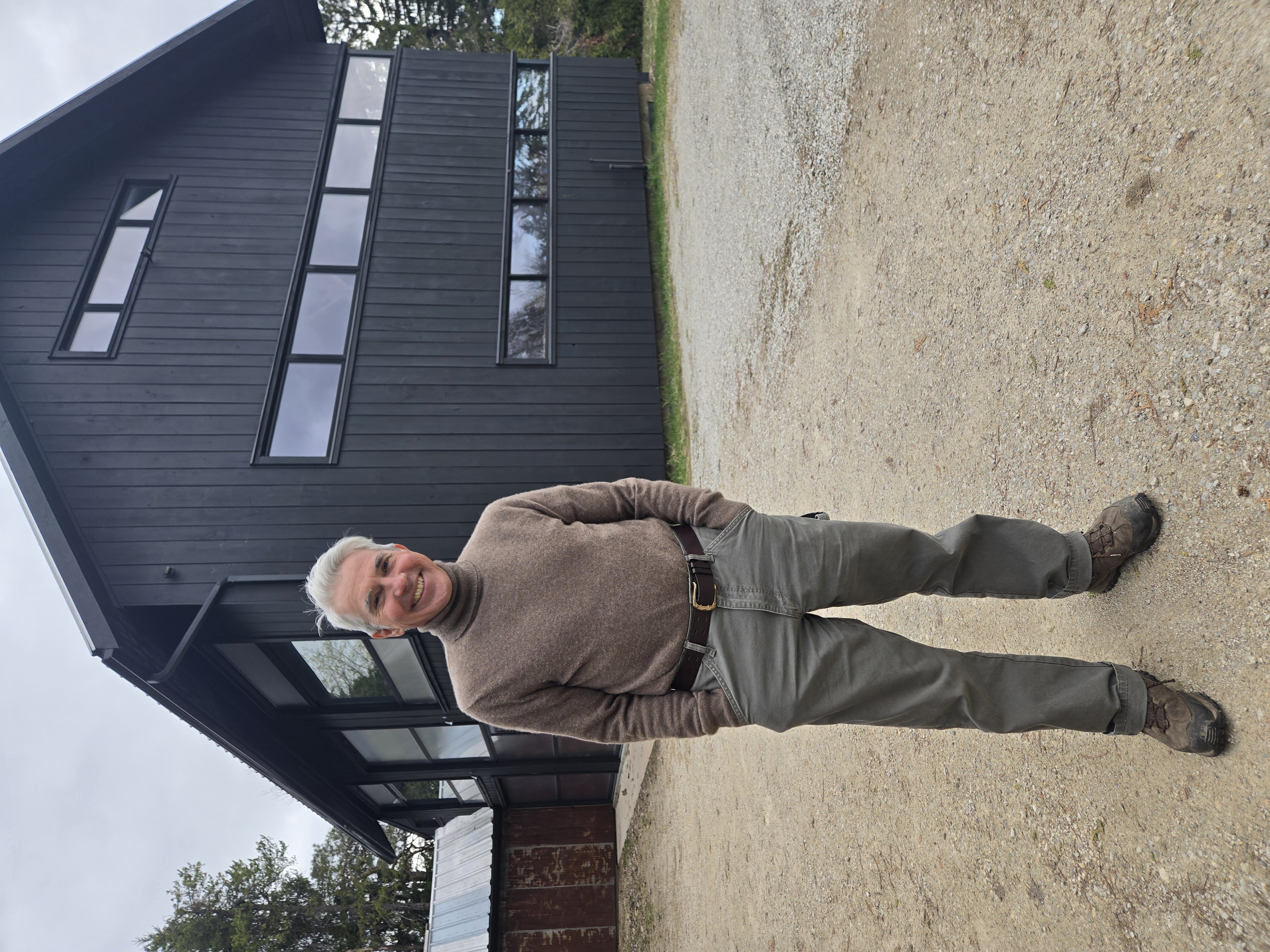
Now, the barn is black and has stylish windows; it has a new life ahead of it. It is lifted a few feet taller, reinforced with steel plates as needed, and it is insulated to be an office, with large bifold doors along the side for a workshop and storage for some classic cars. It even has a kitchenette. The original barn boards are used along the walls on the inside, with new barn boards – painted black – on the outside.
However, Jim says that once the barn was sealed and insulated, it lost that unique light; you know, the way it comes in through the cracks of the barn boards. So he lit the inside barn boards from behind with LED lights, making the entire barn into a glowing fixture.
The black barn is the largest of four barn structures that Jim has moved to the property over the years. An addition behind their Ontario farmhouse was two-thirds of a hay mow, now a gorgeous dining room and living room with an upstairs bedroom loft. Their garage was another old building from Pletchville that they lowered, replacing rotten parts of posts and covering it in the roofing of another barn. Lastly, a small barn was moved from Mono and raised three feet to keep its original use – as a barn.
Jim grew up on the Duntroon property, working in an old barn that was lost to a windstorm many years back. Still, it is clear that his time in that old barn would go on to shape his career. He started as a carpenter and went on to a Master’s Degree in Architecture; his studies took him to Kathmandu and Finland, but eventually he came back to his roots.
Jim runs his hand across a hewn beam in the house, tracing the marks of the broad axe and adze. It would have been cut into this shape in the forest where the tree fell, he explained. To Jim, the imperfections of the timber frames are what make them so interesting. Even the concrete pillars he made to raise the black barn were formed in old barn boards. The concrete shows the details of the wood grain and even the trails that long-gone mice left behind.
Ontario Barn Preservation
Jim is also on the board of Ontario Barn Preservation (OBP), a recently-formed non-profit organization dedicated to preserving, documenting and promoting Ontario barns. He convened three other OBP directors – Hugh Fraser, Will Samis and Darrell Randell – to join an interview with the Rural Voice and share the work they have been doing since the organization began in 2019.
OBP began when Krista Hulshof, owner of VELD Architect near Stratford, felt there was a need to connect with others about old barns, considering how quickly they were disappearing. There was a time these old barns supported Ontario agriculture and paid their way, but now they need our help, she says in an introductory video on the OBP website. She is married to a hog farmer (you’ll know him, he writes Perth Pork’s newsletter!) and had converted an old barn into their home.
“But I didn’t know where my fellow barn lovers were,” she says. When she saw a book about Ontario barns written by Jon Radojkovic, she emailed him. Jon had also wanted to start an organization and connected Krista with historian Dr. John Carter, then to Will Samis, who went on to become another founding director of OBP.
Once they connected to create a formal organization, more barn lovers came out of the woodwork to form a board of directors. They now have about 90 members and are growing. OBP connects people from across the province online, many of whom haven’t met each other in real life.
“I haven’t met Will yet,” says Hugh who is a (semi) retired OMAFA staff member living in Niagara, “though I’ve seen his mug on my computer screen I don’t know how many times.”
“It’s probably for the best that we all stay away from each other,” jokes Will. The group laughs.
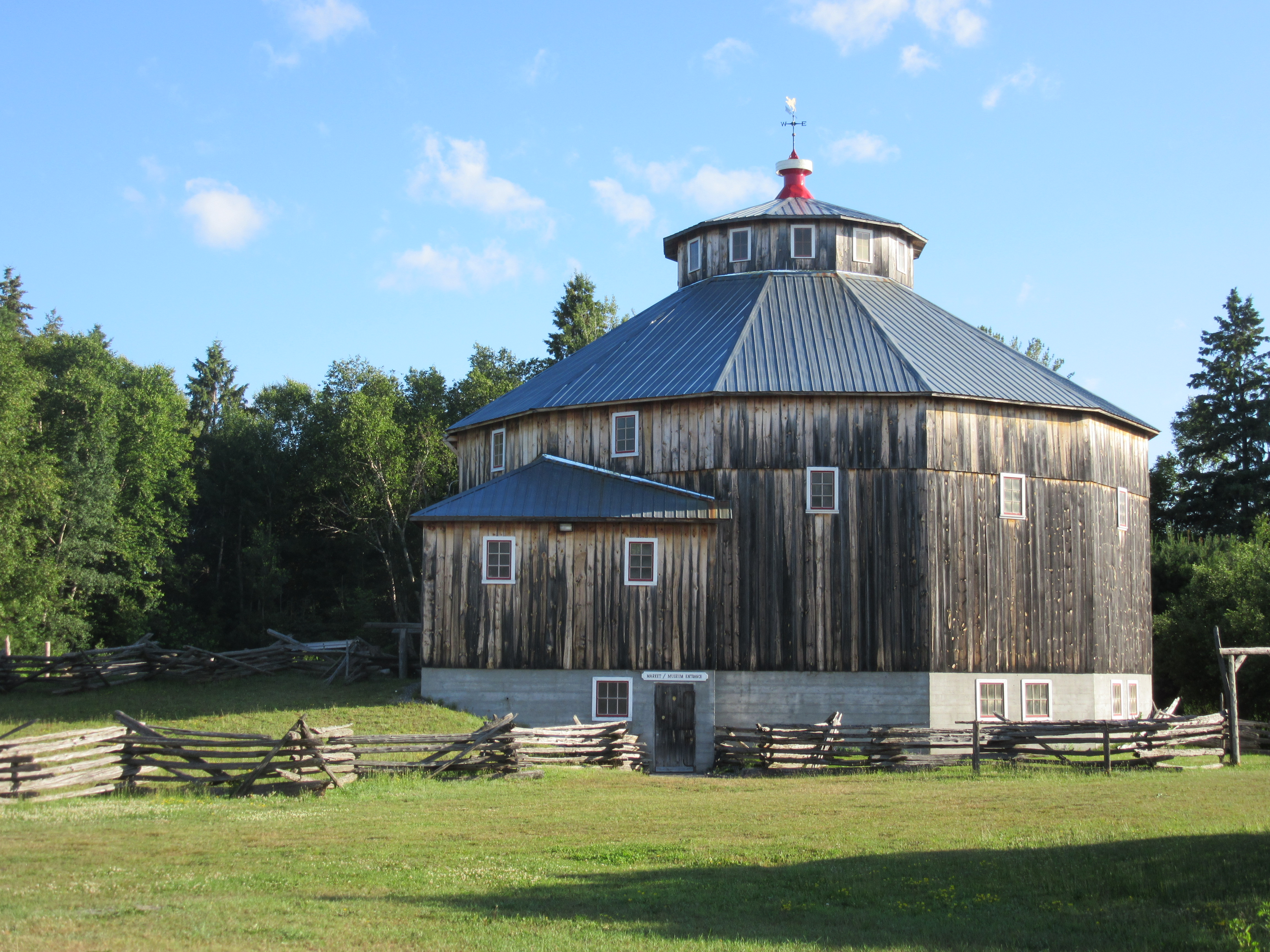
Will Samis lives several hours away from Hugh, in Algoma, on the northern tip of Lake Huron, though he grew up in Northumberland County. While he has fond memories of the old barn he grew up in, he was more recently involved in the relocation and restoration of a 12-sided barn that is now a public events space in Sowerby. The barn was originally built in 1919 by Thomas Cordukes who had come to the area in 1881 from Mystic, Quebec, where the first 12-sided barn was built that year. Another barn in Algoma was modeled after it in 1928, and all three are still standing. They are the only three 12-sided barns in the country.
All the board members in the interview had unique stories of unique barns. Jim recalls seeing a barn owned by an Amish family near Toronto 20 years ago. It was a historic barn – the Baker barn – that had been featured in Eric Arthur’s book, The Barn: A Vanishing Landmark in North America.
When he visited them, their property had just been purchased to pave over with the 407 highway. As they were packing to leave for Pennsylvania, he asked about what was happening to the barn.
“It is coming with us,” they replied.
How old are these barns?
The most common question people have about barns is how old they are, and there are a few ways to tell.
Sometimes, there is a year carved into the cornerstone closest to the house, says Hugh. He tells a story about his home barn and that when he was researching it for a book he was writing, he came across a photo of his brother Barry sitting on the cornerstone just after the barn had been taken down. But he saw a marking on the stone that he hadn’t seen before and on closer inspection, it was the date.
“I just zoomed into the photo and there it was, 1894,” says Hugh. It was something that no one had seen before. Sometimes things aren’t visible to the naked eye, but adjusting the grey-scale settings of a photograph might show you the date.
“What is even more crazy is that the barn came down in 1994,” says Hugh, exactly 100 years after it was built.
For Darrell Randell, his barn had bore holes in the siding: 1923. “I used to tell the neighbour kids that my uncle Jack was just a really good shot,” he laughs. Darrell had farmed there his whole life and over the years, there had been cows, hogs, rabbits and even Clydesdale horses in that barn. When he retired from Ducks Unlimited in 2019, he restored the barn and is now using it as a drive shed.
The year on the cornerstone would be reliable, the OBP board members explain, but other dates could have just been someone else later coming in and writing on the wall, like graffiti.
“History is only as good as the information received,” adds Jim.
There are other ways to find out, however. While there weren’t building permits back then, there could be tax or census records available at local archives that could give a date range of when a barn was built. The Tweedsmuir Histories developed by the Ontario Women’s Institute in the 1940s may have records of barns within their community history books. The building of a barn was a significant event for a family – at least a year of preparation and then a master builder and his crew coming in to put it together – and so it could be recorded as oral history in local history books.
Or one might tell from the nails, because by 1815, square nails were made by machine. Before then, they would have been made by blacksmiths and would be irregular shapes. Round nails (wire nails) were manufactured starting in the 1880s and had replaced the square nails by 1900. Still, nails could have been reused for a later project, so they aren’t always an indication of the year a barn was built
Hugh holds up an eight-sided pin, two inches in diameter and nearly a foot in length. It was given to him the day he was invited to see an old swing beam barn near Harley being taken down by an Amish crew. It is the largest pin he had ever seen, but it helped date the barn to be quite early.
Hugh knows a lot about swing bean barns; he quite literally wrote the book on them –Swing Beam Barns of Niagara – documenting the barns and farmer stories in full colour. Barns of this style, with a thick horizontal beam which allowed for an open threshing floor, were some of the first barns built in Upper Canada (1791-1841), later known as Canada West (1841-1967) and now Ontario. The vast majority were built within about 50 kilometres from Lake Ontario and Lake Erie, by the earliest European settlers.
But the style of the barn doesn’t necessarily say how old it is. There was a swing beam barn built in Grey County, says Jim, that would have been cleared and settled much later.
Perhaps the style of barn said more about where the settler had come from and what barns were built like there, especially in terms of the pitch of the roof. The earliest settlers assumed they could make a thatched roof and made a steeper pitch, but it was soon apparent that trees were more abundant than reeds, so cedar shingles became the standard.
Another way to date a barn is by the quality of wood. The biggest, straightest, and strongest trees were used first and then over time, they used trees of lesser quality. All the good, big timber was gone from Niagara by the 1850s, says Hugh. And Jim adds that barns with a variety of wood, or when the bark is visible, means it was likely built later.
But the wood itself can date a barn as well. By looking at the tree rings, like a fingerprint, it can be compared to other wood from the area in which the date is known. It is called dendrochronology, and it is a science that can also be used to date buildings based on past climate conditions from the area.
Your Old Barn Study
The group has launched Your Old Barn Study (YOBS), recruiting people from across the province to input the location and information of their old barns – whether they are still standing or not – into a database that will help preserve the cultural history of the area. As more of the old barns come down, they hope they can collect as much information as possible about the architecture and dates of construction, as well as the stories and historical photos of these barns.
Inputting the barn was quite simple. There is a link at ontariobarnpreservation.com/barn-study and it begins with adding the location of the barn, its style and orientation and then asks questions about some of its interesting features, inside and out.
There were many photos to illustrate the features, so I learned more about our barn, and gained an appreciation of others, in the process.
“But inputting your barn on YOBS does not mean it is designating it a historical building,” says Darrell. “It is just a matter of preserving records of barns all in one place.”
“Many people think there is nothing special about their barn,” says Hugh, but he says no two barns are the same – they are all unique. People might not realize they have a gem of an old barn on their property, so they encourage everyone to add their old barns to the YOBS collection, so they won’t be forgotten. Even barns that are long-gone can be recorded if someone remembers where it was and what it was.
Of course, not every old barn will be preserved. For many, it is simply not practical or affordable to keep them in good shape. Will shared the story of taking his childhood barn down in Northumberland County. It had been damaged by Hurricane Hazel in 1954 and hadn’t been repaired. When there was nothing but the beams left, he hooked a tractor to it and began to pull.
“Well, it leaned over six feet, but then it moved back upright again and pulled the tractor back,” he laughed. He was stunned. He tried the other side of the barn with the same result.
“Every barn has a story,” says Hugh.
Ontario Barn Preservation is ensuring we don’t forget these barns and the role they played in the rural landscape. Their website has a fascinating blog, a resource directory (Barn Specia-List), a forum to sell, trade, or buy barn wood, tools, etc. and other initiatives alongside YOBS.
They are open to new members! Membership is only $35/year and helps to support the administration of the group. Members meet online a few times a year to hear from speakers, sharing information and connecting.
To find out more, or to join this growing group of barn lovers, go to: ontariobarnpreservation.com. ◊