

Cultivating Connections: Farms at Work builds knowledge and farmland access
By Angelique Fawns
Ontario is losing productive farmland at an alarming rate. The Ontario Farmland Trust estimates, based on 2021 census data, that 319 acres of farmland are lost every day.
It is easy to feel overwhelmed by such statistics. It is hard to know how to make an impact and preserve land for agriculture. But Farms at Work is stepping up and doing something about it. It is one of those changemaker organizations that sees an issue and then builds a coalition to address it.
Farms at Work was founded by Pat Learmonth in 2010, and has been working to support new farmers, keep farmland in production, and strengthen regional food systems ever since Learmonth owns a farm near Peterborough. With a degree in both Environmental Studies and Law, she is a powerhouse and has worked hard to build the organization over the last 15 years, building partnerships, getting grants and hiring staff to make it all happen. She previously worked with the Ontario Soil and Crop Improvement Association (OSCIA) as a workshop leader, has been a key part of Sustain Ontario, and helped to pull farmers and the local Soil and Crop groups, Conservation Authorities and other stakeholders together into the East Central Farm Stewardship Collaborative to jointly support farmers with on-farm stewardship projects.
She recently guided the organization through incorporation as a non-profit and the achievement of charitable status in early 2025 and it all came from a simple, troubling realization.
“We are seeing a decline in farm businesses and farmland going out of production,” says Learmonth. Meanwhile, our population continues to grow.
While much of the public conversation around food focuses on affordability and access, Learmonth takes a wider view. “We believe that community food security goes beyond food insecurity due to poverty,” she explains. “It is about producing more food locally in Ontario so that we have more control over our food sources. We’ve all seen the risks of relying on global supply chains.”
The numbers from Statistics Canada and Farm Credit Canada are sobering. Over the past 45 years, East Central Ontario has seen one-third fewer acres in production. Farmland prices have risen 750 percent, while the number of farm businesses has dropped 38 percent in the past three decades. Most concerning, the number of farmers under the age of 35 has declined by 75 percent.
“These numbers paint a very strong picture of why our work matters,” says Lisa Crawford, Communications Coordinator for Farms at Work. “They show that access to land and support for new farmers is essential for keeping Ontario’s food system functioning.”
Farms at Work envisions robust regional food systems, from farm to fork and back, leading to long-term food security in Ontario. Though the organization focuses primarily on Eastern Central Ontario, some of their work has province-wide impact.
Learmonth says, “We started Farms at Work because we saw that people who wanted to farm had few ways to get started. Supporting new and aspiring farmers quickly became our focus.”
With today’s farm prices, how do new farmers access land?
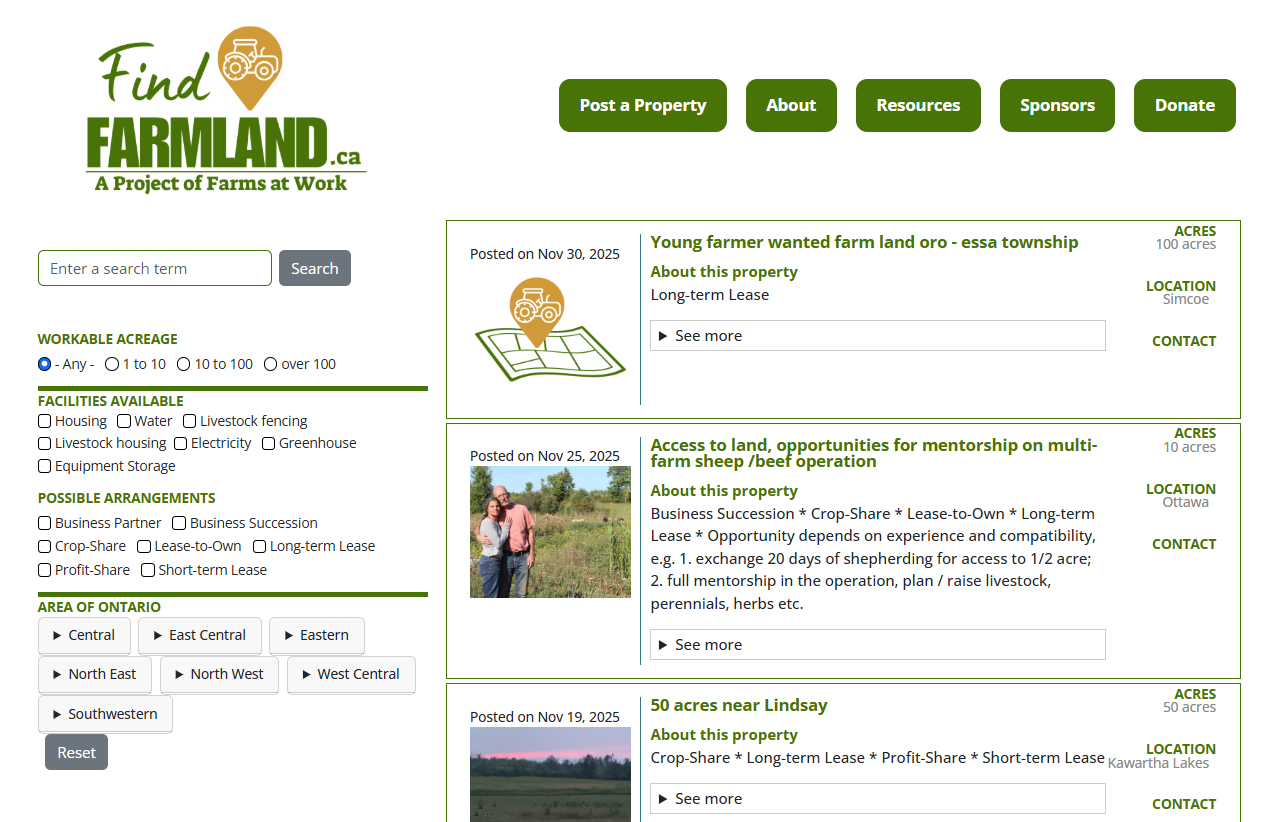
One of Farms at Work’s initiatives is FindFarmland.ca, a free, province-wide online bulletin board that connects landowners with land seekers. So far, the site has been supported by the National Farmers Union – Ontario and the Greenbelt Foundation, though they are seeking more ongoing sponsors to keep this service free to users.
Launched in late 2023, it is designed to help new and expanding farmers find access to land through leases, partnerships, lease-to-own or business succession arrangements. While the site doesn’t list properties for sale, it has become one of the organization’s most active resources.
“Access to affordable land is one of the biggest barriers for new farmers,” says Crawford. “FindFarmland.ca lets landowners post their property for free, knowing thousands of viewers will have the opportunity to see it. The posts come down automatically after four months to keep listings current, and many users find matches within weeks.”
Another key focus for Farms at Work is educating non-farming landowners about the food production value of their land. This group has grown rapidly in recent years as urban buyers purchase rural properties or developers acquire farmland near cities. During the pandemic, many people from urban areas bought farms.
“We’re working on how to reach those landowners and help them understand the role their land plays in the food system,” Learmonth says. “It is wonderful when people plant trees or restore wetlands on marginal land, but when you own high-quality agricultural land—Class 1 to 4—keeping it in production is probably the best contribution you can make to your community.”
Farms at Work is planning a workshop for non-farming landowners on February 20 and there are details on their website at farmsatwork.ca.
Organizations like Ontario Farmland Trust have also played a growing role in helping landowners protect farmland through conservation easements—voluntary agreements that permanently prevent development. “These easements are most valuable near urban areas where farmland is at risk,” Learmonth explains. “They come with tax benefits and are an important part of long-term farmland protection.”
Learmonth speaks from personal experience. On her and her husband’s Peterborough area farm, they’ve hosted young vegetable growers, produced hay, and are now working with a young family who plan to graze cattle rotationally on their land. “We’re not farming ourselves at this stage, but we’re committed to keeping our land in production,” she says. “Supporting new farmers is part of our role.”
Her perspective underscores a theme of collaboration that runs through all Farms at Work’s efforts. Whether farmers sharing land, landowners learning stewardship, or communities rethinking local food systems, the work relies on building connections. The organization reviews data, analyzes trends, listens to the community, and then responds to needs as they arise to help create a more resilient system for East Central Ontario.
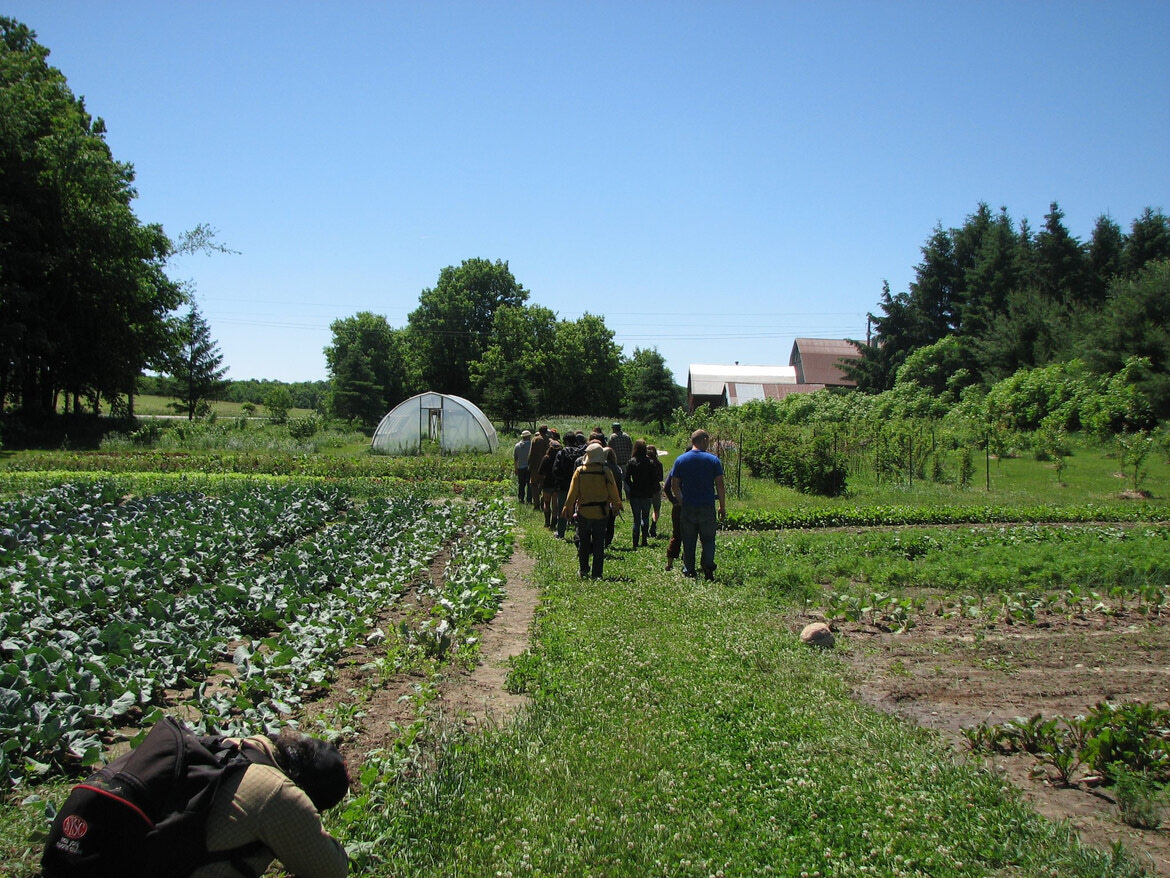
They run several events each year with hands-on learning experiences, field courses and farm tours, and over the years have built a thriving community of supportive farmers.
Their mandate has four pillars:
- To advance education by providing training in farming methods and practices to farmers and prospective farmers in East Central Ontario area.
- To protect farmland for the benefit of the public by acquiring interests in, managing, and facilitating access to farmland for farmers.
- To educate the public on issues related to farming, food systems and community food security.
- To conserve and restore ecosystem health.
Over the years, they have hosted nearly 5,000 people at their events, created a guide for farmland agreements, and supported over 500 on-farm environmental projects through the partnerships in the East Central Farm Stewardship Collaborative. Their website is full of information on stewardship, including a pollinator habitat tool, for farmland owners, current and aspiring farmers alike.
Farms at Work is currently working on a Community Farm project that would offer shared use of infrastructure and education on rented land. “Our dream would be to actually own one or more farms where we could provide opportunities to the community to learn together and grow new farm businesses,” says Learmonth.
“After 15 years, it feels like the conversation has finally caught up,” say Learmonth. “People are realizing that preserving farmland isn’t just about nostalgia—it is about survival. The land that grows our food is a finite resource, and every acre that goes out of production is one we can’t easily get back.”
Still, there are reasons for optimism. “We’ve seen new agricultural programs launched at Trent University and two community colleges in our region,” Learmonth says. “It is encouraging to see post-secondary institutions recognizing agriculture as a viable, innovative field again.”
Farms at Work is currently recruiting board members, seeking donors, and also sponsors across the province to keep FindFarmland.ca free for users. Check out their website at farmsatwork.ca and email [email protected] to connect. ◊