

Cats gone wild: Local programs to manage feral cat colonies
by Mel Luymes
If you’ve had a cat or two dropped off or just appear in the barn and thought, “No problem, they’ll keep the mice down,” you’re not alone. Barn cats are just sneaky, beloved characters that come with the territory.
But what starts as a few cats can quickly turn into dozens. Unmanaged cat populations can grow quickly, and quietly, until they become overwhelming. They can pose threats to the wildlife, spread and succumb to diseases, and become a general nuisance on a farm.
But, thankfully, humane management programs around rural Ontario are gaining traction. There are working cat adoption and trap-neuter-return (TNR) programs available.
“Cat colonies can get out of hand fast, they grow exponentially,” says Taylor Lehman, who spearheads the TNR program with Arthur Animal Rescue. Female cats can become pregnant as young as four months and can have multiple litters in a year, she explains.
Taylor is a busy, working mom with four small children. She is an animal lover and a volunteer with Arthur Animal Rescue. Her Guelph home includes two dogs and a few more socialized cats of their own, as well as some that she fosters. There are litter boxes tucked away in each room, including a trough of it in one corner. She uses 20 dollar bags of grain-based chicken feed as litter and Taylor goes through a lot of it!
For Taylor, her passion for TNR began a few years back when she discovered a feral colony of cats living around her neighbourhood by the Speed River in Guelph. She learned that the colony had been around for about 60 years. As they are often fed by residents or surviving on small wildlife, the colony would only get larger and become more of a concern unless it could be managed. She made it her personal mission to get every cat fixed. And that’s when they expanded the TNR program past just barn cats at the Arthur Animal Rescue.
She wasn’t the first. She learned another local resident had trapped, neutered and returned about 60 cats from this colony in 2019 and 2020. Taylor has done 20 cats so far, noting that a spay or neuter operation also includes a rabies vaccination. “I have a few stragglers left that are very trap savvy,” she says.
“I take binoculars out with me, especially at dusk,” laughs Taylor, “I know that I might look like a weirdo sitting out by someone’s house with binoculars, but the neighbours know exactly what I’m doing.”
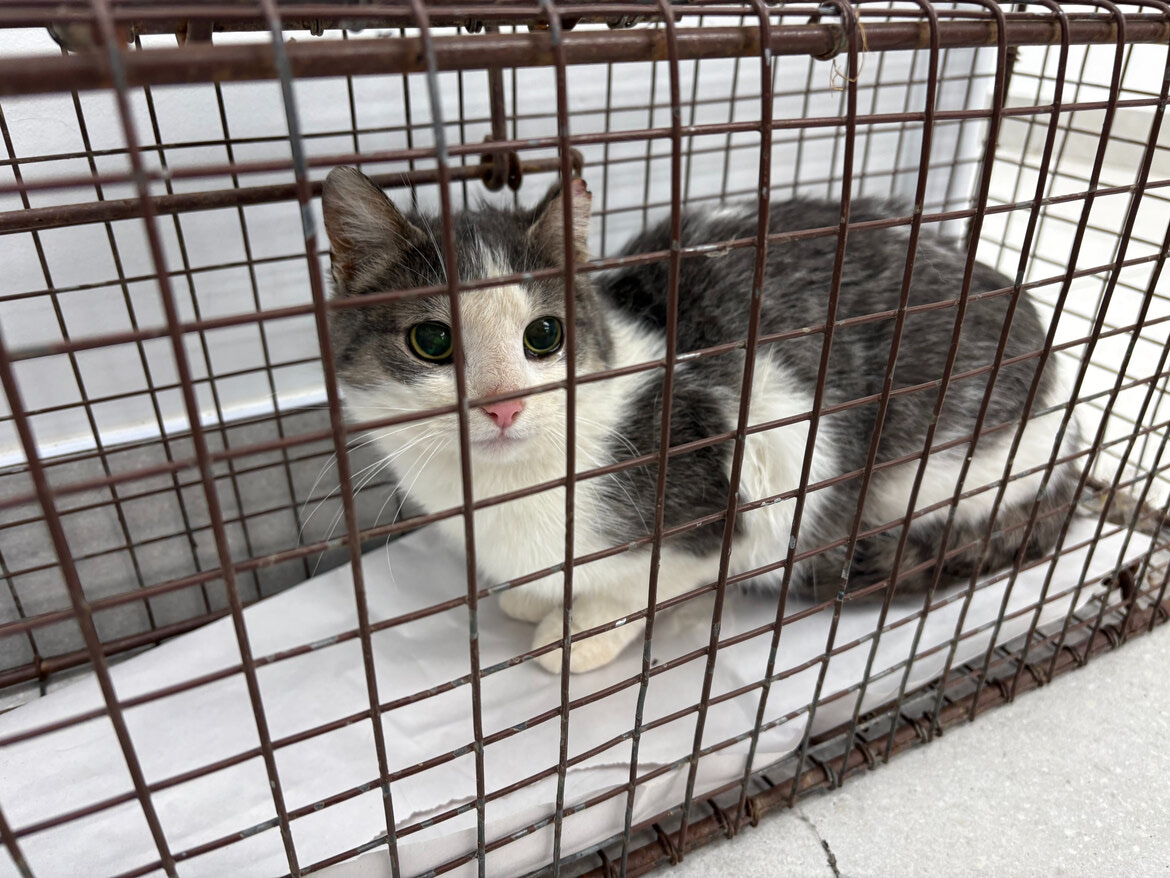
It starts by trapping the cats, baiting them with food in live traps. And Taylor can tell if a cat has been fixed already because it will be ear tipped – having the tip of the left ear cut off – making it relatively easy to see from afar if they have been treated.
One of the colony’s cats that Taylor recently trapped, turned out to be pregnant already and gave birth to a litter of kittens. Momma and the babies are in a crate together, covered by a sheet in the laundry room.
“This one is spicy,” explains Taylor’s two-year-old. It is true. The mother cat hisses and doesn’t like humans, but her kittens will be well-socialized. One of her orange kittens - which they named Cheddar Cheese - was born with a cleft palate and can’t drink properly. Taylor, with her big heart and apparent resilience to sleep deprivation, feeds the kitten milk every three hours (day and night) through a syringe and tube into its stomach. She is committed to the kitten and says when it is older, it will need a $3,000 surgery to fix the cleft palate and live a healthy life. (Hey, if any readers would like to adopt Cheddar Cheese, or contribute, please get in touch!)
After they are trapped, cats are taken to a veterinarian clinic for the operation. Many clinics offer a certain number of discounted surgeries each month to help support the TNR work done in their local communities. For reference, surgeries typically cost about $400 each, but TNR programs are offered discounted rates from clinics.
Most often, she returns the cats back to their colony after the surgery. They have less stress going back to the places and cats they know, Taylor explains, and sometimes they will escape their new living situation to try to find their way back home to their colony anyways. Once fixed, however, the cats can no longer reproduce, have reduced incidents of fighting, spraying and yowling, and over time, their population will decline. Moving a colony is often ineffective, Taylor explains, because it creates a vacuum effect of sorts. Whether it is a scent imprint behind or some signal, it is common for another colony to come in and take over the same space.
For some cats that were born outside and didn’t interact with people, trying to socialize them inside is very stressful for the cats, so they don’t advise that. But sometimes they find friendly cats through the TNR process that they can put up for adoption. In fact, two of Taylor’s housecats came from the Guelph colony, though she brought them in when they were still kittens and could be socialized.
Arthur Animal Rescue is a volunteer-run, non-profit registered charity that is dedicated to rescuing, rehabilitating and rehoming cats and kittens across Wellington County and surrounding regions. They were founded in 2015 and officially registered as a charity in 2023. Without a bricks-and-mortar shelter, they rely on approximately 80 loving foster homes in the area to care for kitties until they can find their permanent homes. They work closely with other rescues, humane societies and vet clinics across the region.
Taylor related a recent project that required all hands on deck for a property near Goderich. It required borrowing live traps from many of the rescues in the area and they trapped all the colony (20 cats in total) at one time for their surgeries. It involved several days of trap training, in which the trap is tied open, and cats are progressively fed closer to the trap, until they will eat inside it.
The Arthur Animal Rescue asks for a $50 donation per cat toward the TNR program. Because they are a charity, they offer tax receipts for the donation. Last year they had 250 cats through the TNR program.
While cats are small, adorable and sleep 70 percent of the time, they are nonetheless an apex predator. They can see in the dark, have incredible hearing, can jump up to five times their body length and somehow always seem to land on their feet. In Canada, free-roaming cats are estimated to kill (collectively) 100-350 million birds per year. The Canadian Veterinary Medical Association estimates there are between five and 10 million free-roaming cats in Canada, and that between 1.5-4.1 million of them are feral or unowned.
Many argue that cats are not domesticated at all, because they can survive without humans. Looking back into history, it is clear that the Egyptians liked cats. A lot. The story goes that when Egyptians began storing grain in the Neolithic period (4500-4200 BCE), they attracted rats, which attracted cats, and those cats that could tolerate the affections of humans had an advantage, because Egyptians would toss them more food.
Still, cats weren’t brought indoors until much more recently. Of course, there are paintings of cats indoors from the Victorian era, but it wasn’t until after World War Two and the rise of suburban living that veterinarians promoted cats living indoors. There were growing concerns with traffic, disease and wildlife impacts.
These days, research shows that 62 percent of Canadians own at least one pet and that there are more cats than dogs as pets; however, cats don’t have bylaws and they are usually give-aways. According to a 2012 study by the Canadian Federation of Humane Societies, there are twice as many homeless cats as dogs brought to shelters. Only 44 percent of cats are adopted and there were more cats than dogs euthanized in shelters.
Ghandi is often quoted: "The greatness of a nation and its moral progress can be judged by the way in which its animals are treated."
Similarly, Betty White said, "You can always tell about somebody by the way they put their hands on an animal".
But, perhaps more well-known is Bob Barker’s sign off at the end of every episode of The Price is Right, as he said, “I’m Bob Barker, reminding you to help control the pet population – have your pets spayed or neutered.” While it has since come to light that the 35-year run of the show was riddled with harassment scandals and lawsuits, at least Bob cared about animals. He established the Barker Foundation in 1995, which provided low-cost spay and neuter programs to help prevent animal suffering and euthanasia.
For all the cat-lovers out there, here are a few ways you can help. Shelters are always looking for people to foster or to adopt (indoor) cats. If you’d like to volunteer with TNR programs, you can be a part of a network of volunteers across the area, and can help set traps, transport cats, or keep trapped cats in a warm place until their surgery date. As well, there are programs to adopt a working barn cat, like the Guelph Humane Society’s program. Email [email protected] for more information.
But, as Taylor explains, the bottleneck for TNR programs is usually the cost of the surgeries, so please consider donating to the program nearest you.
If you’ve got cats on the farm, Taylor recommends getting them brought in to a vet for a spay or neuter surgery as soon as cats are old enough, at least 12 weeks old.
If you need some support, reach out to a shelter in your County or area to enquire about TNR programs. Contact Feline Friends Network (Stratford), Riverside Animal Hospital in Guelph, the Stratford Perth Humane Society, Kitchener Waterloo Humane Society, Guelph Humane Society, East Village Animal Hospital (with locations in Kitchener, London and Hamilton), Feral Cat Rescue, Cats Anonymous (East Garafraxa), Allies for Alley Catz (Kincardine), Georgian Triangle Humane Society (Collingwood), Clinton Community Cats, Vanastra TNR, Bayfield Forgotten Felines, or there may be others. ◊