


Calling all green thumbs
By Mel Luymes
The Royal Agricultural Winter Fair has been celebrating agriculture in the heart of the city since 1922. These days, the Royal runs for 10 days in early November and attracts over 300,000 people to downtown Toronto’s Exhibition Place to see vendors, exhibitors, food competitions, livestock and horsemanship.
There is plenty to see across the nearly 192-acre property, but one of the best exhibits is now right at the front entrance. Organized by the Royal Horticulture Committee, the display features a host of farm produce vying for the top honours. There are pumpkins, beets, cabbage, kale, potatoes, onions, carrots, gourds and more – some of the biggest you’ve ever seen.
Brian Gilroy is an apple grower near Meaford and has been a dedicated advocate of agriculture for decades, inducted into the Ontario Agricultural Hall of Fame in 2023. He is also a long-time volunteer with the Horticulture Committee. In his early years, he often attended the Royal with his family. One of the highlights being his mother’s family farm Glenafton Farms, near Alliston – bringing a few members of their dairy herd to competition. One of his uncle’s cows even had a calf at the Royal, born in downtown Toronto.
“Even as a rural kid, the Royal was an education for me,” says Brian, in an interview with the Rural Voice. He believes the Royal is an incredible opportunity to showcase Canadian agriculture to the public and our urban cousins. He believes that the horticulture competition gives growers the opportunity to connect with consumers.
And that’s why he is a strong believer that horticulture should have representation at the show.
“We have some of the best fruit and vegetable growing regions in the world here,” he explains. It is important for visitors to see that all this variety can be grown close to home and that they need to look for it and ask for it in their grocery stores, he adds.
But over the last 15 or 20 years, many of the competition categories have been cut back and now only the giant categories remain. He shares a competition book from 2009 that included 60 classes of (normal-sized) cabbages, carrots, onions, leeks, garlic, and many more, including categories like most interestingly shaped vegetable. There were over 30 classes for potatoes and over 20 for apples.
Of course, Brian competed in the apple category until it was removed about 10 years ago as scarce promotional dollars were reallocated. An entry required five apples that were true to variety and consistent in shape, colour and size. Brian remembers the care he took searching through his crop to find the perfect entries.
In its heyday, there were apples coming in from British Columbia, Ontario, Quebec and Nova Scotia. The B.C. apple growers sent a representative to the Royal to help promote their apples. Brian admits that some of the reason competitors dropped off was that the number of apple growers have also declined. Around Georgian Bay, where Brian grows, there used to be over 100 growers. Now there are likely around 40 orchard operations on the same acreage, he explains.
Brian continues to serve on the Horticultural Committee. Their goal is to grow back some of the standard categories and increase the number of competitors. It will mean working with producer groups, commodity organizations and getting the word out there to all the green thumbs.
Joe Bush is the current president of the Horticulture Committee. A retired schoolteacher in Toronto, he still grows for the competition, though he doesn’t have enough space to grow the giants. He also makes pickles and preserves that he submits the Royal’s other competitions every year. Last year, he took home the Judges Choice Award for Pickling for his “Hickory Grilled Corn & Tomato Salsa.”
Joe was inspired by the delicious pickles his mother would make and started canning as a hobby after he turned 40 years old. He takes the competitions seriously, with creative and often liqueur-infused jams and jellies. He plans out the growing season and when he can get fresh, local produce for his endeavours. This year, he’ll be making a strawberry-peach jam with Grand Marnier liqueur and aiming to time the very last strawberries of the season to pair with the very earliest peaches from Niagara.
Before he retired, he would often get his grade six classes at Our Lady of the Rosary school in Vaughn to submit something for the Royal’s competitions. Taking the school kitchen and some of the gymnasium, they would spend time chopping and canning. They would have jars to take home for their families, submit to the competitions, and a few extras to gift to some of the support staff at school.
The Royal has an extensive curriculum developed which extends beyond just a school trip to the Royal for the day. They learn and practice math, art, biology and more, through the lens of farming.
Joe says he explained to his class that judging can be quite subjective and that they shouldn’t take it too personally if they didn’t win the competition. While the judges of agricultural fairs across the province have training, it is nonetheless determined by their individual tastebuds.
But for the horticultural competition, judging is often much more objective; most competitions only require a measuring tape and a scale. This year, a few of the 28 categories include:
- Cabbage by weight
- Corn stalk by height
- Carrot root by length
- Display of squash (4’x4’ area)
- Artistic display of vegetables, property named (2’x2’ area, five varieties)
Submissions have an entry fee of $10/entry (plus tax and an administrative fee) and they can be made directly to the Royal; they don’t have to have won at a local fair previously. And Joe adds that having been at a previous fair doesn’t disqualify any submission.
One year, his students entered an artistic display of vegetables and took first place. On the way back to school on the bus, he spoke to the group.
“You’ve done something incredible,” he said. “Something I’ve never been able to do.”
“Beat Joanne Borcsok,” he finished. He explained that Joanne – another member of the Horticultural Committee – has dominated the category for years. Growing in the Holland Marsh, she produces humungous vegetables. She has won the Grand Champion Giant Vegetable Exhibitor Award – scoring the most points in total and having her name inscribed on the Len Rush Memorial Trophy – for 15 of the last 16 years.
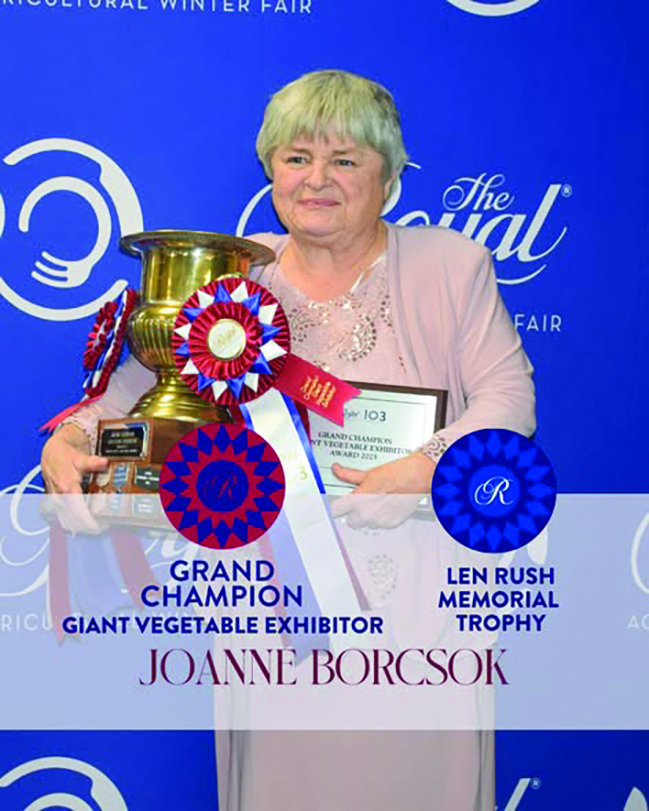
“It isn’t my fault I keep winning,” Joanne laughs, saying she would love other Ontario growers to submit entries and help keep up some healthy competition.
While Joanne and Joe have had a friendly rivalry for years, it was Joanne that encouraged Joe to get on the committee in the first place.
Joanne and her husband, Charlie, just recently retired farming carrots and onions in the Marsh. She grew up in the fields where her own Lithuanian German family farmed 10 acres in the Marsh. Her parents put her and her siblings in a playpen on a wagon that they brought outside while they worked. She married the Hungarian farmer next door and had two children that have grown up to be successful engineers. Like most farms in the Marsh, it got bigger and bigger, and now it is rented out.
As for giant vegetables, she caught the bug 25 years ago when Frank Weening (1932-2010) asked her if she would show vegetables at the Royal. At that time, she says, she hadn’t even heard of the competition; she had considered the Royal primarily for livestock producers and the equine industry.
It isn’t at the best time for field croppers, she says. Her farm team was annoyed that she jumped off the combine to take her vegetables to the Woodbridge Fair in October and to the Royal in November, but they learned to live with it.
In 2015, she grew a beet weighing 53.4 pounds for the Royal, and it made the cover photo of the Toronto Star.
The Marsh soils hold water exceptionally well, and they are good for the root vegetables, says Joanne, but she thinks that the other types will do better on clay and mineral soils.
Growing comes natural to Joanne, but growing giants just takes more time, expense, and space. She has six giant pumpkins started and they will go on to take up a quarter of an acre.
Patrick Watson has a bit more space, however. Pat lives in Komoka and is the president of the Giant Vegetable Growers of Ontario, which is a strong supporter of the Royal, along with other local fairs in Ontario where giant vegetables compete.
Pat isn’t a farmer, but he attended a giant vegetable competition that was being hosted at his father’s farm several years ago and thought he might want to try his hand at growing them as well. He started with pumpkins and after a steep learning curve in year one, he went on to grow a 1100-lb pumpkin in year two.
“You need about 1,000 square feet to grow a giant pumpkin,” Pat explains in an interview with the Rural Voice. And right from the top, he dispelled the biggest myth.
“I don’t know where people came up with that idea that growers inject milk into pumpkin vines,” laughs Pat. “I don’t know any growers who do that.”
There are no big secrets, he says. Growers in the GVGO are very open about what they are doing. They share seeds and tips with each other. In fact, a bag of seeds - winners from last year - comes as part of a $30/yr GVGO membership.
“To get huge vegetables, you need the right seed genetics and healthy soil,” Pat continues. He stresses that soil needs to have good structure and fertility and that well-aged manure is ideal. But from there, the plant also needs to be babied - watered nearly every day and fertilized at different rates according to the growth stage. For pumpkins, the plant itself is cut back to its primary and secondary vines typically. They are a vining plant, and several post roots shoot out from the vines to support the plant. It needs to be fertilized at all those rooted areas.
For pumpkins, growers don’t leave anything to chance. The moment a flower opens, often early in the morning, they hand pollinate it with another selected line and then close the flower shut. Then they look at the fruit with the biggest potential at around the time they are the size of beach balls. They choose which pumpkin will grow on and the rest are culled from the plant.
Some place the pumpkin on a palette and others put a scale under it. For Pat, he digs out an area as a cradle under the pumpkin and puts sand under the pumpkin so it would have proper drainage and look rounder. Joanne uses Styrofoam with sand and places several mousetraps around her pumpkins. Even one mousehole in a pumpkin will disqualify it from competition, she explains.
Every year, growers try something different. This year, Joanne will be trying worm castings in the soil for the first time.
For pumpkins, bigger isn’t always heavier. The thicker the walls of the pumpkin, the heavier it will be. So, in the end, they all go on a scale.
There are a few events that attract the biggest vegetables – like Port Elgin Pumpkinfest and the Prince Edward County Giant Pumpkin Contest – because they are officially sanctioned as weigh-offs for the Great Pumpkin Commonwealth (GPC). Being a GPC event involves paperwork but winning there means it is easier to submit to the Guiness Book of World Records.
And while Pat’s 1100-pound pumpkin was formidable, it doesn’t compare with many of the pumpkins being grown around Ontario.
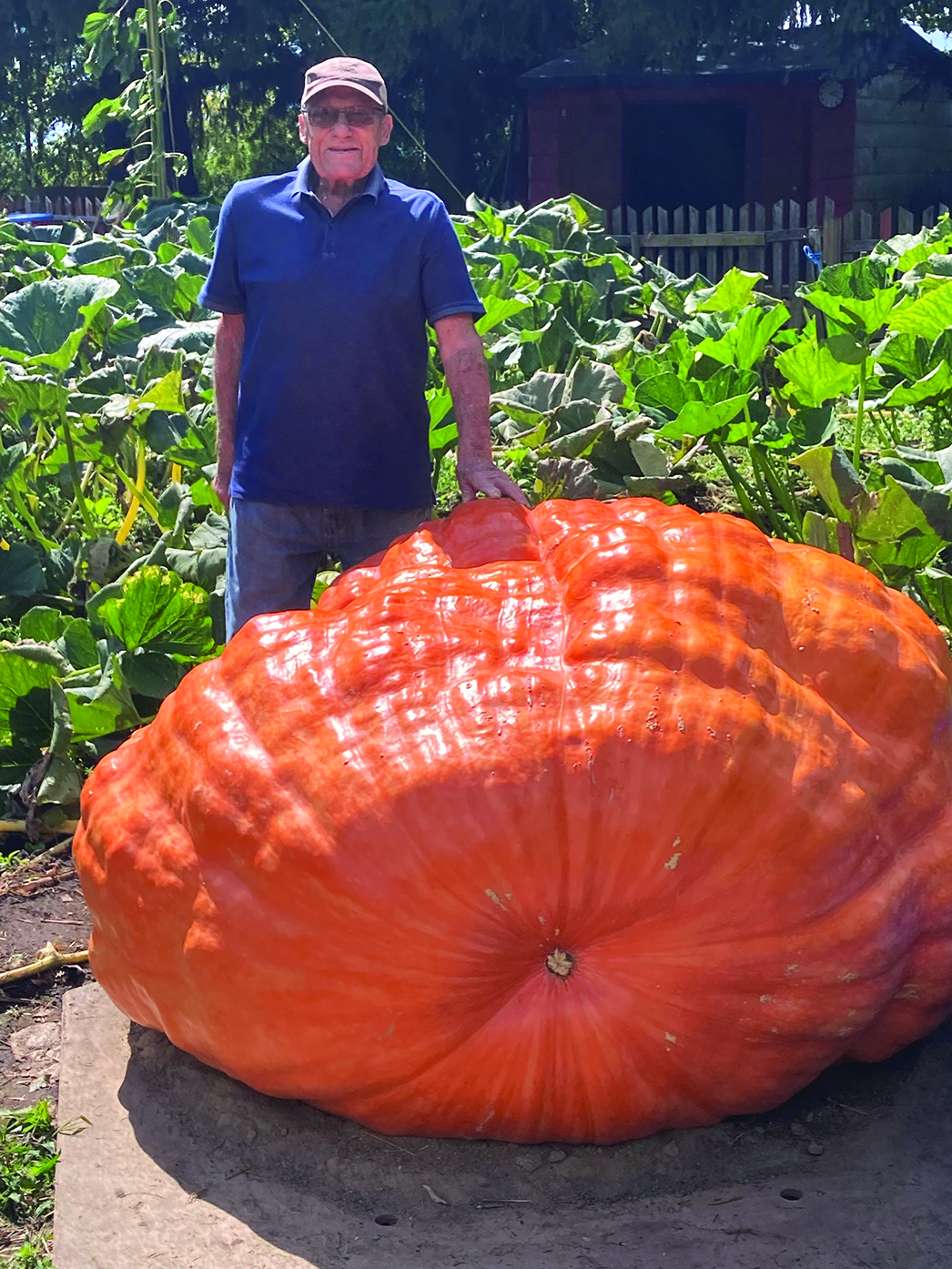
“There’s no reason we can’t grow a world-record pumpkin here in Ontario,” says Pat. Past winners in Ontario have been Jeff Warner (1,966 lbs near Englehart in 2024), Terry Weber (1965 lbs near Kincardine in 2025).
The current record of 2,819 pounds, however, is a pumpkin (named Muggle) grown by twin brothers Ian and Stuart Paton in England last year, which beat out Travis Gienger’s 2,749-pounder (named Michael Jordan) grown in Minnesota in 2023. For these winners, growing means starting the pumpkin early, keeping it under a hoop house early in the season.
The Royal’s heaviest pumpkin winner goes home with $1500, while the other categories get $50 for first place. The feature vegetable – this year, it is sunflower heads – gets a $200 first place award. Some large vegetables can be sold as novelties to nurseries, Halloween displays and the like, though Joanne doesn’t bother selling her vegetables due to the liability.
“No one is making a living growing giant vegetables,” Pat laughs. It is an expensive hobby, and Joanne would sure agree. But growers love the challenge and they love the grower community as well.
The timing of the Royal means that it isn’t the season for certain vegetables. Pat nearly had a record-breaking tomato last year. When he took it from the vine, it was 8.48 lbs.
“It was heavier than an average baby,” he laughs. And baby it, he had. It started last fall, preparing the garden with well-aged cattle manure, and he used Domingo tomato seed. Then he trimmed back the suckers on the tomato and took off the leaves closest to the ground to prevent blight.
“But the leaves are the solar panels that grow the fruit, so you don’t want to take off too many,” he says.
Tomato plants want to produce many fruit, but he had to cull all but one. And then he needed to support the plant to carry the tomato, so he built the tomato a hammock.
He was delighted to see the weight of the tomato, which was more than the current national record of 7.42 lbs. He called over his friend (and the current record holder, also named Pat) to be a witness. They would have to go to a certified scale and take a photo to count as evidence.
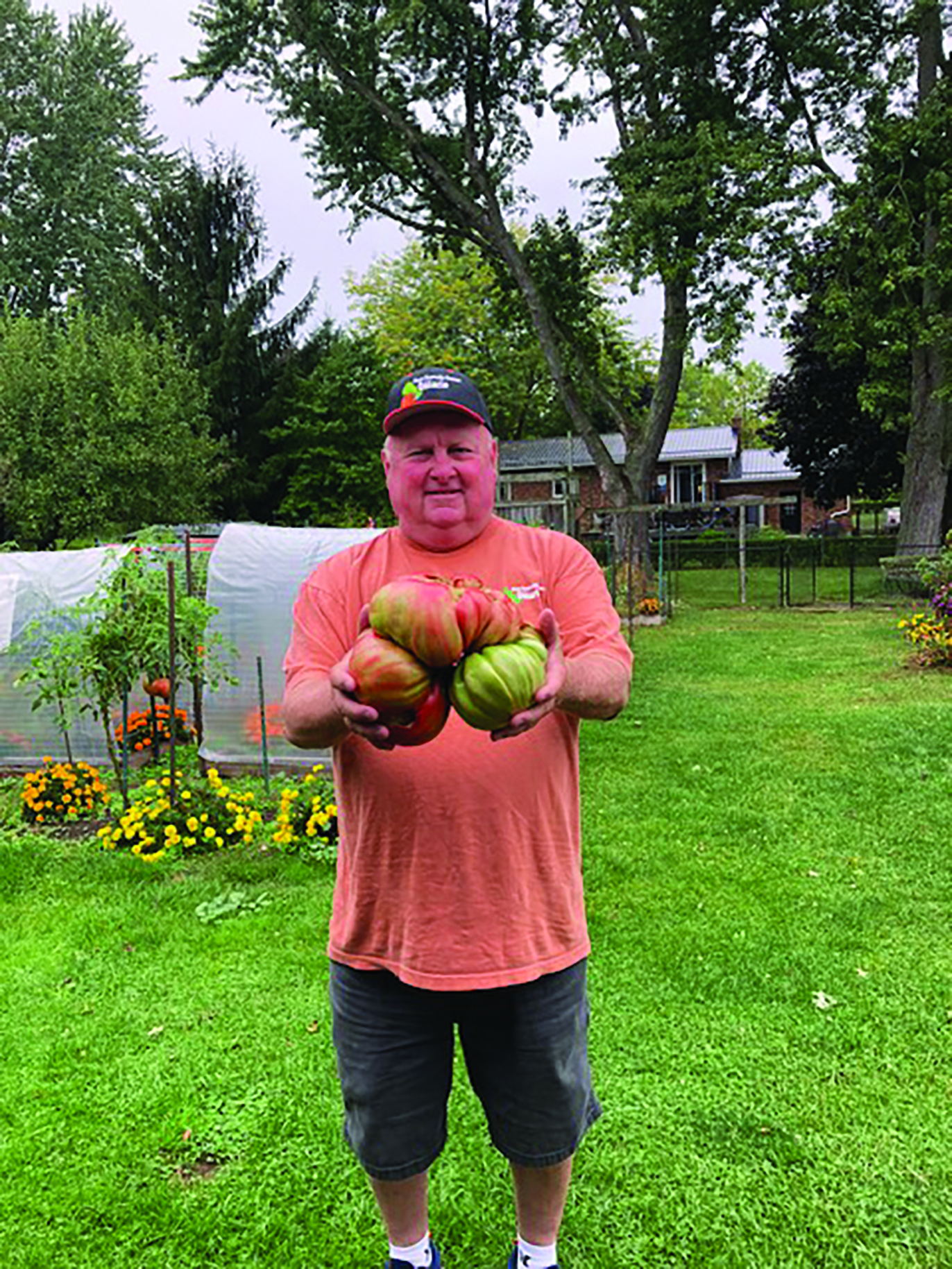
But then he noticed that the tomato was leaking from a crack it had developed in the skin, which disqualified it. In retrospect, Pat admits he could have used less water and fertilizer at the end there.
“If you’re not blowing them up, you’re not growing them,” Pat laughs. He explains that is a common saying of one of his friends.
While the Royal is not a Great Pumpkin Commonwealth sanctioned event, it is nonetheless an important event for competitors. And they are some of the only categories remaining in the horticulture competition. The Royal Horticultural Committee hopes that more people will enter the competitions so that they can bring back more categories, perhaps even categories like Christmas trees, tobacco or Asian vegetables.
“It is a missed opportunity,” concludes Brian. While he loves the giant vegetables as much as anyone, he hopes that the rest of the categories will make a comeback.
The Royal is a tradition that has lasted for over a century, rewarding excellence, while showcasing innovation and the newest production methods. As well, it has long-connected rural and urban audiences, helping farmers tell the incredible story of agriculture.
If readers have something great growing in their garden this year, there is still plenty of time to submit it to the Royal’s horticultural competition. The entry deadline is October 30, though late entries (and an additional fee) are accepted up to the arrival dates, with the judging done on November 4). Full details will soon be available online at www.royalfair.org/compete/horticulture-competition and if you’re interested in the Giant Vegetable Growers of Ontario, see gvgo.ca. ◊