

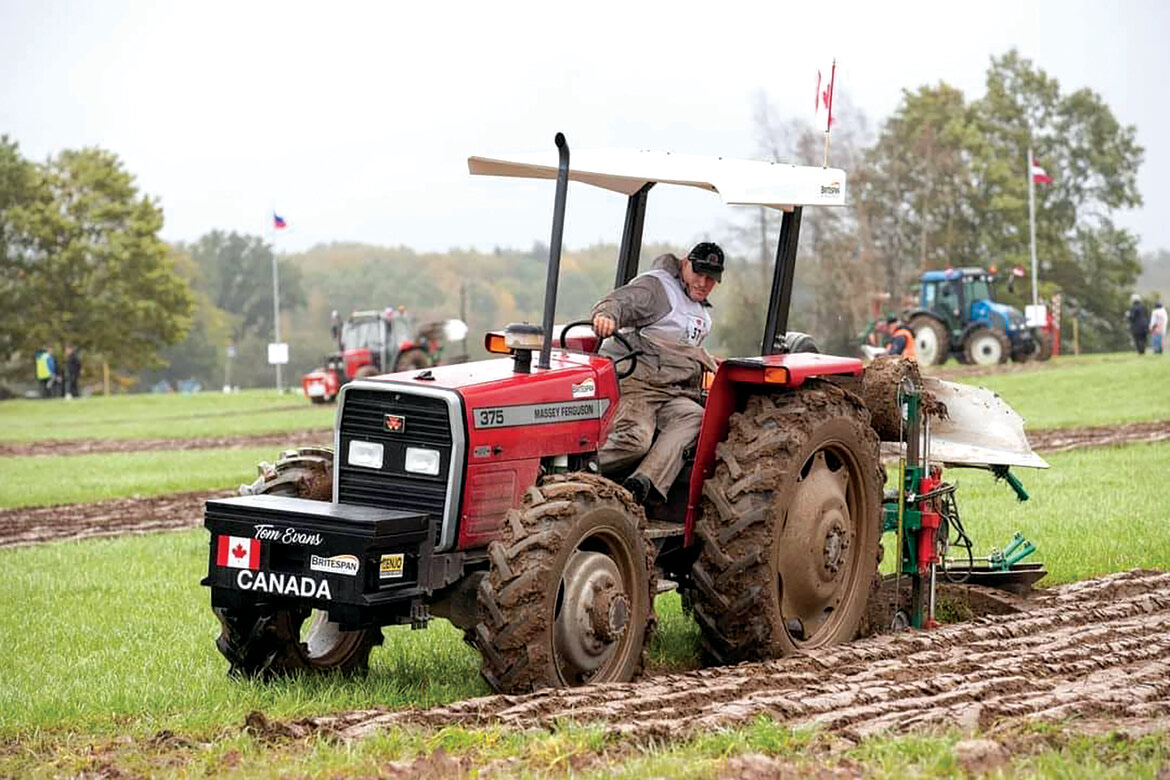
Bruce County's King of the Furrow: Match plowing takes Tom Evans around the world
By Mel Luymes
Little did a young Tom Evans know that when he and his father purchased an antique plow in 1989, that plowing would go on to take him around the world.
For the last decade, Tom has been winning both Ontario and Canadian plowing competitions and has represented Canada at the World Ploughing Championships three times, travelling to Kenya (2017), Minnesota (2019), and Latvia (2023). But for Tom, it is less about winning and more about mastery, and about the friendships he has made along the way.
“Match plowing is like a combination of three sports,” he says. On one hand, it is like golf, because you’re playing against yourself, and on the other hand, it is like racing cars, because you need the machine to work right. Lastly, it is like figure skating, he laughs, because it is judged by a group of people, based on precision and technique.
He remembers it started with an old Massey-Harris 30 tractor that his grandfather had on the farm next door. He loved that tractor, but it was sold in the early 1980s. A few years later Tom and his father, Irwin, decided to buy that same model from a local dealership. At $700, they went halfsies on it for a father-son project and restored the tractor. Tom had more money than most 11-year-olds at that time; he’d earned it by having a sow in the family’s farrow-to-finish operation north of Tiverton.
Two years later, they had their eyes on a plow and bought a restored Massey-Harris plow at a local auction.
Jack McGillivray, who was president of the Bruce County Plowman’s Association at the time, told them the plow had been used in competitions and asked if they would be interested in taking it to the Plowing Match that year.
That’s how it started. When he was 13 years old, Tom placed fourth out of five in the beginner’s competition that was held at Jack Riley’s farm.
“I didn’t know what I was doing, but I was having fun,” he laughs.
It went on that way for years – competing in local matches, without success on the podium.
He competed in his first International Plowing Match (IPM) when it was held in Walkerton in 1993. He recalls placing ninth out of eleven in his class.
But something switched around 2006 before the IPM in Peterborough, and he thought if he was going to keep plowing, he should try to level up.
“So, I read the book, took everything apart, tightened up the plow, and measured everything,” he says. When he took the plow to the next show in Ayton, he came second place after Ken O’Brien, a multi-time champion from Midhurst.
“Even Ken came over and encouraged me to keep going,” he remembers. He went to the IPM the next week in Peterborough in 2006 and wound up winning Reserve Champion in the antique class.
“I was over the moon,” he says. Tom explains that the antique class is the most affordable way to get into plowing, requiring a plow that was built before 1958 and without modifications. “You could have as little as $1500 wrapped up in the tractor and plow,” he says.
Tom was one of the youngest in the class at the time. Most of the competitors were just about as old as their plows, he jokes. That was before he got hooked on the challenge of the reversible plow class in 2007 and soon got his nickname – Tommy Rollover. At that time, Kverneland was offering reversible plows for match competitions to use for free, to get more people competing in that class.
Both classes begin by making an opening that they must complete in 20 minutes – which is then judged. After a 60-minute judging break, competitors flip the furrow back in to make a crown, which is 8-12 furrows. The conventional plows start to work in a clockwise manner around it, flipping the soil to the right, and complete a 100-by-20 metre plot. Competitors in the reversible class move across the plot, rotating from the right-hand to left-hand moldboards while turning on the headlands.
The reversible class has an added layer of difficulty in that they must plow a half-acre plot that is shaped like a trapezoid – still 100 metres long, but 24 metres at one end tapered to 16 metres at the other. This means that they must make a triangle along the one side of the plot, finished with a rectangle.
Judging is half showmanship and half technical. Stewards measure the time, depth, plot dimensions and support the judges. In competition, every detail matters.
Tom explains the various classes at the IPM. There is a class of horse-drawn plows, subdivided into walk-behind or riding plows (Class 1). The antique class (Class 6) is also subdivided into trailed plows (pulled behind a tractor on wheels) and mounted plows attached to a three-point hitch. Classes 2 through 4 feature two-, three-, and four-bottom plows, respectively. Competitors are also grouped by age: under 16, under 21 and over 21, with the adult class often split into younger and older divisions.
And lastly, there is Class 5, the Ontario Championship, where Tom now competes. This class of conventional and reversible two-furrow plows feeds the top three or four competitors into the Canadian competition the following year. And winners of both categories in the Canadian competition can go to the World Ploughing Competition the following year, making it a three-year process in all.
Tom has won the Canadian competition four times and went on to represent Canada at three World Ploughing Competitions: Kenya (2017), Minnesota (2019) and Latvia (2023).
At the world level, every competitor is at the top of their game, and the judging is far stricter. They are given 20 minutes to make their opening cut for judging. After that they have 2 hours and 40 minutes to do the plot. Tom explains that time management is critical. Ideally, you should have less than one minute to spare, he says. If you finish 15 minutes early, it means you missed some details and could have done a better job.
Being even one second over the allocated time is a five-point deduction, Tom explains. And every centimetre off target depth is another deduction, and depth is measured in four places. Every quarter of an inch matters, he says.
At his first global competition in Kenya, he was worried that competitors would be cut-throat but was surprised to find an encouraging community that would soon feel like a global family.
It wasn’t as simple as just hopping on a plane. Tom went to Africa prepared. As usual, he did his homework on the soil types and, in this case, he would be dealing with some of Africa’s heavy clay. He handmade plastic mouldboards for his reversible plow, because he knew the clay would be too sticky for his steel ones.
He put the plow and all the parts he might need in a shipping container along with (teammate) Jay Lennox’s conventional plow, and two tractors with plows from the American team. It cost them each $10,000 just to ship the plows, which they paid for by local fundraising. It was an eight-week journey to ship the plows, while Tom, Jay and their coach, Daryl Hostrawser flew in the week before the event in order to practice on some ground they had rented nearby. Practice involves days of plowing, inspecting, taking photos and measurements, and making adjustments.
As for the tractors, a local Massey Ferguson dealership agreed to give them tractors to use for free.
“It was perhaps the nicest-looking dealership I’d ever seen,” laughs Tom. He and Jay got to use two brand-new Massey 4708 tractors and were told the entire staff was there to support them.
The dealership hoped they would get some publicity from the event. And indeed, they did.
At world competitions, there are two days of competition. One is on sod and the other on stubble. Tom went on to place second in sod plowing, and eighth overall. Massey spread the word far and wide.
“I thought if I could place in the top 15, I would be satisfied,” he says. When Tom got on the podium his first year, he could barely believe it.
They even had the Kenyan president attend and shake all the competitors’ hands. Afterwards, he went with others on a safari to make the most of their trip.
He went on to compete again in Minnesota in 2019 with Brian Davenport (Owen Sound) as his coach and Bert Beyens (Strathroy) as his teammate in the conventional class. He placed 15th overall.
During the pandemic, there were two years without a world competition, but Tom went on to represent Canada again in 2023 in Latvia. This time Bert Beyens was his coach, and Brian Davenport was his teammate. 2023 was also a hard year for the Evans family, as their father – Irwin Evans – had passed away in May.
Going to Latvia, part of the former Soviet Union, was an incredible experience. The competition was held in Kuldīga, a gorgeous old town with cobblestone streets, elaborate buildings, and a beautiful landscape. Their hotel was in a duke’s 1600s residence.
Again, they had the expense of shipping their equipment overseas and, again, the community came out to support his trip. They held a fundraising dinner in nearby Underwood and even had to turn people away.
“Every cent I needed to get to the competition was raised that night,” says Tom, who is so grateful for the support.
He also spent a week practicing in advance in the deep topsoil of Latvia.
But nothing could have prepared him for what happened on the second day of competition. Just as they got the green light to begin plowing, the wind picked up and the rains came down. Tom says he couldn’t see his sighting stake to make his first pass so he had no choice but to wait until he could see it.
Eventually he got going, dressed in a Bass Pro Shop fishing suit with his hood up, he plowed while they got four inches of rain. He hit a rock and blew a hydraulic line and took the one-hour breakdown allowance, requiring parts from in town. On his last pass, the sun had come out, but he got stuck. With the tractor wheels spinning, the depth wheels gone, he picked up the plow and called it done, with only two seconds to spare.
He got out of there feeling pretty badly about the competition. But he dressed up and attended the banquet. When he looked at the result, he started at the bottom and was surprised to find himself finishing fifth overall in the reversible class, and Brian finishing seventh in conventional.
Though a Canadian hasn’t won the competition since 1961, Tom is pleased with how well Canada is doing on the global stage. Ireland has been dominating the world competition for much of the last decade, and he credits that to a very high level of competition there. Ireland’s plowing match attracts about 100,000 people a day and is the largest show of any kind in the country, with media attention and plenty of funding.
Looking back, Tom can hardly believe how far plowing has taken him.
“Medals are great, but the friendships I’ve made have been the best part,” he says. It is a community of people who are very like-minded and supportive of each other. They keep in touch through Facebook and Tom counted birthday wishes from friends across 18 countries earlier this year.
Tom loves learning bits of different languages so he can make connections with people around the world. Over the years, he has met so many friends, including Aigars Laurinovics, the organizer of the Latvian competition, who had worked in Kincardine for Canadian Agra decades earlier. Or friends like Swiss competitor Marco Ansgt, the two-time winner of the reversible class who also lost his father the same year Tom did.
Tom says that a fellow plowman from Ireland, Ronnie Coulter, often says. “You don’t have to be crazy to do this, but if you are, it’s a massive help.”
The plowing community all have a love for agriculture and tractors, but also need plenty of concentration, dedication and attention to detail.
“You can’t just do it quickly, you have to stop, check and make adjustments,” says Tom. “It is a great skill for anything in life, especially for farming.”
As several of his peers have retired, Tom is now one of the most experienced plowmen in his class. While he still hopes to compete, he also wants to support his peers and coach upcoming competitors.
As for becoming a judge, he laughs. “No, my eyes are too good to be a judge,” he says, recalling a time some competitors gifted a judge with a white cane. It’s all in fun, however.
As well, competing takes a lot of time and effort, taking him away from his work at Britespan Building Systems, where he now leads product development. The business has been a big supporter of Tom and the competitions.
While the Evans family (including Tom’s parents – Irwin and Isobel – and younger sisters Jeannie and Laura) got out of pig farming in 2002, they kept cash cropping about 400 acres, until Irwin got sick. They have been renting out the farm since then, except for 15 acres that Tom still farms himself with his father’s old equipment which he keeps in working order.
“I hope he’s happy that I’m still at it,” he says. “It means a lot that I get to drive his tractor in the field.”
Tom will be competing at this year’s IPM held in Bruce County at Lang Farms near Walkerton, September 22-26. He is chairing the plow committee, and will be bringing some of his friends from around the world, including a few from Belgium, Ireland and the U.S.
Tom is also involved in the local fair board and is the current president of the Bruce County Plowman’s Association and organized their plowing match in Ferndale on Saturday August 29.
“I’m really blessed to have been able to do this,” he reflects.
Last year, Tom plowed his 15 acres with his two-furrow reversible. It took a while, he admits, but it is always good practice for him. More importantly, it kept him connected, to the land, to his father, and to that old Massey-Harris plow. ◊