

A thorn in the woodlot: Huron-Perth Woodlot Association highlights buckthorn control
by Mel Luymes
Early May took a turn for the chilly when about 50 members of the Huron-Perth Chapter of the Ontario Woodlot Association joined for their spring tour around Belgrave. The group started at the field on the east side of the Maitland River in Maitland Valley Conservation Authority’s (MVCA) Wawanosh property.
MVCA staff members discussed the history of the property and some of the ways they were trying to manage the woodlots and plantations on it. There had been several acres of white pine planted in the early 1980s in the marginal agricultural areas of the 400-acres wooded property that had been purchased in 1972, said Stewart Lockie, MVCA’s Conservation Areas Coordinator. The rolling, stoney, fields have several springs and small streams coming from the hills and MVCA aims to restore these areas with trees to improve water quality.
The plantation had been selectively harvested in 2010 and 2021, but now – like most woodlots in the area – have been overtaken by invasive buckthorn. While the MVCA has plans to infill and plant more sugar maples around the property, they knew they needed to control the buckthorn first.
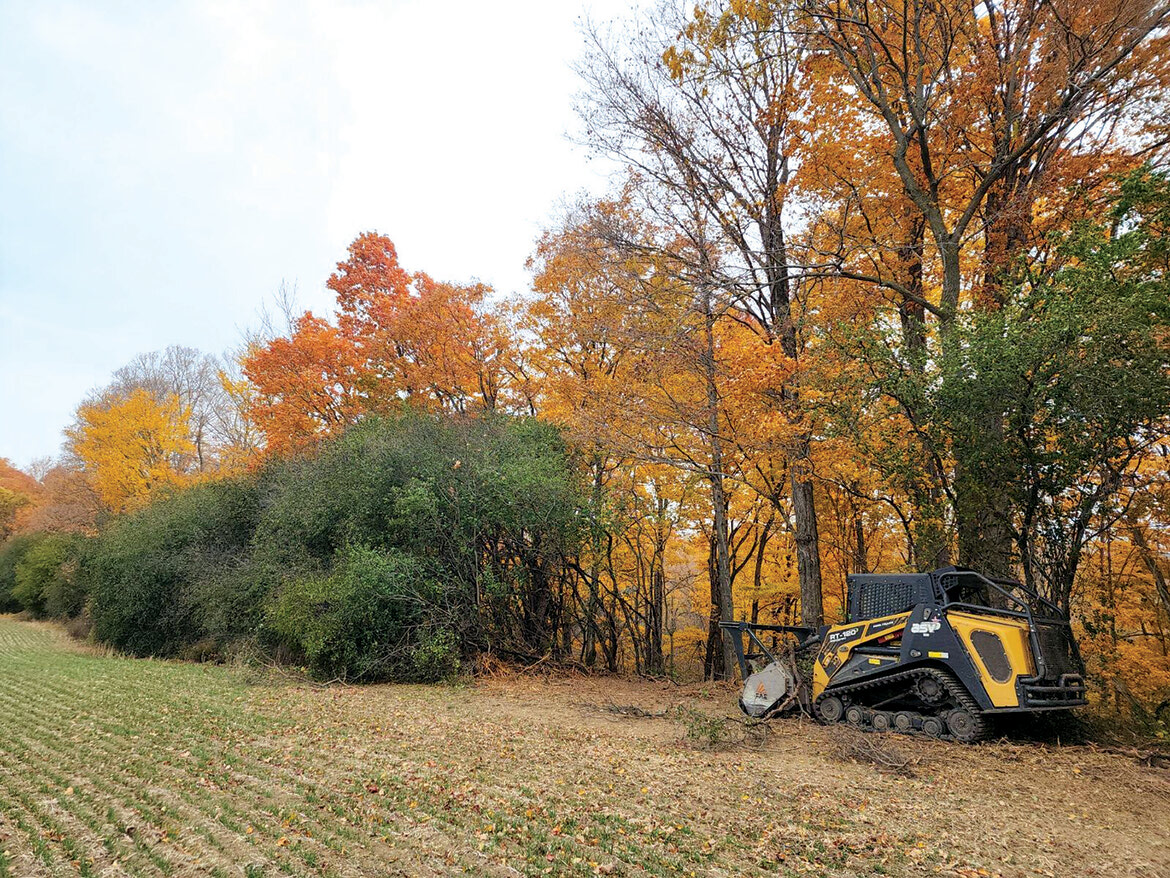
Tim Prentice, MVCA’s Field Services Specialist, outlined the issues they saw. Buckthorn had crept from the woodlot into the field. There were nearly 50 feet of it in some places, forming a tall dense web of thorny bushes that choked out the vegetation under it.
There are two types of buckthorn shrubs, both introduced as ornamentals; there is Common buckthorn (Rhamnus cathartica) and glossy/alder buckthorn (Frangula alnus). They both green up earlier and stay green later than other bushes in a woodlot, so they are easy to spot in the spring and fall. Common buckthorn is on Ontario’s noxious weeds list under Ontario’s Weed Control Act, as it also acts as a host to various crop diseases.
Buckthorn has small, oval leaves, while the glossy variety has shiny leaves and tight parallel curving veins. Common buckthorn has a thorn on the tip, but glossy does not. There are both male and females of the plant and the females produce thousands of berries. Birds eat the dark, round, berries and – according to many – these berries have a “laxative” effect, scattering the seeds far and wide. And don’t hang your laundry out to dry during buckthorn berry season, suggests Steve Bowers, who also attended the event.
They can spread quickly in the understory of a woodlot and will thrive along the edges or wherever there are holes in the canopy, for example, from dead ash trees. They have a woody stem that can grow up to a foot in diameter, producing a small gnarled-looking tree, reaching up to 20 feet tall. They suppress the rest of understory vegetation yet provide poor ground cover and contribute to bare soil and increased erosion. They are difficult to manage, because they grow quickly and suckers will come back from roots and after cutting.
While foresters began to recognize that buckthorn would become an issue in the 1990s, buckthorn has since become one of the most dominant understory species in Southern Ontario woodlots. It made up 50-75 percent of the understory in the Wawanosh white pine plantation, estimated by MVCA staff. So, they knew they needed to do something to manage the invasion..
They started with the edges, estimating that there was at least five acres of a solid stand of buckthorn along the plantation edge. They started with basal spraying of Garlon, which is a selective herbicide containing triclopyr, available only to those with an exterminator’s license, designed for controlling woody plants and broadleaf weeds in forests. It works by mimicking plant growth hormones, resulting in uncontrolled growth and eventual death. It is not suitable for use near water and best used in dry conditions.
Tim Prentice notes that they only needed a few squirts directly on the bark at the base of the tree (basal spraying) with a backpack sprayer to kill the buckthorn, which they did in 2024. Once the buckthorn plant was dead, they hired Forest City Landworks Ltd to come in with their rotary grinder – a carbide tooth grinder mounted on a 120HP skid-steer loader. The operator spent seven long days going back and forth along the edges, grinding the buckthorn in place. MVCA staff had marked any other maple or other trees and manually cut the buckthorn around them in attempts to save them from the carnage. What remains is now a duff layer and MVCA staff came back with a small boom sprayer on a side by side to apply roundup to the edges and kill any small suckers or new growth.
Come early May, there were trout lilies growing up through the woody mulch. Over time, the buckthorn mulch will decompose, and soon the MVCA hopes to reforest the area. Buckthorn seeds remain viable in the soil for several years so it will be important for them to monitor the area and to plant other trees and shrubs to fill the space.
“It’s a hopeful story but this isn’t the full solution,” says Tim in his presentation. “We still have buckhorn in the plantation.”
The tour moved to another section of the property where they could see the little green leaves under the white pines, as far as the eye could see.
Obviously, the rotary grinder wasn’t going to work in the plantation; the trees were spaced too close together. Instead MVCA is trying a different strategy amongst the trees. They have someone with a chainsaw and another person with a backpack sprayer. The first person cuts the buckthorn stem at about 2-3 feet so that it is still visible, and the other sprays the stump with a few shots of Garlon.
The branches of the buckthorn can decompose in place, and it is best if they are in smaller pieces to make better contact with the soil, says Tim. However, too much dead wood can increase the acidity of the soil.
Some participants suggested that fencing goats in a woodlot might also help control buckthorn. They will eat young stems, and strip bark in forested areas that are difficult for machinery. However, buckthorn will resprout and require frequent grazing. Goats are also rather unselective and will forage on the rest of the seedlings and plants in the understory as well.
Still, goats could be a promising control measure when used alongside other controls. Five years ago, when Sean Thomas saw buckthorn and multiflora rose taking over the understory of a woodlot he owns near Goderich, he bought some goats to manage the issue. He has seen goats used for site clean-ups in the area. They do a good job, especially on hilly areas, and they also help to aerate and fertilize the soil. Still, there are plenty of other considerations, like remote fencing, guard dogs to protect them from predation, insurance, and local bylaws, he says.
Most participants were also struggling with buckthorn in their own woodlots, so MVCA staff had a hopeful message and some great pointers. Start at the edges and work in, they said. When they are relatively small plants, they can be pulled out relatively easily from moist soil, and a “weed wrench” (also known as an extractigator) can be used to help pull them up. Additionally, they advised tackling the seed-producing females first, apply herbicide in the fall for a better success rate, work systematically in manageable blocks, and clean equipment after working in infested areas.
After the Wawanosh tour, the caravan of vehicles went to Bodmin Farms Ltd., where our own Kate Procter showed participants the 20-acre reforestation project she had planted in 2023 on some floodplains that were historically pastured. The MVCA planted small stock trees into the pasture at eight-by-eight-foot spacing. They planted nearly 10,000 seedlings in total: 80 percent in conifers – spruce, pine and cedars – because they resist the deer and mice, and the rest in pockets of maples, oaks and black walnuts.
They planted them in areas with the best chance of survival. Black walnuts do very well in wet areas near the river, but they are allelopathic (that is, they inhibit the growth of other plant species around them), so they grouped them together apart from the rest of the trees. Trees along the river help to cool down the water, They also planted highbush cranberry and red osier dogwood along the river to help attract pollinators.
The project was paid for by Huron Clean Water, Nature Smart Climate Solutions, Maitland Conservation Foundation, and a 1.6 acre wetland was funded by Ducks Unlimited. Field drainage tile outlets into the wetland, but it was modified to have deeper pockets, shallow slopes and the right vegetation to create supportive habitat for frogs, turtles, etc.
“It is great to actually be able to see the trees now, coming up through the grass,” says Kate, to the group gathered at the farm. Her son Wes had cut the grass (carefully, while she searched for the trees) with a bush hog, but now that the trees are tall enough, they can stop mowing so much.
The group met at the Wingham Community Centre for a hot lunch, a raffle of incredible items donated by members, and the Huron-Perth Chapter’s Annual General Meeting. Dave Bray, President of the Chapter, updated the group on the availability of liability insurance for Ontario Woodlot Association’s members through BrokerLink. The package includes insurance for vacant land liability in case someone is injured while in the woodlot, including claims from trespassers. As well, it covers legal responsibility if a forest fire is deemed to have started on the member’s property and has optional coverage for woodlot damage from windstorm, ice or fire.
As well, Dave discussed the ongoing Private Land Advanced Forest Resource Inventory using remote sensing, run by the Ontario Woodlot Association. LiDAR imagery is being used to provide detailed insights into the health of woodlots across the province and the last time a good survey of Ontario’s woodlots was done was in 1978-1981. As of now, Huron and Perth Counties have not yet been mapped. The Huron-Perth Chapter conducted the business portion of their Annual General Meeting and welcomed two new board members, Shannon Millar and Karlene Zurbrigg, both MVCA staff members.
The day concluded with a presentation about funding for tree planting by Shannon Millar MVCA’s Restoration Supervisor. MVCA combines and “stack” funding from several sources, including federal, provincial, municipal, private and through Maitland’s Conservation Foundation, to provide trees to landowners, often at no cost. She outlined the work that MVCA has done in their watershed through the federal Resilient Agricultural Landscape Program (RALP) funding, including 15 kilometres of windbreaks and five kilometres of stream buffers. There are plenty of funding opportunities for tree-planting available for 2026, including another year of RALP funding. Windbreaks, stream buffers, and reforesting marginal lands can be fully funded this year, so Shannon encouraged people to contact the MVCA to take full advantage. Her contact is [email protected] or 519-355-3557 x233.
The Ontario Woodlot Association (OWA) was established in 1992 and the Huron-Perth chapter was established in 1995. Membership is $50 and can be purchased online at www.ontariowoodlot.com/join.◊