

A tall order for hemp
By Mel Luymes
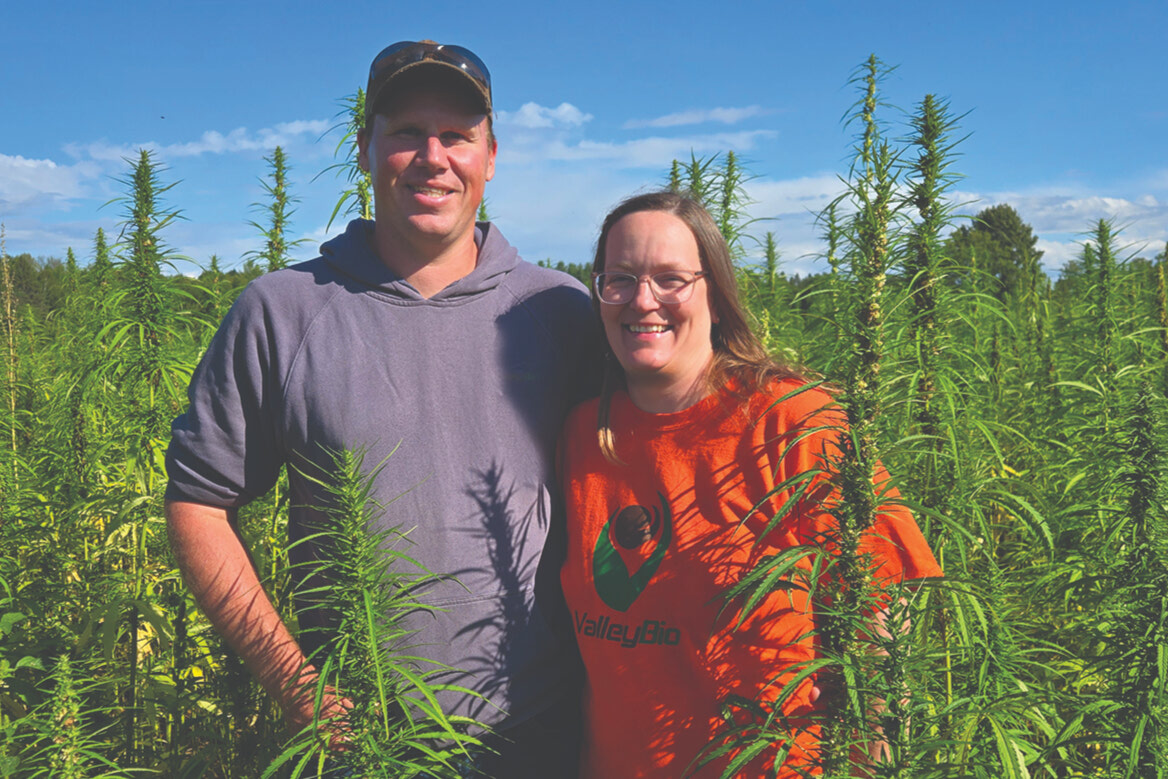
It wasn’t a typical crop growing in Eastern Ontario. As the Stone family’s hemp crop grew to nearly 10 feet, drivers slowed down for a better look. They probably wondered the obvious: Is that a field of marijuana?!
Hemp is hardly a new crop. It has been cultivated for thousands of years and was grown in Upper Canada in the 1800s before its production was prohibited in Canada in 1938. Commercial production was legalized again in 1998.
These days, Reuben and Keanan Stone – of Stone Farms near Cobden – are helping push the industry forward with hemp genetics and seed production, as well as farm-built processing technology.
Trained as a mechanical engineer, Reuben Stone has been drawn to solving agricultural problems, especially those related to new and niche markets for Ontario producers. His work in hemp began 17 years ago through a connection in Woodstock who was looking to source hempseed for export and it grew from there.
“We came in at the bottom of a dip and have been lucky to grow with the crop,” says Reuben. When they started, there were only 2000 acres of hemp grown in all of North America. While food grain has been driving much of the growth, he is now seeing a growing demand for the natural fibres as well.
There is nothing particularly complicated about growing hemp, Reuben explained during a field day he hosted in August. He had gathered a group of industry partners – including farmers, agronomists and researchers – to tour both his flax and hemp fields and discuss the future of fibre production in Canada.
Out in the field, the group got to see (and smell) the crop up close. Some buds were dustier than others. Reuben explained that while some hemp cultivars are dioecious (having separate male and female plants), it often leads to inconsistent maturation. In this field, the cultivar was monoecious, having both sexes of flowers on one plant. The dusty buds were the males.
Reuben no-tilled this hemp crop into soybean stubble in early May, planting about 30 to 40 pounds per acre, with the fertilizer applied up front to promote biomass growth, though – in this case – the field would be used primarily for hemp seed production. Reuben and Keanan founded UniSeeds Inc. in 2012, developing and producing hemp seed and genetics.
Hemp can also be grown as a grain crop. Hemp seeds are highly nutritious, containing complete protein, omega-3 and omega-6 fatty acids, vitamins and minerals. The seeds can also be pressed into oil.
Its sturdy stalk can be harvested for the inner woody portion, called hurd, which can be used in composite board, hempcrete and other industrial products. The outer portion of the stalk is a bast fibre that can be used for rope, textiles and other fibre products. Hemp can also be grown for cannabidiol (CBD), a non-intoxicating cannabinoid used in some therapeutic products.
It should be noted here that hemp is not marijuana. Just in case you were scratching your head. Both are Cannabis sativa, but they have been bred for very different purposes, and industrial hemp contains very little tetrahydrocannabinol (THC). In Canada, industrial hemp is defined as cannabis containing no more than 0.3 percent THC in its flowering heads and leaves. Reuben and Keanan still have to deal with people (and police) that have a hard time understanding the difference.
With so many opportunities for end markets, hemp keeps the Stone family quite busy. They keep the crop a priority despite a young family and a highly diversified business. They also own Valley Bio Ltd. and produce pedigreed seed, as well as providing seed cleaning and treatment and conducting crop research. They grow cover crop seed and were early adopters of drone-seeding technology.
They still love growing hemp and have been highly involved in the Canadian Hemp Trade Alliance (CHTA), which began in 2003 to promote Canadian hemp and hemp products.
“Hemp has taken me around the world,” Reuben says.
Along the way, he has looked at plenty of specialized hemp equipment. Much of it hasn't made a lot of sense for Ontario conditions.
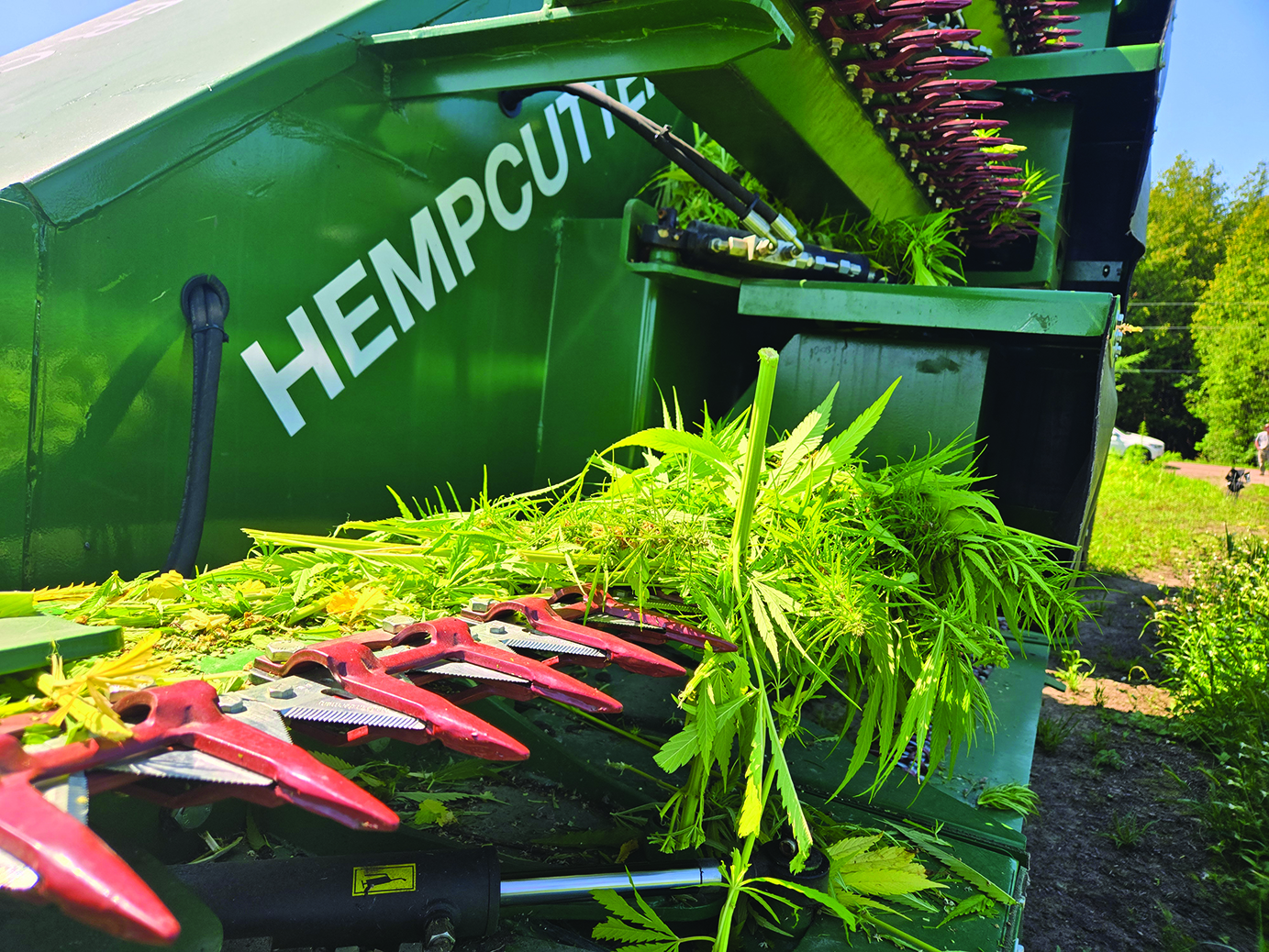
Peter Düshop, a current CHTA board member from British Columbia, was at the Stones’ farm for the field day with the KP-4 Hemp Cutter that Reuben demonstrated. Peter outlined some of the issues with harvesting and baling a crop that can reach 10 feet tall. For him, the Lithuanian-built hemp mower was a fraction of the cost of other specialized hemp harvesting equipment and helped solve many of the problems by using four staggered, combine-style sickle-bar cutter units to cut the stalk into roughly two-foot sections and drop them on the ground.
The stalk needs time and moisture to “ret” (essentially, partially decompose) in the field. This breaks down the pectin that binds the long, stringy bast fibres to the woody hurd. After a few weeks – or sometimes even over the winter – the retted hemp stalks can be tedded, raked and baled with conventional hay equipment. From there, they can be sent to a decortication plant, where the hurd is separated from the bast fibre.
This is where Reuben saw the opportunity.
What if the decorticator could come to the field?
He secured grant funding from the Ontario Agri-Food Research Initiative (OAFRI), engineering support from the Prairie Agricultural Machinery Institute (PAMI) and help from neighbour Duane Horst of ARDEE Solutions to bring his concept to life.
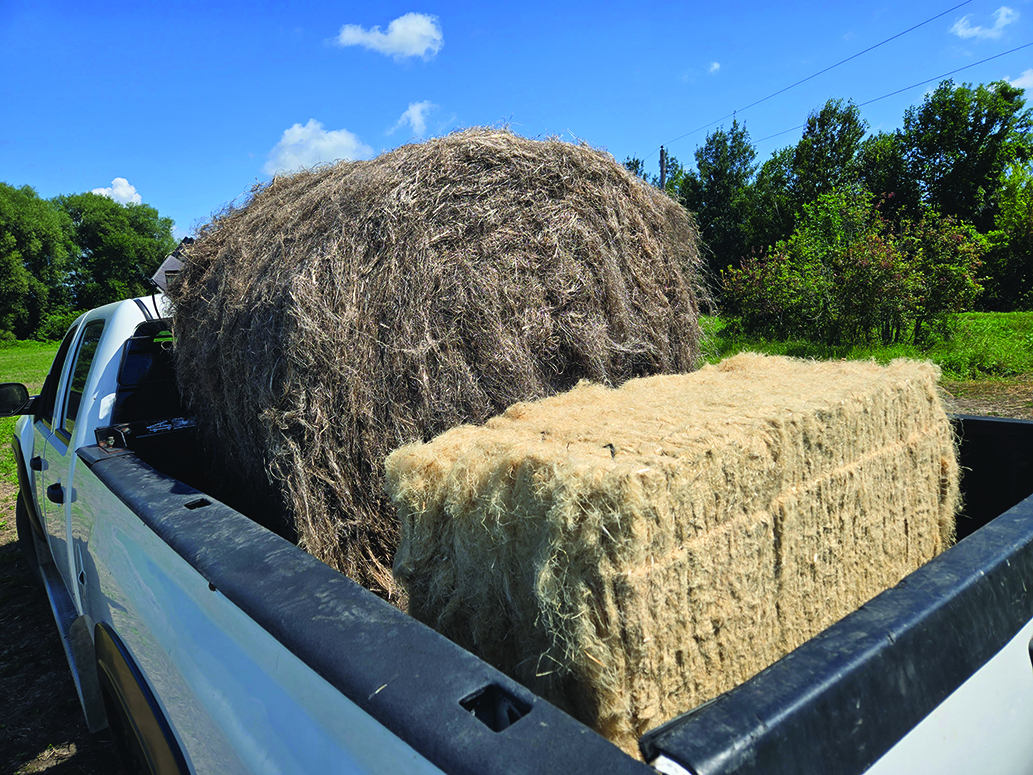
It started with a cylinder-walker combine they had used for hemp grain harvesting for 10 years. It was retrofitted with a pickup head to pull retted hemp inside, separate the hurd into the grain tank and lay the bast fibre back out behind the machine.
From there, a baler – which has also been modified – picks up the bast fibre, and the bales are transported for further processing.
Reuben demonstrated the equipment in the field. The process starts (much) earlier with hemp grain harvest, which involves running a 30-foot draper head up to 5-6 feet in the air to remove the grain-bearing portion at the top of the plant. The remaining standing stalks are cut down to ret in the field before being raked and tedded into windrows.
From there, the windrow is processed through the modified combine to remove much of the hurd before the baler follows to pick up the bast fibre. They first attempted to run the baler directly behind the combine so the fibres wouldn’t need to touch the ground again, but there was a mismatch in processing speeds between the two machines.
Not to mention a lot of dust.
The mobile unit doesn’t do as good a job as a $20-million decortication plant, Reuben explains, but it reduces the material to less than 20 per cent of its original volume, substantially reducing transportation costs.
It took a few attempts, but they are happy with the result and will be unveiling it at the CHTA meeting in November in Calgary.
But the field day wasn’t done. Understanding the hemp industry also means understanding the end markets.
Theo Jemtrud, currently studying his Master of Architecture at Carleton University, presented research on hempcrete as a building material. Made with hemp hurd, a lime-based binder and water, hempcrete offers another potential market for the crop as a lightweight insulating building material.
It is often promoted for its potential to reduce the carbon footprint of buildings. Hemp takes up carbon dioxide as it grows, while the lime-based binder also undergoes carbonation as it cures.
The day concluded with a demonstration of creating a “precast” hempcrete slab. Stew Oliver, a leading hempcrete practitioner in the province, mixed hemp hurd, lime and water in a small batch mixer. He discussed the benefits of hempcrete, including its breathability, fire resistance and absence of volatile organic compounds (VOCs).
However, using an unconventional building material comes with its own challenges, including how hempcrete wall systems interact with conventional moisture-control requirements.
It spurred a lively discussion among researchers, engineers and industry representatives about standardizing materials for testing and navigating Ontario’s Building Code. Hempcrete does not yet have a straightforward prescriptive pathway in Ontario, meaning projects may need to demonstrate that an alternative solution provides the level of performance required by the Building Code.
For Reuben, those conversations illustrate both the promise and the challenge facing hemp. Farmers can grow the crop, but developing an industry requires much more: varieties suited to Ontario, affordable harvesting equipment, efficient processing and manufacturers willing to turn the resulting fibre and hurd into products people will buy.
The Stones are working on those pieces from both ends – developing the crop in the field while engineering ways to get it into the hands of processors and manufacturers.
There are high hopes for this tall crop. The bigger task now is to keep growing the industry around it. ◊