

A comeback for flax
By Mel Luymes
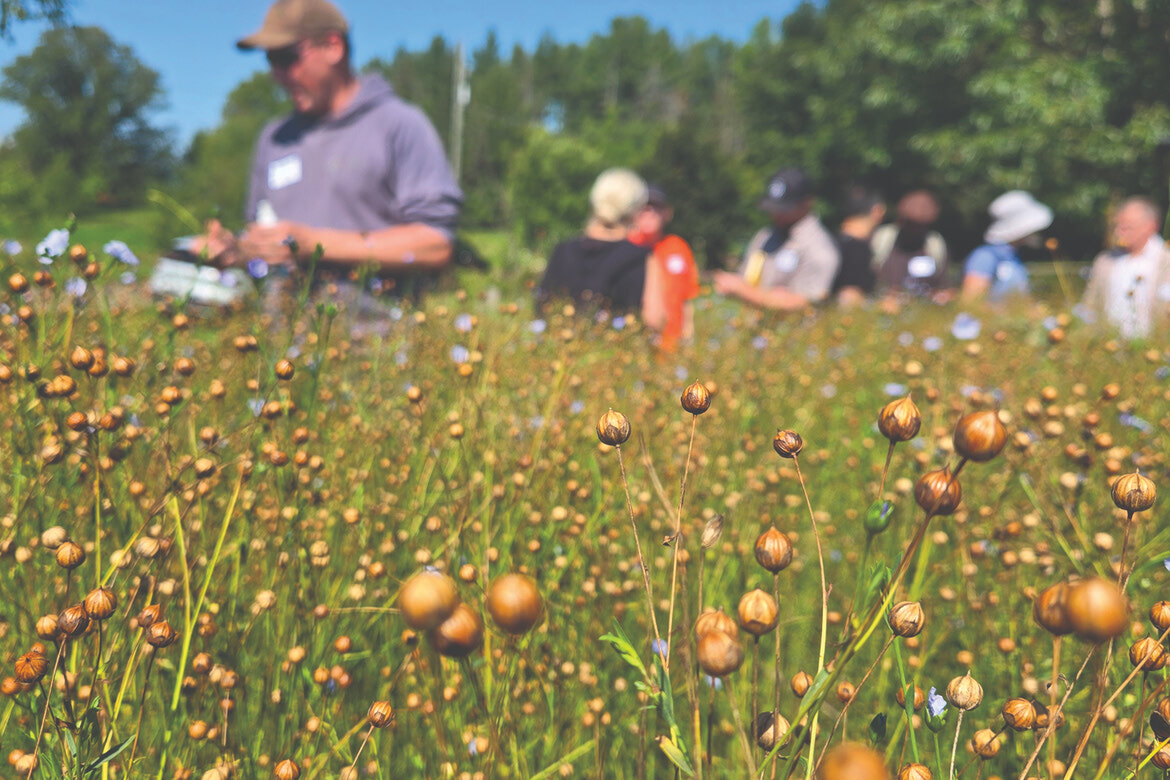
The cool morning fog cleared into a hot, humid day for the tour of Stone Farms’ flax fields near Cobden on August 13. Weeks earlier, the field would have been a sea of blue flowers, but now it was just days away from harvest. Plump bolls ripened in the sun.
For many on the tour, it was the first time seeing a whole field of the crop.
Flax is an annual, indeterminate plant with a shallow taproot. It is relatively frost-tolerant and takes about 95 days to reach maturity. Its fibrous stalk, made up of fine threads, grows 90 to 120 cm tall and produces five-petalled blue flowers that are short-lived and self-fertilizing. The flowers produce round seed pods containing six to 10 small, shiny brown seeds.
The seeds have an oil content of 33 to 43 percent, making flax a valuable oilseed for various products, as well as livestock feed. Planted in April or May, the crop is harvested in August. It is important to note, however, that the optimal harvest time for fibre production comes before the seeds have matured enough for good oilseed production. Historically, farmers therefore grew a crop with the goal of producing either a good yield of fibre or oilseed.
Along the western coasts of France, Belgium and the Netherlands, farmers have been growing flax for fibre for generations, building a private, $1.5-billion linen fibre industry. The Canadian Prairies, however, grow roughly half a million acres of flaxseed for livestock feed and human nutrition every year, and the tough, oily straw is often burned because it is too difficult to manage otherwise.
As for Ontario, the crop hasn’t been grown in a major way for decades.
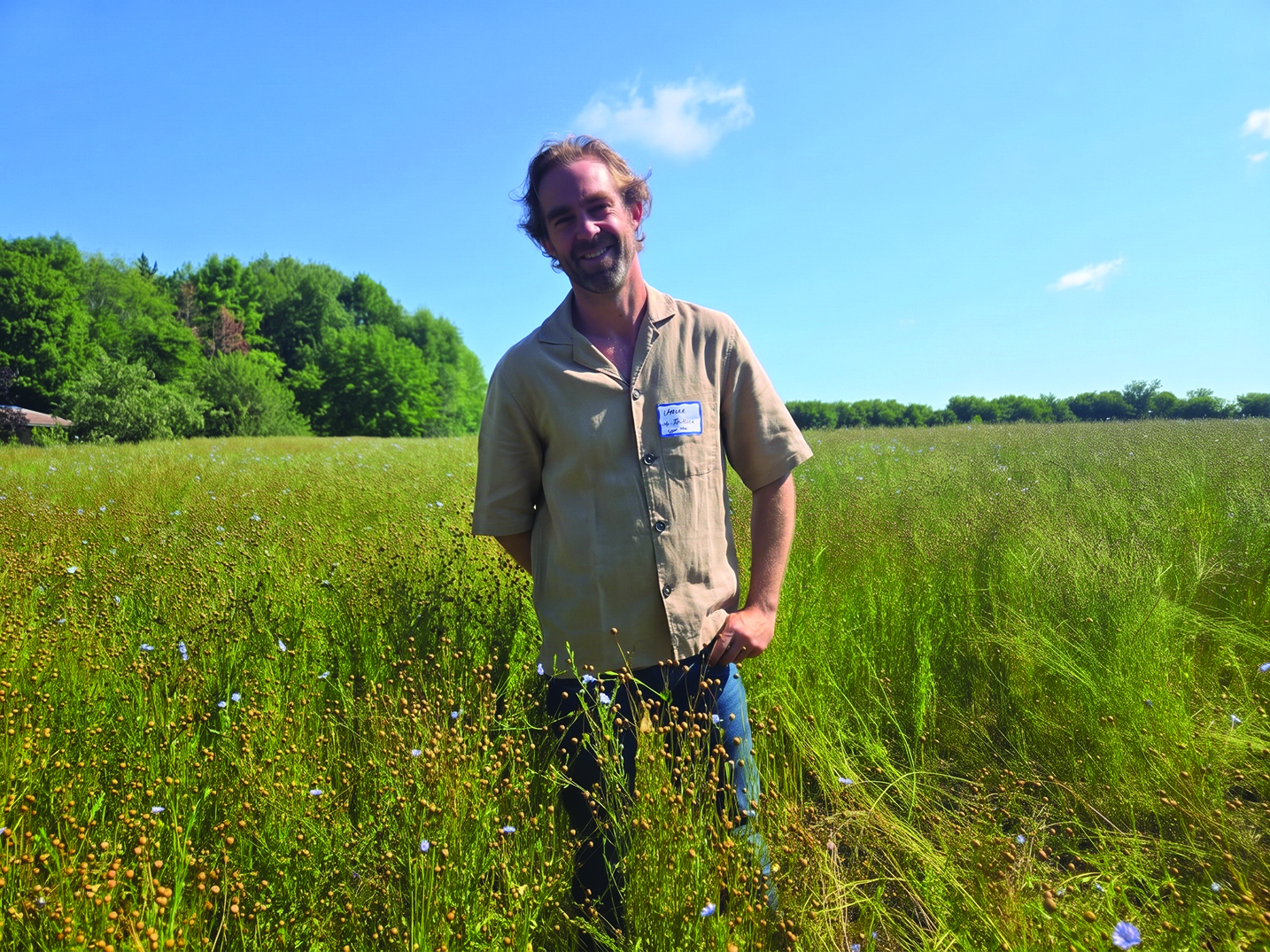
But Arin Gintowt, founder and president of Canflax, is hoping to change that. Based in Montreal, with a background in fashion and high-end textiles, he started Canflax in 2023 and aims to build the infrastructure in Ontario and Quebec that would allow farmers to grow fibre flax and compete on a global scale.
“Flax is the textile of antiquity,” he began his presentation from the field.
Linum usitatissimum, its Latin name, means the “most useful thread.” It was one of the first wild plants to be cultivated and is believed to have been domesticated on the Indian subcontinent more than 10,000 years ago, even before many food crops. While flax is also an oilseed crop, it was historically valued for the strong, fine fibres in its stalk, which were made into linen sails on Phoenician ships and used in mummification by the ancient Egyptians.
So, it was no surprise that flax came with early European settlers to their colonies. It was one of the first cash crops in Upper Canada (later Ontario), and some of the earliest flax production was centred around German Mennonite communities in Doon and Conestogo. Processed bags, twine and upholstery, along with linseed meal cakes, were bound for Europe.
One of the biggest disadvantages to growing fibre flax was that it was extremely labour-intensive. The entire plant had to be pulled from the ground to preserve the longest stalk possible and maximize fibre yields.
In the 1800s, stalks were bundled together into sheaves and propped up in stooks in the field to dry. The stooks were brought to the mill, where the seed pods, or bolls, were removed through a process called rippling. The stalks were then taken back to the field and spread evenly in rows to break down through a process called retting.
The rows were flipped with a long pole after a few weeks so the sun, dew, rain and biological activity could break down the woody parts of the stems and release the fibrous threads inside. The stalks were then lifted and brought back to the mill or piled in a local storage barn.
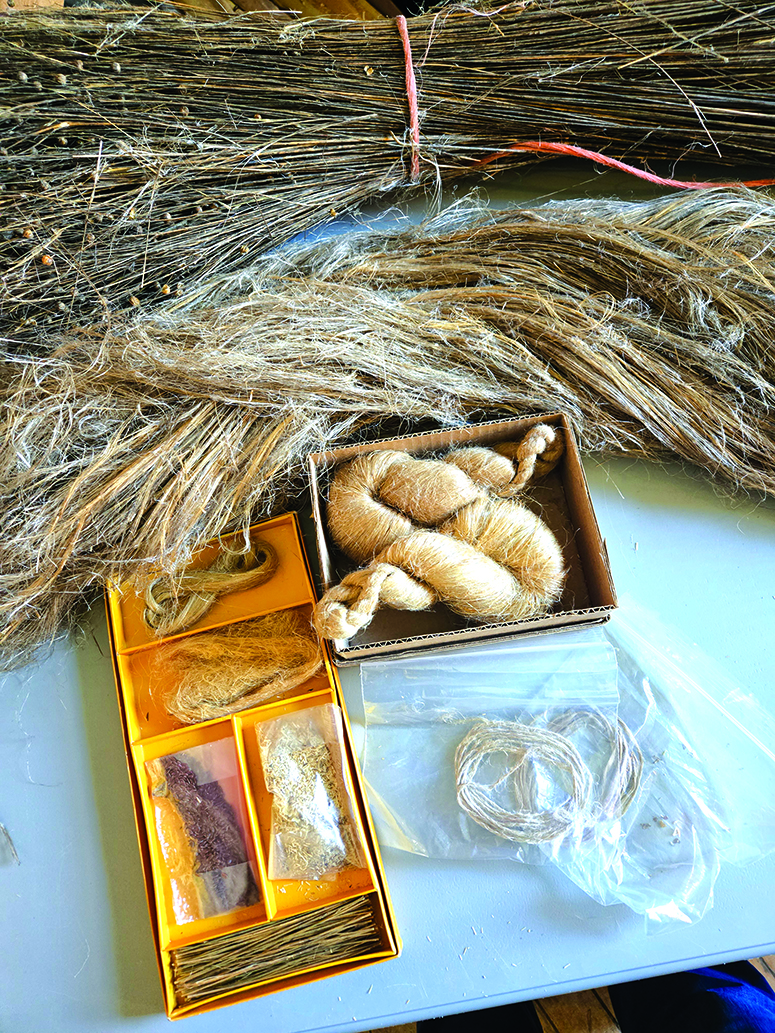
In the mill, the retted flax went through machines that separated the stalk from the linen fibres through rolling, or breaking, and scraping, or scutching. The end products were bales of short, coarse fibres called tow and bundles, or stricks, of twisted “line” fibres that were exported to England, Ireland or the United States for further processing.
All the pulling, stooking and retting was well beyond what a farm family could manage alone, often requiring 12 people per acre to harvest the crop in time. Labour crews — including Indigenous labour crews — or community bees were organized to get the job done.
There were three major hits to the fibre flax industry over the years, explains Arin.
The first was the invention of the cotton gin in the late 1700s, which made it difficult for flax to compete with cotton. However, disruption to the cotton trade during the American Civil War (1861-1865) was a huge boon to Upper Canada’s flax fibre farmers. Both World Wars also boosted demand when flax fibre could not be sourced from Western Europe.
By the early 1900s, however, the industry had shifted away from fibre and toward oil. The ready-made paint industry needed linseed oil, leading to a massive shift away from fibre scutching mills.
The third disruption was the rise of polyester in the 1950s, as synthetic fibres soon overtook much of the linen market.
We’ve all heard the stories: farmers saying that just one flax crop paid for the entire farm. But the booms and busts of Ontario’s flax market over the last 150 years earned it the nickname “the gambler’s crop.”
Arin believes much of the Great Lakes region has both the climate and the agricultural culture to enter the global flax fibre market in a sustained way.
He has spent time in Western Europe studying its production, processing and marketing. It is a highly insular market – built on handshakes, without insurance or forward contracting – dominated by families who have been growing flax for generations.
Quality is their goal. Fetching about $8,000 CAD per acre, growers spare no expense on the crop. They have developed the agronomy and machinery to handle the specialized work of rippling, pulling, flipping and lifting flax.
For quality, it all hinges on the retting process, Arin explains. Many have tried to move the process indoors or into vats of water, but those methods are either too costly or environmentally damaging, he adds.
The ocean breeze of Western Europe is ideal for retting. What flax needs is to lie on the ground with a good rain every few days and dew or fog every morning.
“Much like this morning’s fog,” he says.
That is why he believes Ontario and Quebec are ideal growing regions. But if the stalks get a week of rain, or a week of dry weather, quality can plummet, he warns.
Arin grew his own crop of flax in Quebec a few years ago. He retted and scutched it by hand and brought it to Europe to have it judged for quality.
It was very good, he said. And then the Europeans got nervous.
They encouraged him to get into the short-fibre flax market (for composite materials, insulation and heavy textiles) rather than the more lucrative long-fibre market used for high-end clothing, bedsheets, banknote paper, etc.
It isn’t easy, he admits.
“It is like trying to start making sparkling wine in a world of champagne,” he explains. The Europeans don’t want the competition.
Eighty percent of the world’s fibre flax is grown in Europe, and 80 percent of that is grown in France. But linen processing is now largely done in China and India. There are other areas – including Russia, northern China and Egypt – with some production, but all eyes are on Ontario and Quebec, says Arin.
“The world is expecting Canada to enter the fibre industry,” he says. “It isn’t a question of if, but when.”
As Arin looked around Eastern Ontario for keen farmers, he quickly connected with Reuben and Keanan Stone. Stone Farms already had a decade of experience growing hemp for fibre and seed through Uni Seeds, as well as plenty of experience growing other crops for seed production through Valley Bio, so it was a natural fit.
It starts with getting rights to the seed, says Arin, which Canflax has done. Next is developing and investing in specialized harvesting, turning and baling equipment. The final step is opening a scutching mill here.
All of this needs to be in place before farmers can be expected to jump into production in a big way, he says. It represents millions of dollars in investment before farmers start planting.
As for this field of flax outside Cobden, it is a fibre variety being grown for seed, which will be used domestically. The seed came from France and was planted at 35 lb/ac., only about a third of the seeding rate for a fibre crop. The field had been no-till for many years. Reuben used pre-plant herbicides and plenty of potash up front but hasn’t applied anything since. There were some challenges with residue from the previous crop, but he hasn’t seen much weed pressure.
As for harvesting, the crop can’t be desiccated because chemical residues could impede the retting process.
After swathing the crop, Reuben harvested the seed on August 26 and left the windrows on the ground to gain some experience with retting.
For now, it is just a few farms around Ontario and Quebec – experiments in relearning a crop that Ontario farmers once knew well. But when Canflax can put the machinery, processing and markets back in place, these blue-flowered fields could once again become part of our region’s agricultural landscape. ◊